


Beijing should immediately stop all flights on four civil aviation routes that were launched yesterday morning, the Mainland Affairs Council (MAC) said yesterday, adding that aviation officials across the Taiwan Strait should begin negotiations on the issue as soon as possible.
“China must be held accountable for any serious consequences that would affect the cross-strait relations should it continue to allow the flights to operate,” MAC Minister Katharine Chang (張小月) said at a news conference in Taipei.
The aviation routes are northbound flights on the north-south M503 route, which is very close to the median line of the Taiwan Strait, as well as three east-west extension routes — W121, W122 and W123 — along the southeast coast of China.
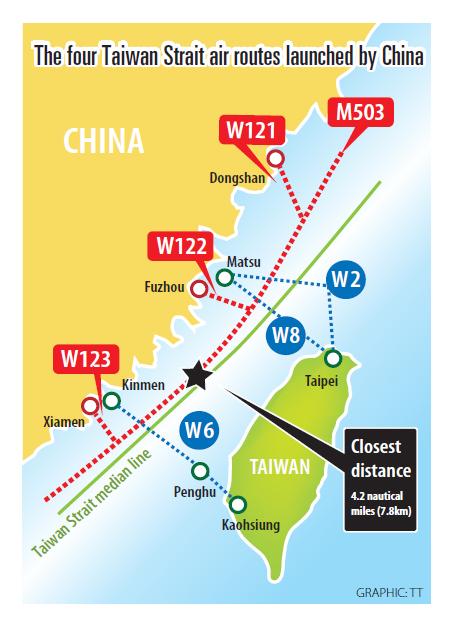
China unilaterally created the routes in 2015 on the grounds that they would be used to alleviate flight congestion on its A470 route.
Both sides then reached an agreement in 2015 following negotiations between civil aviation officials that only southbound flights would be permitted on route M503 and that the three extension routes would not be activated until after the negotiations had been completed, Chang said.
However, China simultaneously activated the three extension routes and allowed northbound flights to operate on the M503 route yesterday morning without negotiating with Taipei in advance, Chang said.

Photo: Chien Jung-fong, Taipei Times
“We believe that China not only breached the terms of the 2015 agreement, but it is also attempting to cover its malicious intentions toward Taiwan — both politically and militarily — under the guise of civil aviation. The move has generated concerns that it could potentially change the ‘status quo’ across the Taiwan Strait,” she said.
Since both sides of the Taiwan Strait agreed to allow southbound flights use the M503 route in 2015, the actual rate of usage had been very low, Chang said.
Civil Aeronautics Administration (CAA) statistics show that about 60 to 70 flights use the southbound M503 route daily.
The council has informed China’s Taiwan Affairs Office about the nation’s position on this matter through established channels of communication, Chang said, adding that its appeals were made out concerns for aviation safety.
Flights on the M503 route do not only carry Taiwanese and Chinese passengers, they also carry passengers from other nations and their safety could be affected by the launch of the new routes, Chang said, adding that the council has yet to receive an official response from China.
The nation would take corresponding measures if China ignores those demands, Chang said, without naming specifics.
Asked when China informed Taiwan about the activation of these four routes, CAA Director-General Lin Kuo-hsien (林國顯) said that his agency was not informed about the change until about 8am yesterday, when Chinese aviation officials in Fuzhou and Xiamen contacted air traffic control personnel in Matsu and Kinmen.
China then made an official announcement about the routes at 10am, he said.
Lin said that the 2015 agreement clearly stipulates that the M503 route is only for southbound flights, which in reality should operate 6 nautical miles (11km) west of the route.
If flights have to deviate from the designated route due to inclement weather or other reasons, the flights should move west, he said.
“We have not negotiated over the issues involving northbound flights on the M503 route or the three extension routes, so we want [China] to avoid using them, otherwise our air traffic control officers would not know how to guide the flights in emergency situations,” Lin said.
The W122 route is very close to that used by flights between Taipei and Matsu, while the W123 route could clash with the route used by flights to Kinmen from either Tainan or Kaohsiung, he said.
“The routes are also very close to the radar control towers in Kinmen and Matsu. This is why we need to negotiate on these issues,” Lin said, adding that the CAA had informed the International Civil Aviation Organization and the US about the situation.
Deputy Minister of the Transportation and Communications Frank Fan (范植谷) said that it was unacceptable that China activated the routes without prior negotiations with Taiwan, adding that 80 international and domestic Taiwanese airlines have been notified to not use any of the routes.

Tropical Storm Gaemi strengthened into a typhoon at 2pm yesterday, and could make landfall in Yilan County tomorrow, the Central Weather Administration (CWA) said yesterday. The agency was scheduled to issue a sea warning at 11:30pm yesterday, and could issue a land warning later today. Gaemi was moving north-northwest at 4kph, carrying maximum sustained winds near its center of up to 118.8kph and gusts of 154.8kph. The circumference is forecast to reach eastern Taiwan tomorrow morning, with the center making landfall in Yilan County later that night before departing from the north coast, CWA weather forecaster Kuan Shin-ping (官欣平) said yesterday. Uncertainty remains and

SEA WARNING LIKELY: The storm, named Gaemi, could become a moderate typhoon on Wednesday or Thursday, with the Taipei City Government preparing for flooding A tropical depression east of the Philippines developed into a tropical storm named Gaemi at 2pm yesterday, and was moving toward eastern Taiwan, the Central Weather Administration (CWA) said. Gaemi could begin to affect Taiwan proper on Tuesday, lasting until Friday, and could develop into a moderate typhoon on Wednesday or Thursday, it said. A sea warning for Gaemi could be issued as early as Tuesday morning, it added. Gaemi, the third tropical storm in the Pacific Ocean this typhoon season, is projected to begin moving northwest today, and be closest to Taiwan on Wednesday or Thursday, the agency said. Today, there would likely

DISRUPTIONS: The high-speed rail is to operate as normal, while several airlines either canceled flights or announced early departures or late arrivals Schools and offices in 15 cities and counties are to be closed today due to Typhoon Gaemi, local governments announced last night. The 15 are: Taipei, New Taipei City, Taoyuan, Tainan, Keelung, Hsinchu and Kaohsiung, as well as Yilan, Hualien, Hsinchu, Miaoli, Chiayi, Pingtung, Penghu and Lienchiang counties. People should brace for torrential rainfall brought by the storm, with its center forecast to make landfall on the east coast between tonight and tomorrow morning, the Central Weather Administration (CWA) said. The agency issued a sea warning for the typhoon at 11:30pm on Monday, followed by a land warning at 11:30am yesterday. As of

CASUALTY: A 70-year-old woman was killed by a falling tree in Kaohsiung as the premier warned all government agencies to remain on high alert for the next 24 hours Schools and offices nationwide are to be closed for a second day today as Typhoon Gaemi crosses over the nation, bringing torrential rain and whipping winds. Gaemi was forecast to make landfall late last night. From Tuesday night, its outer band brought substantial rainfall and strong winds to the nation. As of 6:15pm last night, the typhoon’s center was 20km southeast of Hualien County, Central Weather Administration (CWA) data showed. It was moving at 19kph and had a radius of 250km. As of 3pm yesterday, one woman had died, while 58 people were injured, the Central Emergency Operation Center said. The 70-year-old


 RSS
RSS