


The US yesterday expressed its disappointment in China’s sentencing of Taiwanese human rights advocate Lee Ming-che (李明哲) to five years in prison and called for his release.
“The United States is disappointed that Lee Ming-che has been sentenced to five years in prison on vague charges of ‘subversion of state power,’” American Institute in Taiwan (AIT) spokeswoman Sonia Urbom said.
The AIT urges the Chinese authorities to release Lee and allow him to reunite with his family, she said.
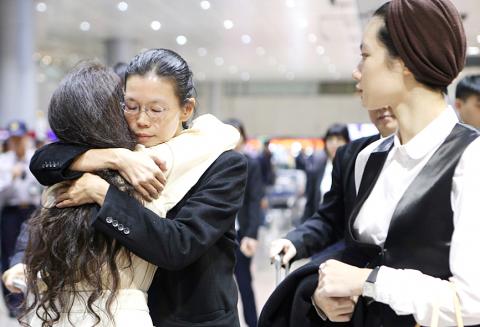
Photo: CNA
The statement came one day after a Chinese court sentenced Lee over charges of attempting to subvert state power on the grounds that Lee had been an “active participant” in an organization founded by Chinese national Peng Yuhua (彭宇華) to pressure China to accept a multiparty political system.
Lee was accused of using the Internet to intervene in and attract attention to major events in China.
His conviction marks China’s first known criminal prosecution of a nonprofit worker since Beijing in April last year passed a law tightening controls over foreign non-governmental organizations (NGOs).
The court said Lee has decided not to appeal.
Lee, a staff member of Taipei’s Wenshan Community College and volunteer with Covenants Watch, was detained after entering China on March 19.
He was initially thought to have gone missing, until China’s Taiwan Affairs Office on March 29 said that he had been detained.
However, it did not disclose the charges he was facing until May.
Freedom House, which researches and advocates for democracy and human rights, yesterday also published a statement condemning the ruling.
“The court conviction and imprisonment of Lee Ming-che for his social media posts is an attempt by China to silence advocates for democracy throughout the region, extending even to activists’ private conversations with friends,” Freedom House president Michael Abramowitz said in a statement.
Lee’s being found guilty of subversion of state power is “a rejection of the most fundamental democratic values,” Abramowitz said.
Lee’s wife, Lee Ching-yu (李凈瑜), urged the public to continue to pay attention to her husband’s situation now that he has embarked on a new chapter of his life as a prisoner of conscience.
“We must not let him suffer alone in a corner of the world, forgotten,” Lee Ching-yu said upon landing at Taiwan Taoyuan International Airport from China, where she attended her husband’s hearing.
She also expressed her gratitude to the US government, the international community and local NGOs for supporting her and her husband over the past few months.
Meanwhile, China said that any attempt to “hype up” its decision to jail a Taiwanese rights activist for subversion would be futile, after the Democratic Progressive Party (DPP) administration labeled the result “unacceptable.”
“Any attempts to hype up the case for political ends or to instigate opposition between compatriots across the [Taiwan] Strait will all be futile,” China’s Taiwan Affairs Office spokesman Ma Xiaoguang (馬曉光) told reporters at a regular news briefing.
State-backed tabloid Global Times said in an editorial that the DPP’s statement was tantamount to encouraging Taiwanese to come to China and break the law.
“We hope that Taiwanese will not accept the DPP’s witchcraft and will not become an assault team or sacrificial victims for them,” it said.
Additional reporting by Reuters

The National Chungshan Institute of Science and Technology yesterday showcased its locally developed variants of the Vision 60 robotic patrol dog, which it plans to deploy on the nation’s outlying territories in the South China Sea. The variants were produced under the Joint Lab project — created by the institute and domestic companies — and assembled with domestically produced motors, lenses and artificial intelligence (AI) systems alongside licensed tech from the US, Missile and Rocket Systems Research Division deputy director Jen Kuo-kang (任國光) told the media event at a military base in Taipei’s Dazhi (大直) area. Taiwan has built up its strengths

RIGHT DIRECTION: Taiwan’s efforts to prevent forced labor include a proposal to ‘fully prohibit’ employers from withholding workers’ documents, an official said Taiwan is to establish a mechanism to restrict imports of goods linked to forced labor, the Executive Yuan said yesterday, after the US proposed imposing additional tariffs on Taiwanese goods over labor concerns. “The Ministry of Labor and the Ministry of Economic Affairs are to establish an interministerial review procedure,” Executive Yuan spokesperson Michelle Lee (李慧芝) said at a news briefing in Taipei. “The government is to use the Foreign Trade Act [貿易法] as the legal basis to restrict imports of goods produced with forced labor” and bring its supply chain governance more in line with international standards on human rights, resilience
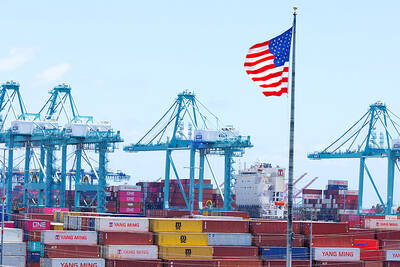
NOT IMMEDIATE: Taiwan has a chance to appeal the proposed 10 percent tariff before it starts, while other countries face a 12.5 percent tariff from the trade office Taiwan is among 60 economies determined by the US to have failed to impose or enforce a ban on the importation of goods produced with forced labor, according to a notice released on Tuesday by the Office of the US Trade Representative (USTR), which proposed imposing an additional 10 percent or more tariff on them. The USTR in a statement said that following an investigation, it had determined under Section 301 of the Trade Act of 1974 that the failure of the 60 economies to impose and effectively enforce a prohibition on the importation of goods produced with forced labor is
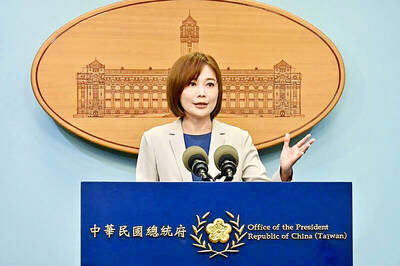
TIT-FOR-TAT: The US allegedly revoked the visa of a Chinese national working at Xinhua News Agency in the US in response to Beijing’s expulsion of Vivian Wang The Presidential Office yesterday condemned China for expelling a New York Times correspondent from Beijing following the newspaper’s interview with President William Lai (賴清德), saying the move highlighted Beijing’s suppression of press freedom and its threat to international news media. Taiwan has noted a series of recent incidents in which Beijing used similar tactics to “threaten and pressure international media outlets and journalists,” Presidential Office spokeswoman Karen Kuo (郭雅慧) said in a statement. “This concerns not only press freedom and freedom of expression, but also the safety of journalists, and Taiwan and relevant partners are paying close attention to the situation,” she


 RSS
RSS