


It is difficult for Beijing’s unilaterally constructed “one China” principle to win public recognition in Taiwan, the Mainland Affairs Council (MAC) said yesterday in response to Chinese President Xi Jinping’s (習近平) reiteration of Beijing’s determination to quash any Taiwanese pro-independence forces.
The council issued a statement expressing regret over Xi’s report yesterday at the opening ceremony of the Chinese Communist Party’s (CCP) 19th National Congress in Beijing, in which he reiterated Beijing’s adherence to its previous cross-strait policy.
“The differences in [political] systems and ideologies across the Taiwan Strait have not created a gulf in interactions over the past three decades. Rather, artificial obstructions and divisions have been the main causes of the worsening deadlock,” the council said.
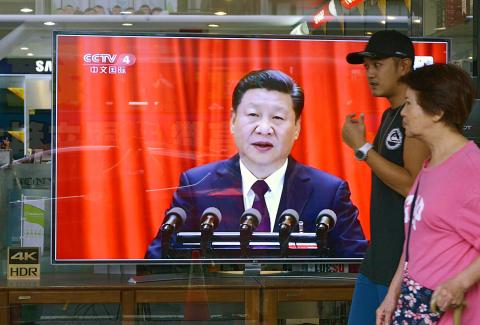
Photo: AFP
The council urged Beijing to accept that it is unlikely for its unilateral and heavy-handed “one China” principle and “one country, two systems” formulation to gain the support of Taiwanese.
“Respect and communication are the only keys to narrowing the differences between the two sides,” the council said.
In his three-and-a-half-hour report, Xi mentioned the so-called “1992 consensus” four times, saying it embodies the spirit of Beijing’s “one China” principle and clearly defines the nature of cross-strait relations.
The “1992 consensus” — a term former Mainland Affairs Council chairman Su Chi (蘇起) admitted to making up in 2000 — refers to a tacit understanding between the Chinese Nationalist Party (KMT) and the CCP that both sides acknowledge there is “one China,” with each side having its own interpretation of what “China” means.
The “1992 consensus” lies at the center of the cross-strait stalemate. Beijing has been persistent in its stance that it is the prerequisite for exchanges and dialogue, while the Democratic Progressive Party (DPP) government has refused to accept it, instead calling for a “new pattern of engagement.”
Meanwhile, Xi said that China over the past five years has firmly opposed and prevented Taiwanese independence, and that Beijing has achieved a historical meeting between the two sides’ leaders.
He was referring to his meeting with then-president Ma Ying-jeou (馬英九) in November 2015, the first meeting between the top leaders of Taiwan and China since the KMT’s retreat to Taiwan in 1949.
China has “the resolve, confidence and ability to defeat separatist attempts for Taiwanese independence in any form,” Xi said.
“We will never allow any person, organization or political party, at any time or in any form, to separate any part of Chinese territory from China,” he said.
The congress is seen as the most significant political gathering in China since Xi came to power in 2012. His remarks on cross-strait relations are to serve as important indicators of Beijing’s policy toward Taiwan.
The council, expressing the hope that China could work to adopt policies that promote “democracy, peace, fairness and justice” as it endeavors to become stronger and carry out systematic reform, called on Beijing to adopt “a new mindset and healthy attitude” toward cross-strait relations.
“When dealing with cross-strait issues, President Tsai Ing-wen (蔡英文) and her government have a rational and pragmatic attitude, and have refrained from any forms of provocation,” the council said, adding that joint efforts should be made to explore a new model for interactions and to promote pragmatic communication to move cross-strait relations forward.
The Presidential Office issued a mild response compared with that issued by the council.
“The government has endeavored to maintain cross-strait relations based on public opinion and domestic consensus, and has continuously extended a friendly hand in the hope of resolving our divisions and differences through virtuous interactions,” the office said, adding that it believes the international community understands and has noticed those efforts.
The DPP government’s policy to strive for regional peace and stability has always been clear and persistent, the office said.
It also reiterated Tsai’s “new four noes” for cross-strait ties.
“Our goodwill remains unchanged. Our promise [to maintain the ‘status quo’] remains unchanged. We will not return to the old path of conflict and we will not succumb to pressure,” it said.

Tropical Storm Gaemi strengthened into a typhoon at 2pm yesterday, and could make landfall in Yilan County tomorrow, the Central Weather Administration (CWA) said yesterday. The agency was scheduled to issue a sea warning at 11:30pm yesterday, and could issue a land warning later today. Gaemi was moving north-northwest at 4kph, carrying maximum sustained winds near its center of up to 118.8kph and gusts of 154.8kph. The circumference is forecast to reach eastern Taiwan tomorrow morning, with the center making landfall in Yilan County later that night before departing from the north coast, CWA weather forecaster Kuan Shin-ping (官欣平) said yesterday. Uncertainty remains and

SEA WARNING LIKELY: The storm, named Gaemi, could become a moderate typhoon on Wednesday or Thursday, with the Taipei City Government preparing for flooding A tropical depression east of the Philippines developed into a tropical storm named Gaemi at 2pm yesterday, and was moving toward eastern Taiwan, the Central Weather Administration (CWA) said. Gaemi could begin to affect Taiwan proper on Tuesday, lasting until Friday, and could develop into a moderate typhoon on Wednesday or Thursday, it said. A sea warning for Gaemi could be issued as early as Tuesday morning, it added. Gaemi, the third tropical storm in the Pacific Ocean this typhoon season, is projected to begin moving northwest today, and be closest to Taiwan on Wednesday or Thursday, the agency said. Today, there would likely

DISRUPTIONS: The high-speed rail is to operate as normal, while several airlines either canceled flights or announced early departures or late arrivals Schools and offices in 15 cities and counties are to be closed today due to Typhoon Gaemi, local governments announced last night. The 15 are: Taipei, New Taipei City, Taoyuan, Tainan, Keelung, Hsinchu and Kaohsiung, as well as Yilan, Hualien, Hsinchu, Miaoli, Chiayi, Pingtung, Penghu and Lienchiang counties. People should brace for torrential rainfall brought by the storm, with its center forecast to make landfall on the east coast between tonight and tomorrow morning, the Central Weather Administration (CWA) said. The agency issued a sea warning for the typhoon at 11:30pm on Monday, followed by a land warning at 11:30am yesterday. As of

CASUALTY: A 70-year-old woman was killed by a falling tree in Kaohsiung as the premier warned all government agencies to remain on high alert for the next 24 hours Schools and offices nationwide are to be closed for a second day today as Typhoon Gaemi crosses over the nation, bringing torrential rain and whipping winds. Gaemi was forecast to make landfall late last night. From Tuesday night, its outer band brought substantial rainfall and strong winds to the nation. As of 6:15pm last night, the typhoon’s center was 20km southeast of Hualien County, Central Weather Administration (CWA) data showed. It was moving at 19kph and had a radius of 250km. As of 3pm yesterday, one woman had died, while 58 people were injured, the Central Emergency Operation Center said. The 70-year-old


 RSS
RSS