


US President Donald Trump yesterday that the US will be forced to “totally destroy” North Korea unless Pyongyang backs down from its nuclear challenge, mocking North Korean leader Kim Jong-un as a “rocket man” on a suicide mission.
Loud murmurs filled the green-marbled UN General Assembly hall when Trump issued his sternest warning yet to North Korea, whose ballistic missile launches and nuclear tests have rattled the globe.
Unless North Korea backs down, he said: “We will have no choice than to totally destroy North Korea.”
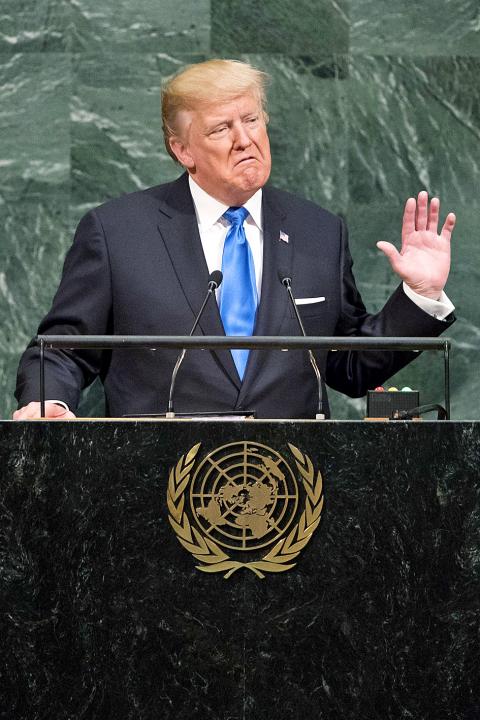
Photo: AFP
“Rocket man is on a suicide mission for himself and his regime,” he said.
The North Korean mission to the UN did not immediately respond to a request for comment on Trump’s remarks.
A junior North Korean diplomat remained in the delegation’s front-row seat for Trump’s speech, the North Korean mission said.
In his first appearance at the annual gathering of world leaders, the president used a 41-minute speech to take aim also at Iran’s nuclear ambitions and regional influence, Venezuela’s collapsing democracy and the threat of Islamist extremists. He also criticized the Cuban government.
However, his strongest words were directed at North Korea. He urged UN member states to work together to isolate the Kim government until it ceases its “hostile” behavior.
He said North Korea’s pursuit of nuclear weapons and ballistic missiles “threatens the entire world with unthinkable cost of human life.”
In what may have been a veiled prod at China, the North’s major trading partner, Trump said: “It is an outrage that some nations would not only trade with such a regime but would arm, supply and financially support a country that imperils the world with nuclear conflict.”
Turning to Iran, Trump called the 2015 nuclear deal negotiated by former US president Barack Obama an embarrassment and hinted that he may not recertify the agreement when it comes up for a deadline in the middle of next month.
“I don’t think you’ve heard the last of it,” he said.
He called Iran an “economically depleted rogue state” that exports violence.
The speech marked his latest attempt to lay out his “America First” vision for a US foreign policy aimed at downgrading global bureaucracies, basing alliances on shared interests, and steering Washington away from nation-building exercises abroad.
Trump told world leaders at the 193-member global body that the US does not seek to impose its will on other nations and will respect other countries’ sovereignty.
“I will defend America’s interests above all else,” he said. “But in fulfilling our obligations to other nations we also realize it’s in everyone’s interest to seek a future where all nations can be sovereign, prosperous and secure.”
Reading carefully from a script, Trump said the US military would soon be the strongest it has ever been.
Turning to Venezuela, Trump called the collapsing situation there “completely unacceptable,” adding: “We cannot stand by and watch.”
He said the US was considering what further actions it can take.
Shortly before Trump’s speech, UN Secretary-General Antonio Guterres appealed from the General Assembly lectern for statesmanship to avoid war with North Korea.
“This is the time for statesmanship,” the former prime minister of Portugal said. “We must not sleepwalk our way into war.”
The UN Security Council has unanimously imposed nine rounds of sanctions on North Korea since 2006 and Guterres appealed for the 15-member body to maintain its unity on the North.

The CIA has a message for Chinese government officials worried about their place in Chinese President Xi Jinping’s (習近平) government: Come work with us. The agency released two Mandarin-language videos on social media on Thursday inviting disgruntled officials to contact the CIA. The recruitment videos posted on YouTube and X racked up more than 5 million views combined in their first day. The outreach comes as CIA Director John Ratcliffe has vowed to boost the agency’s use of intelligence from human sources and its focus on China, which has recently targeted US officials with its own espionage operations. The videos are “aimed at
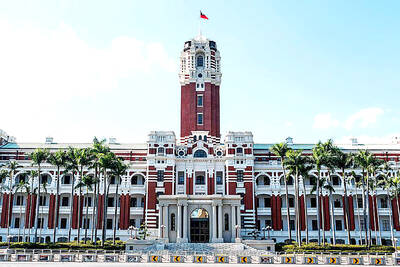
STEADFAST FRIEND: The bills encourage increased Taiwan-US engagement and address China’s distortion of UN Resolution 2758 to isolate Taiwan internationally The Presidential Office yesterday thanked the US House of Representatives for unanimously passing two Taiwan-related bills highlighting its solid support for Taiwan’s democracy and global participation, and for deepening bilateral relations. One of the bills, the Taiwan Assurance Implementation Act, requires the US Department of State to periodically review its guidelines for engagement with Taiwan, and report to the US Congress on the guidelines and plans to lift self-imposed limitations on US-Taiwan engagement. The other bill is the Taiwan International Solidarity Act, which clarifies that UN Resolution 2758 does not address the issue of the representation of Taiwan or its people in
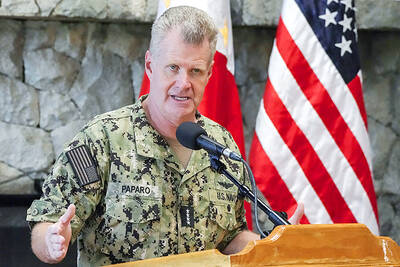
US Indo-Pacific Commander Admiral Samuel Paparo on Friday expressed concern over the rate at which China is diversifying its military exercises, the Financial Times (FT) reported on Saturday. “The rates of change on the depth and breadth of their exercises is the one non-linear effect that I’ve seen in the last year that wakes me up at night or keeps me up at night,” Paparo was quoted by FT as saying while attending the annual Sedona Forum at the McCain Institute in Arizona. Paparo also expressed concern over the speed with which China was expanding its military. While the US
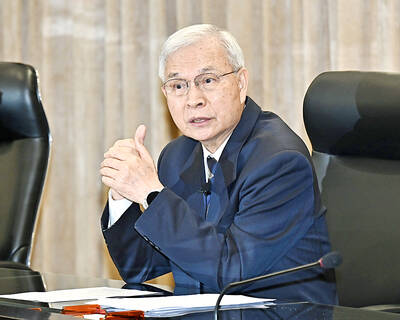
SHIFT: Taiwan’s better-than-expected first-quarter GDP and signs of weakness in the US have driven global capital back to emerging markets, the central bank head said The central bank yesterday blamed market speculation for the steep rise in the local currency, and urged exporters and financial institutions to stay calm and stop panic sell-offs to avoid hurting their own profitability. The nation’s top monetary policymaker said that it would step in, if necessary, to maintain order and stability in the foreign exchange market. The remarks came as the NT dollar yesterday closed up NT$0.919 to NT$30.145 against the US dollar in Taipei trading, after rising as high as NT$29.59 in intraday trading. The local currency has surged 5.85 percent against the greenback over the past two sessions, central


 RSS
RSS