


More than 1,000 people yesterday attended a funeral procession for a Philippine teenager slain by police last week, turning the march into one of the biggest protests yet against Philippine President Rodrigo Duterte’s deadly “war on drugs.”
The death of Kian Loyd delos Santos has drawn widespread attention to allegations that police have been systematically executing suspected drug users and dealers — a charge the authorities deny.
Nuns, priests and hundreds of children, chanting “justice for Kian, justice for all” joined the funeral procession as it made its way from a church to the cemetery where the 17-year-old was buried.

Photo: EPA
Delos Santos’ father, Saldy, spoke briefly during a mass to defend his son’s innocence and express anger at the police.
“Don’t they have a heart? I’m not sure they do. There’s a lot of churches, they should go there,” he said, his voice cracking with emotion.
Delos Santos was dragged by plainclothes policemen to a dark, trash-filled alley in northern Manila before he was shot in the head and left next to a pigsty, said witnesses, whose accounts appeared to be backed up by surveillance footage.
Police have said they acted in self-defense after Delos Santos opened fire on them.
His parents and lawyers on Friday filed a murder complaint against the three anti-narcotics policemen.
If accepted, the complaint would follow at least two cases filed last year against police over Duterte’s war on drugs, which has killed thousands of Filipinos, outraged human rights groups and alarmed Western governments.
Delos Santos’ flower-draped coffin passed through a major highway on a small truck decorated with tarpaulins on which “Run, Kian, Run” and “Stop the killings” were printed on each side.
Passing motorists honked in support.
“This is a sign that the people have had enough and are indignant over the impunity that prevails today,” Renato Reyes, secretary-general of left-wing activist group Bayan (“Nation”), said in a statement. “The people protest the utter lack of accountability in the police force.”
Mourners, some of them wearing white shirts, held flowers, small flags and placards denouncing the killing.
A member of Rise Up, a Manila-based coalition of church-related groups opposing the drug war, told reporters that families of about 20 victims joined the procession.
“I came to support the family. I want justice for Kian and all victims — including my son,” said 35-year-old Katherine David, whose 21-year-old son was shot dead with two other men by police in January.
Philippine Department of Justice personnel armed with assault rifles were on guard during the procession and outside the church.
Most people in the Philippines support the anti-drug campaign and Duterte remains a popular leader, but questions have begun to be asked since the death of Delos Santos, which came during a spike in killings across the Philippines’ main island, Luzon, last week.
The president’s communication office yesterday reiterated that he would not tolerate wrongdoing by law enforcement and called on the public to “trust the justice system under the Duterte presidency.”
However, bereaved mother David believes the response to Delos Santos’ killing marks a turning point in opposition to the drug war.
“There’s been a big change. Before, police could kill and nobody paid attention. Now people are starting to show support and sympathy,” she said.

‘NO SECURITY RISK’: The Railway Bureau reassured the public that the technicians’ activities were limited to technical guidance and did not involve sensitive systems The Railway Bureau yesterday said it had invited eight Chinese technicians to assist with an airport MRT construction project. The bureau issued the confirmation after an Internet user said Chinese nationals had entered the construction zone of Taiwan Taoyuan International Airport’s Terminal 3 project. They asked why “individuals from an enemy state” were allowed access to such a major national infrastructure project, which raised serious concerns over Taiwan’s industrial safety, sensitive systems and information security. The bureau’s Northern Region Engineering Branch Office said subcontractor Taiwan Handle Industrial Co (台灣手把工業) of the Taoyuan airport MRT’s “Contract No. CU05 Project A14 Station Civil, MEP &
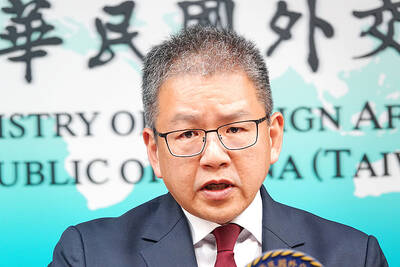
Taiwan is still in the process of assessing the possibility of recruiting workers from Eswatini, the Ministry of Foreign Affairs said yesterday, adding that its goal is to help Eswatini upgrade its vocational training centers. If there are plans to recruit workers from Eswatini, safeguarding national security, protecting public health and ensuring the employment rights of Taiwanese would be prerequisites, Department of West Asian and African Affairs Director-General Yen Chia-liang (顏嘉良) told a news conference. Key considerations would also include filling labor shortages in specific industries, and fostering bilateral professional and technical exchanges, he said. Yen was asked about the progress of labor

A US uncrewed surface vessel (USV) encountered multiple Chinese warships during an autonomous transit of the Taiwan Strait, US defense company Seasats said in a statement on Wednesday. Seasats announced that a Lightfish USV had completed the first autonomous transit of the Taiwan Strait. Over five days, the USV traversed the entire length of the Strait while constantly monitoring surface vessel traffic, the company said. The Lightfish encountered multiple Chinese warships, one of which was a Chinese People’s Liberation Army Navy (PLAN) Type 056 corvette, it said. The Chinese vessels were operating “well within Taiwan’s exclusive economic zone without transmitting their identity via the
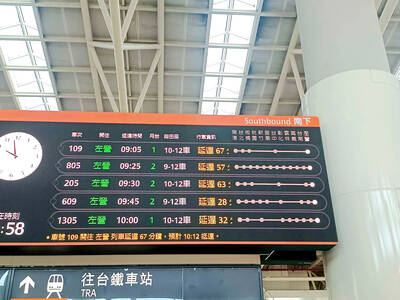
The nation’s usually punctual high-speed rail system yesterday was hit by major disruptions after all scheduled services were canceled and replaced with three hourly trains offering only non-reserved seating, affecting more than 200,000 passengers. Preliminary findings indicate the disruption was caused by a faulty power module in a track switch control cabinet, Taiwan High-Speed Rail Corp (THSRC) said, adding that as a full system inspection could only be conducted after operations end for the day, a decision on whether normal service would resume today would be announced before the first train departs. During a routine inspection early yesterday, a switch signal abnormality


 RSS
RSS