


Renaming Japan’s representative office in Taipei as the Taiwan-Japan Relations Association would help lessen misunderstandings and reflect Taiwan’s burgeoning relationship with Japan, association president Chiou I-jen (邱義仁) said yesterday at the official unveiling of the association’s new doorplate in Taipei.
“While people were clear about what we were concerned with when the office was first established, as time has gone by, many no longer have a clue,” Chiou said, recalling how he once received a telephone call asking him to resolve an issue in Hawaii.
“Finally” changing the name of the non-governmental agency, formerly known as the Association of East Asian Relations, Taiwan, after almost 45 years lends clarity to the association’s mission, he said.
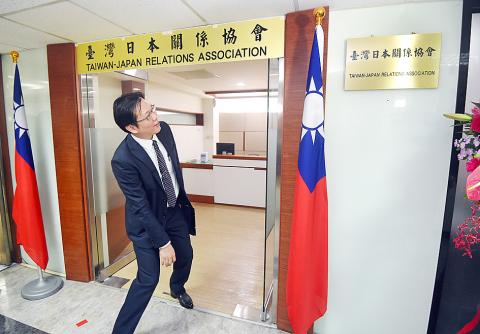
Photo: Liao Chen-huei, Taipei Times
The association was established in 1972 to handle relations with Japan after diplomatic ties were broken off, with its Tokyo branch — the Taipei Economic and Cultural Representative Office in Japan — also serving as Taiwan’s de facto embassy in the nation.
While officially a civic organization under government contract, most employees simultaneously hold positions at the Ministry of Foreign Affairs.
The name change follows a similar change on the part of its Japanese counterpart earlier this year, which changed its name from Interchange Association, Japan to the Japan-Taiwan Exchange Association.
“Before we changed our name, a lot of people were not clear about our mission — we even had people calling and asking us about marriage matches,” Japan-Taiwan Exchange Association Representative Mikio Numata said, adding that the renaming is a “historic step,” as its name now conforms with reality.
“The name changes not only help the outside world understand the substantial content of both associations’ work — it also verifies the continued positive development of Taiwan-Japanese relations,” Minister of Foreign Affairs David Lee (李大維) said.
Relations have “never been better or more intimate,” he said, citing record-high bilateral trade and tourism.
Any discussion of renaming the Coordination Council for North American Affairs — which handles relations with the US — would have to wait until US President Donald Trump fills key Department of State vacancies, he said.
The ministry’s Japanese Political Affairs director, Fu Kuo-hua (傅國華), said the name changes primarily reflected a shift in Taiwan’s stance.
Japan had proposed using “Taiwan-Japan” to name the associations when official diplomatic ties were first broken off, but the proposal was rejected by Chiang Kai-shek’s (蔣介石) administration, which wanted to use “Chinese-Japanese,” he said.
China yesterday called the name change a “conspiracy” and urged Japan not to send “false signals” to Taiwan and the international community.
“We strongly object to this attempt to upgrade Japanese-Taiwanese relations,” Chinese Ministry of Foreign Affairs spokeswoman Hua Chunying (華春瑩) said. “We urge the Japanese government to scrupulously abide by the principles of the Japan-China Joint Communique, as well as all the promises which Japan has made to China to the present, including holding firm to the ‘one China’ principle.”
“The Japanese government should take concrete action to correct wrong methods and should not send false signals to Taiwan’s government and the international community, creating new interference for Sino-Japanese relations,” she said. “We also want to tell the Taiwanese government that any attempt to create ‘two Chinas’ or ‘one China, one Taiwan’ is doomed to failure.”
Additional reporting by CNA

Tropical Storm Gaemi strengthened into a typhoon at 2pm yesterday, and could make landfall in Yilan County tomorrow, the Central Weather Administration (CWA) said yesterday. The agency was scheduled to issue a sea warning at 11:30pm yesterday, and could issue a land warning later today. Gaemi was moving north-northwest at 4kph, carrying maximum sustained winds near its center of up to 118.8kph and gusts of 154.8kph. The circumference is forecast to reach eastern Taiwan tomorrow morning, with the center making landfall in Yilan County later that night before departing from the north coast, CWA weather forecaster Kuan Shin-ping (官欣平) said yesterday. Uncertainty remains and

SEA WARNING LIKELY: The storm, named Gaemi, could become a moderate typhoon on Wednesday or Thursday, with the Taipei City Government preparing for flooding A tropical depression east of the Philippines developed into a tropical storm named Gaemi at 2pm yesterday, and was moving toward eastern Taiwan, the Central Weather Administration (CWA) said. Gaemi could begin to affect Taiwan proper on Tuesday, lasting until Friday, and could develop into a moderate typhoon on Wednesday or Thursday, it said. A sea warning for Gaemi could be issued as early as Tuesday morning, it added. Gaemi, the third tropical storm in the Pacific Ocean this typhoon season, is projected to begin moving northwest today, and be closest to Taiwan on Wednesday or Thursday, the agency said. Today, there would likely

DISRUPTIONS: The high-speed rail is to operate as normal, while several airlines either canceled flights or announced early departures or late arrivals Schools and offices in 15 cities and counties are to be closed today due to Typhoon Gaemi, local governments announced last night. The 15 are: Taipei, New Taipei City, Taoyuan, Tainan, Keelung, Hsinchu and Kaohsiung, as well as Yilan, Hualien, Hsinchu, Miaoli, Chiayi, Pingtung, Penghu and Lienchiang counties. People should brace for torrential rainfall brought by the storm, with its center forecast to make landfall on the east coast between tonight and tomorrow morning, the Central Weather Administration (CWA) said. The agency issued a sea warning for the typhoon at 11:30pm on Monday, followed by a land warning at 11:30am yesterday. As of

CASUALTY: A 70-year-old woman was killed by a falling tree in Kaohsiung as the premier warned all government agencies to remain on high alert for the next 24 hours Schools and offices nationwide are to be closed for a second day today as Typhoon Gaemi crosses over the nation, bringing torrential rain and whipping winds. Gaemi was forecast to make landfall late last night. From Tuesday night, its outer band brought substantial rainfall and strong winds to the nation. As of 6:15pm last night, the typhoon’s center was 20km southeast of Hualien County, Central Weather Administration (CWA) data showed. It was moving at 19kph and had a radius of 250km. As of 3pm yesterday, one woman had died, while 58 people were injured, the Central Emergency Operation Center said. The 70-year-old


 RSS
RSS