


Democratic Progressive Party (DPP) lawmakers yesterday denounced China’s obstruction of Taiwan’s participation at this year’s World Health Assembly (WHA), while Chinese Nationalist Party (KMT) lawmakers said President Tsai Ing-wen (蔡英文) should do more to deal with China’s actions than just tweeting.
Taiwan did not receive an invitation to the WHA by Monday — the final day for online registration — with China’s Taiwan Affairs Office attributing the nation’s exclusion to its refusal to recognize the so-called “1992 consensus” and the “one China” principle.
DPP members of the Foreign Affairs and National Defense Committee and the Social Welfare and Environmental Hygiene Committee yesterday issued a joint statement condemning China and the WHO for Taiwan’s exclusion on political grounds.

Photo: Wang Yi-sung, Taipei Times
Legislators decried China’s obstruction and the WHO’s acquiescence to Beijing, which they said went against the WHO’s principle of ensuring health for all regardless of religious, ethnic or political differences.
Last year, Taiwan received an invitation after the online registration deadline and the possibility remains that the nation would be able to participate this year, DPP Legislator Wang Ding-yu (王定宇) said.
“We urge the WHO to uphold its principle of ‘leaving no one behind’ and correct the mistake [of excluding Taiwan] before the WHA meeting begins,” Wang said. “It is extremely humiliating that 23 million Taiwanese are excluded from the global disease prevention network.”
During the SARS epidemic in 2003, Taiwan’s reaction to the fatal disease was initially slow as the nation was not a WHO member, causing delays in disease control information exchange, DPP Legislator Lin Ching-yi (林靜儀) said.
Taiwan applied for WHO membership the same year, but was rejected, with a Chinese representative to the WHO spurning the request, saying: “Who cares about you?” to the Taiwanese delegation, Lin said.
Taiwan’s exclusion from the WHA this year “demonstrates again how rude and barbaric China is,” Lin said.
“China’s obstruction will only distance the Taiwanese public from China. Beijing has to take full responsibility for a possible deterioration in cross-strait relations,” DPP Legislator Lo Chih-cheng (羅致政) said.
Separately yesterday, the KMT legislative caucus criticized the Presidential Office after Tsai tweeted for the 11th time calling for Taiwan’s inclusion at the WHA.
The situation warrants a more coherent response than tweeting, the caucus said.
KMT Legislator Lee Yen-hsiu (李彥秀) said Taiwan has made many contributions to global health, and epidemic prevention and management under the WHO, but the Tsai administration has done little other than posting on Twitter.
China’s position is clear and the ball is in Tsai’s court, she said, adding that social media platforms are useful for promoting policies during an election, but tweeting is not useful for making policy after taking the reins of government.
“The government should think about how to respond to international realities and Tsai knows full well what the key to the problem is. It is fine not to recognize the ‘1992 consensus,’ but if so the government should consider an alternative framework for cross-strait relations,” Lee said.
The DPP slammed former president Ma Ying-jeou’s (馬英九) policy to participate in the WHA under the name “Chinese Taipei” by saying this policy “lowers the nation’s dignity,” Lee said.
However, the nation has not received an invitation from the WHA under Tsai’s leadership, Lee added.
“There is more to governance than making tweets,” she said. “The DPP is a ruling party with a legislative majority. It should understand international realities to find a solution, instead of making condemnations.”
KMT Legislator Chiang Wan-an (蔣萬安) said that KMT lawmakers are saddened by the turn of events and they approve of the Ministry of Health and Welfare’s tenacity in dealing with the situation.
Politics should have no place in global health, he added.
However, the Tsai administration should have anticipated Beijing’s response and been more prepared by making plans or conducting negotiations, Chiang said.
Later yesterday, the DPP denounced the KMT for its criticism of the government when the nation needs bipartisan support for its bid to seek WHA participation.
“Public health is not a political issue, and the KMT should not use the occasion for political leverage, which would only worsen the public perception of the KMT,” DPP spokesman Chang Chih-hao (張志豪) said.

PROVOCATIVE: Chinese Deputy Ambassador to the UN Sun Lei accused Japan of sending military vessels to deliberately provoke tensions in the Taiwan Strait China denounced remarks by Japan and the EU about the South China Sea at a UN Security Council meeting on Monday, and accused Tokyo of provocative behavior in the Taiwan Strait and planning military expansion. Ayano Kunimitsu, a Japanese vice foreign minister, told the Council meeting on maritime security that Tokyo was seriously concerned about the situation in the East China and South China seas, and reiterated Japan’s opposition to any attempt to change the “status quo” by force, and obstruction of freedom of navigation and overflight. Stavros Lambrinidis, head of the EU delegation to the UN, also highlighted South China Sea
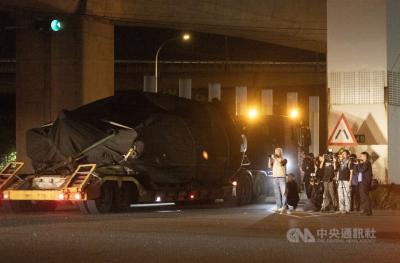
The final batch of 28 M1A2T Abrams tanks purchased from the US arrived at Taipei Port last night and were transported to the Armor Training Command in Hsinchu County’s Hukou Township (湖口), completing the military’s multi-year procurement of 108 of the tanks. Starting at 12:10am today, reporters observed more than a dozen civilian flatbed trailers departing from Taipei Port, each carrying an M1A2T tank covered with black waterproof tarps. Escorted by military vehicles, the convoy traveled via the West Coast Expressway to the Armor Training Command, with police implementing traffic control. The army operates about 1,000 tanks, including CM-11 Brave Tiger
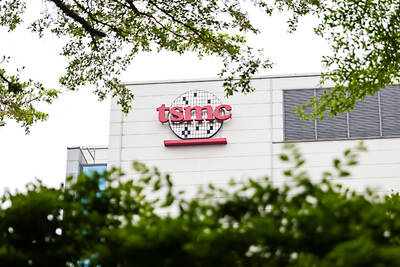
Taiwan Semiconductor Manufacturing Co (TSMC, 台積電), the world’s largest contract chipmaker, said it expects its 2-nanometer (2nm) chip capacity to grow at a compound annual rate of 70 percent from this year to 2028. The projection comes as five fabs begin volume production of 2-nanometer chips this year — two in Hsinchu and three in Kaohsiung — TSMC senior vice president and deputy cochief operating officer Cliff Hou (侯永清) said at the company’s annual technology symposium in Silicon Valley, California, last week. Output in the first year of 2-nanometer production, which began in the fourth quarter of last year, is expected to

Taiwan’s drone exports surged past US$100 million in the first quarter, exceeding last year’s full-year total, with the Czech Republic emerging as the largest buyer, the Ministry of Economic Affairs said. Exports of complete drones reached US$115.85 million in the period, about 1.2 times the total recorded for all of last year, the ministry said in a report. Exports to the Czech Republic accounted for about US$100 million, far outpacing other markets. Poland, last year’s top destination, recorded about US$11.75 million in the first quarter. Taiwan’s drone exports have expanded rapidly in the past few years, with last year’s total


 RSS
RSS