


Chiang Kai-shek (蔣介石) was a “respected veteran” who put Taiwan’s security ahead of his goals, Chinese Nationalist Party (KMT) Central Policy director Alex Tsai (蔡正元) said yesterday, adding that all KMT members must be required to recite this “standard” response to questions about the former president’s role in the 228 Incident.
Tsai hosted a KMT news conference to address criticism by pan-green politicians and their supporters who say Chiang, who died 42 years ago yesterday, was the mastermind of the 228 Incident.
After the 228 Incident erupted in 1947, militia occupied public agencies — including airports, city governments, schools and hospitals — prompting Chiang, the national leader at the time, to deploy troops to Taiwan in a last-ditch effort to quash the insurgency, just like any head of state would, Tsai said.

Photo: CNA
“If [Kaohsiung Mayor] Chen Chu (陳菊) were kidnapped by a militia, it would be impossible for Taipei-based President Tsai Ing-wen (蔡英文) to sit idly by and not send any troops to quash the militia in Kaohsiung,” Alex Tsai said.
Then-Taiwan governor Chen Yi’s (陳儀) governance gave rise to the 228 Incident and Chiang, concerned that the conflict between KMT troops and the masses would escalate, sent Chen a telegram urging him to make sure that the troops did not take retaliatory action or they would be charged with treason, Alex Tsai said.
The telegram indicated that Chiang’s sole intention in sending the troops was to suppress the insurgents and although any skirmish would inevitably cause collateral damage, the death toll was insignificant compared with that during the revolt against Japanese rule when Taiwan was ceded to Japan, he said.

Photo: Fang Pin-chao, Taipei Times
Considering this and the fact that Chiang was at the time preoccupied with forming a strategy to counter the Chinese Communist Party forces gathered in China’s Yanan City, it is evident that the pan-green camp’s accusations that Chiang was a “murderer” responsible for the 228 Incident was unfair and slanderous, he said.
Chiang’s leadership was also instrumental to the then-KMT government’s victory over the People’s Liberation Army in the 1949 Battle of Kuningtou and the 823 Artillery Bombardment in 1958, without which Kinmen County would have been lost and Taiwan would have fallen under Chinese communist rule, he said.
Alex Tsai said the least any KMT member wanting to run for office in the party can do is to defend Chiang when Chiang is criticized.
“They should not distance themselves from Chiang just to pander to Taiwanese independence advocates or bereaved families of the 228 Incident,” he said.
Asked by reporters whether his remarks were directed at former president Ma Ying-jeou (馬英九), who on Feb. 27, in response to reporters’ questions, said that Chiang “had a responsibility” in the 228 Incident, Alex Tsai said that Ma had not given the question careful thought and gave an “unfair” reply.
“Therefore, we would like to issue a special notice to all KMT members who hold or have held positions in the party to adhere to the standard response: ‘Chiang Kai-shek is not the murderer in the 228 Incident, but a leading warrior and veteran who protected Taiwan,’” he said.
“This is the standard answer the party wishes to establish today. Anyone who diverts from this answer does not deserve to serve as a KMT employee or official,” he said.
Separately yesterday, former vice president Wu Den-yih (吳敦義), who is running in next month’s KMT chairpersonship race, said that without Chiang’s dedication to the Republic of China, Taiwan would still be occupied by the Japanese instead of being governed by Tsai Ing-wen today.
Although Chiang was not perfect, his role in the 228 Incident should be evaluated in a fair and just manner, Wu said.
KMT Chairwoman Hung Hsiu-chu (洪秀柱) said the Democratic Progressive Party’s plan to remove remnants of Chiang’s rule is aimed at severing Taiwanese people’s emotional ties to Beijing and fulfilling its dream of independence.
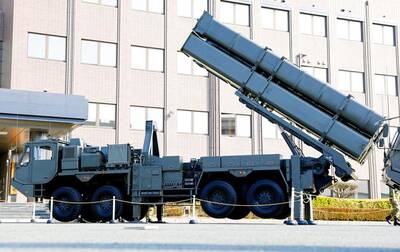
Japan has deployed long-range missiles in a southwestern region near China, the Japanese defense minister said yesterday, at a time when ties with Beijing are at their lowest in recent years. The missiles were installed in Kumamoto in the southern region of Kyushu, as Japan is attempting to shore up its military capacity as China steps up naval activity in the East China Sea. “Standoff defense capabilities enable us to counter the threat of enemy forces attempting to invade our country ... while ensuring the safety of our personnel,” Japanese Minister of Defense Shinjiro Koizumi said. “This is an extremely important initiative for
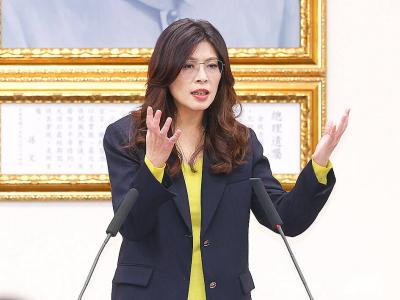
Chinese Nationalist Party (KMT) Chairwoman Cheng Li-wun (鄭麗文) today accepted an invitation from Chinese President Xi Jinping (習近平) to lead a delegation to China next month, saying she hopes to promote the peaceful development of cross-strait relations and bring stability to the Taiwan Strait. “I am grateful and happy to accept this invitation,” Cheng said in a statement from the KMT chairperson’s office. Cheng said she hopes both sides can work together to promote the peaceful development of cross-strait relations, enhance exchange and cooperation, bring stability to the Taiwan Strait and improve people’s livelihoods. At today's news conference, Cheng said any efforts to
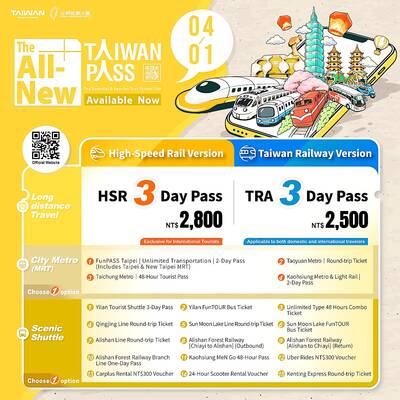
MORE POPULAR: Taiwan Pass sales increased by 59 percent during the first quarter compared with the same period last year, the Tourism Administration said The Tourism Administration yesterday said that it has streamlined the Taiwan Pass, with two versions available for purchase beginning today. The tourism agency has made the pass available to international tourists since 2024, allowing them to access the high-speed rail, Taiwan Railway Corp services, four MRT systems and four Taiwan Tourist Shuttles. Previously, five types of Taiwan Pass were available, but some tourists have said that the offerings were too complicated. The agency said only two types of Taiwan Pass would be available, starting from a three-day pass with the high-speed rail and a three-day pass with Taiwan Railway Corp. The former costs NT$2,800

The nation’s fastest supercomputer, Nano 4 (晶創26), is scheduled to be launched in the third quarter, and would be used to train large language models in finance and national defense sectors, the National Center for High-Performance Computing (NCHC) said. The supercomputer, which would operate at about 86.05 petaflops, is being tested at a new cloud computing center in the Southern Taiwan Science Park in Tainan. The exterior of the server cabinet features chip circuitry patterns overlaid with a map of Taiwan, highlighting the nation’s central position in the semiconductor industry. The center also houses Taiwania 2, Taiwania 3, Forerunner 1 and


 RSS
RSS