


The Ministry of National Defense said Patriot Advanced Capability-3 (PAC-3) missile batteries have been deployed on the east coast in response to an increased Chinese military presence in the area.
To improve integrated air defense capabilities, the ministry has deployed missiles to Hualien and Taitung counties, and merged the Air Defense Missile Command with the air force to streamline the chain of command, a ministry report submitted to the Legislative Yuan said.
The reorganization and relocation was ordered after the Chinese People’s Liberation Army (PLA) conducted several long-distance naval and aviation training missions — featuring an aircraft carrier and fleets of nuclear-capable bombers — in the East China Sea, South China Sea, East Indian Ocean and western Pacific Ocean to demonstrate its long-range power projection capabilities and Beijing’s ambition to dominate the Asia-Pacific region.
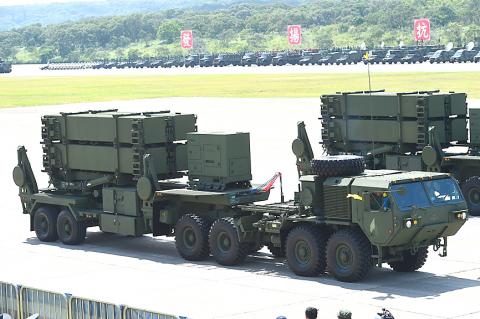
Photo: Chang Chia-ming, Taipei Times
Annual military exercises would test the effectiveness of the deployments, the ministry said.
It is the first time the ministry has confirmed the deployments, after speculation emerged following the publication of photographs last month showing missiles in the military’s air defense bases in eastern Taiwan.
The report also announced a doctrinal shift from “effective deterrence” to “multiple deterrence.”
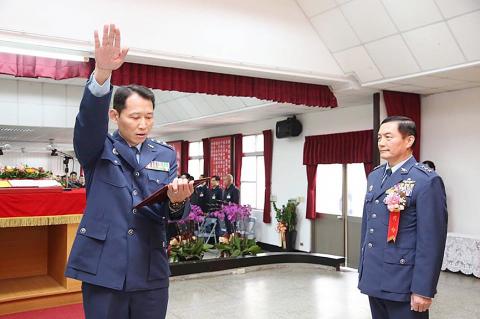
Photo: Military News Agency
The ministry said that it would develop the defense industry to ensure self-sufficiency and national security.
A quadrennial defense review, along with three defense plans that are expected to be the guidelines for the nation’s military buildup, are to be submitted to the Legislative Yuan by March 19.
The military is to conduct new exercises, including integrated air-and-sea training, rescue missions, fishing boat escort missions and supply missions in response to the PLA’s actions.
In addition to field exercises, computer-aided simulations are to be part of regular armed forces exercises.
A tactical engagement simulation system has been built for the army, and the ministry is exploring creating new simulation systems using virtual and augmented-reality technologies.
Measures have been taken to improve the military’s digital warfare capabilities this year, with Academia Sinica and the National Chungshan Institute of Science and Technology forming partnerships with the military, the ministry added.
The Air Defense Missile Command was yesterday merged with the air force at a handover ceremony at the command’s Taishan District (泰山) headquarters in New Taipei City.
The command, to be headed by Colonel Yu Jen-ming (游仁明), is expected to merge with the Air Defense Artillery Command to improve operational efficiency.
“The missile command is a high-tech, combat-ready unit and it is one of the most important components of the integrated air defense system,” Air Force Commander General Shen Yi-ming (沈一鳴) said.
The merger would see the transfer of PAC-3, Tien Kung anti-ballistic missiles and Hawk anti-aircraft missiles, as well as tactical counterstrike missiles and Hsiung Feng 2E cruise missiles, to the air force.

Tropical Storm Gaemi strengthened into a typhoon at 2pm yesterday, and could make landfall in Yilan County tomorrow, the Central Weather Administration (CWA) said yesterday. The agency was scheduled to issue a sea warning at 11:30pm yesterday, and could issue a land warning later today. Gaemi was moving north-northwest at 4kph, carrying maximum sustained winds near its center of up to 118.8kph and gusts of 154.8kph. The circumference is forecast to reach eastern Taiwan tomorrow morning, with the center making landfall in Yilan County later that night before departing from the north coast, CWA weather forecaster Kuan Shin-ping (官欣平) said yesterday. Uncertainty remains and

SEA WARNING LIKELY: The storm, named Gaemi, could become a moderate typhoon on Wednesday or Thursday, with the Taipei City Government preparing for flooding A tropical depression east of the Philippines developed into a tropical storm named Gaemi at 2pm yesterday, and was moving toward eastern Taiwan, the Central Weather Administration (CWA) said. Gaemi could begin to affect Taiwan proper on Tuesday, lasting until Friday, and could develop into a moderate typhoon on Wednesday or Thursday, it said. A sea warning for Gaemi could be issued as early as Tuesday morning, it added. Gaemi, the third tropical storm in the Pacific Ocean this typhoon season, is projected to begin moving northwest today, and be closest to Taiwan on Wednesday or Thursday, the agency said. Today, there would likely

DISRUPTIONS: The high-speed rail is to operate as normal, while several airlines either canceled flights or announced early departures or late arrivals Schools and offices in 15 cities and counties are to be closed today due to Typhoon Gaemi, local governments announced last night. The 15 are: Taipei, New Taipei City, Taoyuan, Tainan, Keelung, Hsinchu and Kaohsiung, as well as Yilan, Hualien, Hsinchu, Miaoli, Chiayi, Pingtung, Penghu and Lienchiang counties. People should brace for torrential rainfall brought by the storm, with its center forecast to make landfall on the east coast between tonight and tomorrow morning, the Central Weather Administration (CWA) said. The agency issued a sea warning for the typhoon at 11:30pm on Monday, followed by a land warning at 11:30am yesterday. As of

CASUALTY: A 70-year-old woman was killed by a falling tree in Kaohsiung as the premier warned all government agencies to remain on high alert for the next 24 hours Schools and offices nationwide are to be closed for a second day today as Typhoon Gaemi crosses over the nation, bringing torrential rain and whipping winds. Gaemi was forecast to make landfall late last night. From Tuesday night, its outer band brought substantial rainfall and strong winds to the nation. As of 6:15pm last night, the typhoon’s center was 20km southeast of Hualien County, Central Weather Administration (CWA) data showed. It was moving at 19kph and had a radius of 250km. As of 3pm yesterday, one woman had died, while 58 people were injured, the Central Emergency Operation Center said. The 70-year-old


 RSS
RSS