


Tour operators must immediately stop offering one-day tours departing from Taipei or Kaohsiung to Chiayi’s Alishan (阿里山), Nantou County’s Cingjing Farm (清境農場), Taichung’s Wuling Farm (武陵農場), Hsinchu County’s Smangus Village (司馬庫斯), Pingtung County’s Kenting (墾丁) and Hualien, the Tourism Bureau said yesterday.
The tours are deemed “high-risk” as drivers must spend long hours on the road and face uncertain conditions to reach their destinations, Tourism Bureau Deputy Director-General Chang Shi-chung (張錫聰) said.
The bureau made the announcement after meeting with representatives of the Directorate-General of Highways, the Ministry of Labor, the Travel Quality Assurance Association and consumer protection agencies to assess the one-day tour industry.
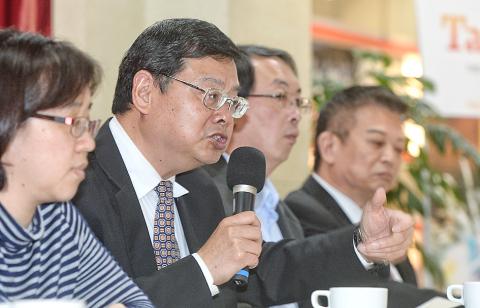
Photo: Lin Cheng-kung, Taipei Times
Tour operators must stop offering such tours or face fines of between NT$10,000 and NT$50,000.
In addition, domestic tours that leave early in the morning and return late at night must have two drivers taking turns, Chang said, adding that should operators have trouble meeting that stipulation, they must change tour itineraries or have travelers use public transport systems.
If the bus is the only means of transportation during a tour, drivers may not drive more than 300km per day on ordinary roads and 200km per day in mountainous areas, he said.
Should the trip involve both ordinary and mountain roads, the driving distance would be limited to 200km per day, he said.
Other agreements reached at the meeting include a complete ban on the so-called “zero-fee” tours, in which tour operators are compensated by collecting commission from shop owners that travel groups visit, he said.
The Travel Quality Assurance Association should quickly make public a reasonable price range for various one-day tours, Chang said.
Tour operators would be given guidelines for the design of domestic tours, which include giving tour bus drivers adequate time to rest, he said.
The guidelines also stipulate that tour operators must assess the type of tour bus, and whether it is to travel on any of the roads the Directorate-General of Highways deems dangerous.
The bureau said it has identified more than 100 domestic tours whose operators have been asked to explain how they are going to transport travelers.
According to the bureau, only 20 high-risk domestic tours are still on the market.
Tour operators should offer consumers full refunds for one-day tours purchased for the 228 Memorial Day holiday if their tours are deemed high-risk and then canceled, Consumer Protection Committee senior ombudsman Wang Te-ming (王德明) said.
“If tour operators are asked to remove those tours, that means there were risks in offering them. Based on their standard contracts with consumers, tour operators should refund consumers if they are at fault for disrupting travel plans by providing high-risk products,” Wang said.
“Should tour operators want to raise tour prices if their operational costs increase, they would have to renegotiate the contract with consumers. If consumers refuse to accept the terms of the contract, tour operators should refund their money,” he said.
“Tour operators, on the other hand, can always choose to absorb the costs to redeem people’s confidence after the freeway accident last week,” he added.

NO-LIMITS PARTNERSHIP: ‘The bottom line’ is that if the US were to have a conflict with China or Russia it would likely open up a second front with the other, a US senator said Beijing and Moscow could cooperate in a conflict over Taiwan, the top US intelligence chief told the US Senate this week. “We see China and Russia, for the first time, exercising together in relation to Taiwan and recognizing that this is a place where China definitely wants Russia to be working with them, and we see no reason why they wouldn’t,” US Director of National Intelligence Avril Haines told a US Senate Committee on Armed Services hearing on Thursday. US Senator Mike Rounds asked Haines about such a potential scenario. He also asked US Defense Intelligence Agency Director Lieutenant General Jeffrey Kruse

STUMPED: KMT and TPP lawmakers approved a resolution to suspend the rate hike, which the government said was unavoidable in view of rising global energy costs The Ministry of Economic Affairs yesterday said it has a mandate to raise electricity prices as planned after the legislature passed a non-binding resolution along partisan lines to freeze rates. Chinese Nationalist Party (KMT) lawmakers proposed the resolution to suspend the price hike, which passed by a 59-50 vote. The Taiwan People’s Party (TPP) voted with the KMT. Legislative Speaker Han Kuo-yu (韓國瑜) of the KMT said the resolution is a mandate for the “immediate suspension of electricity price hikes” and for the Executive Yuan to review its energy policy and propose supplementary measures. A government-organized electricity price evaluation board in March

NOVEL METHODS: The PLA has adopted new approaches and recently conducted three combat readiness drills at night which included aircraft and ships, an official said Taiwan is monitoring China’s People’s Liberation Army (PLA) exercises for changes in their size or pattern as the nation prepares for president-elect William Lai’s (賴清德) inauguration on May 20, National Security Bureau (NSB) Director-General Tsai Ming-yen (蔡明彥) said yesterday. Tsai made the comment at a meeting of the Legislative Yuan’s Foreign Affairs and National Defense Committee, in response to Democratic Progressive Party (DPP) Legislator Wang Ting-yu’s (王定宇) questions. China continues to employ a carrot-and-stick approach, in which it applies pressure with “gray zone” tactics, while attempting to entice Taiwanese with perks, Tsai said. These actions aim to help Beijing look like it has

China is mischaracterizing UN Resolution 2758 for its own interests by conflating it with its “one China” principle, US Deputy Assistant Secretary for China and Taiwan Mark Lambert said on Monday. Speaking at a seminar held by the German Marshall Fund, Lambert called for support for Taiwan’s meaningful participation in the international community at a time when China is increasingly misusing Resolution 2758. The resolution had a clear impact when it changed who occupied the China seat at the UN, Lambert said. “Today, however, the PRC [People’s Republic of China] increasingly mischaracterizes and misuses Resolution 2758 to serve its own interests,” Lambert said. “Beijing


 RSS
RSS