


A deal to purchase an upgraded naval vessel communications system worth NT$2.15 billion (US$68.18 million) has been finalized with the US government, a high-ranking Taiwanese military officer said yesterday.
The officer, who declined to be named, said the deal secured the purchase of upgraded Link-16 and Link-11 systems, which would connect the Republic of China (ROC) Navy directly to the command center for the US’ Pacific fleet.
The system will give the ROC Navy the ability to share coordinates and other information with the US Seventh Fleet during combat operations, the officer said, adding that the move ties the two navies closer together.
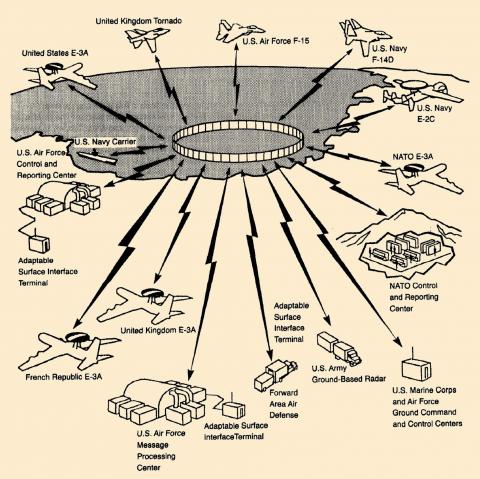
Image in the public domain provided by Wikimedia Commons
The systems are already in use by NATO members and the US’ other allies in the Pacific, the officer said, adding that information can be shared among all allies during combat operations should the need arise.
The US can direct all of its allies in the field to coordinate operations, the officer said.
The officer said some of the ROC Navy’s ships would use the Link-16 system, which will connect those ships to other vessels, land-based radar systems and other military installations.
Kidd-class destroyers, Cheng Kung-class frigates, Lafayette-class frigates and Knox-class frigates would all use the Link-16 system, the officer said, adding that missile-equipped patrol ships and support vessels would use the Link-11 system, which only connects with other vessels.
The officer said the deal was rushed through with coordination between the American Institute in Taiwan and military representatives stationed in the US, adding that shipment and installation of the systems are expected to be completed by June 2021.
The officer said that while the systems’ main components are to be acquired from the US, communications and photoelectric components would be produced by domestic manufacturers.
Democratic Progressive Party (DPP) Legislator Lo Chih-cheng (羅致政) said that control over information is at the heart of armed conflict.
An effective means to transmit information is fundamental to military strategy, Lo said, adding that the procurement of the Link-16 and Link-11 systems would greatly benefit the nation’s military.
DPP Legislator Wang Ding-yu (王定宇) said the process of military cooperation with allies in the region began late last year when Taiwan, Japan and the US communicated military aircraft identifier signal information with each other, adding that Japan included contingencies for a possible conflict in the Taiwan Strait among recent training activities.
Outcomes in modern military conflicts are decided within seconds, Wang said, adding that the systems would dramatically improve the military’s reaction time and allow for rapid coordination of movements.
Additional reporting by Aaron Tu

Tropical Storm Gaemi strengthened into a typhoon at 2pm yesterday, and could make landfall in Yilan County tomorrow, the Central Weather Administration (CWA) said yesterday. The agency was scheduled to issue a sea warning at 11:30pm yesterday, and could issue a land warning later today. Gaemi was moving north-northwest at 4kph, carrying maximum sustained winds near its center of up to 118.8kph and gusts of 154.8kph. The circumference is forecast to reach eastern Taiwan tomorrow morning, with the center making landfall in Yilan County later that night before departing from the north coast, CWA weather forecaster Kuan Shin-ping (官欣平) said yesterday. Uncertainty remains and

SEA WARNING LIKELY: The storm, named Gaemi, could become a moderate typhoon on Wednesday or Thursday, with the Taipei City Government preparing for flooding A tropical depression east of the Philippines developed into a tropical storm named Gaemi at 2pm yesterday, and was moving toward eastern Taiwan, the Central Weather Administration (CWA) said. Gaemi could begin to affect Taiwan proper on Tuesday, lasting until Friday, and could develop into a moderate typhoon on Wednesday or Thursday, it said. A sea warning for Gaemi could be issued as early as Tuesday morning, it added. Gaemi, the third tropical storm in the Pacific Ocean this typhoon season, is projected to begin moving northwest today, and be closest to Taiwan on Wednesday or Thursday, the agency said. Today, there would likely

DISRUPTIONS: The high-speed rail is to operate as normal, while several airlines either canceled flights or announced early departures or late arrivals Schools and offices in 15 cities and counties are to be closed today due to Typhoon Gaemi, local governments announced last night. The 15 are: Taipei, New Taipei City, Taoyuan, Tainan, Keelung, Hsinchu and Kaohsiung, as well as Yilan, Hualien, Hsinchu, Miaoli, Chiayi, Pingtung, Penghu and Lienchiang counties. People should brace for torrential rainfall brought by the storm, with its center forecast to make landfall on the east coast between tonight and tomorrow morning, the Central Weather Administration (CWA) said. The agency issued a sea warning for the typhoon at 11:30pm on Monday, followed by a land warning at 11:30am yesterday. As of

CASUALTY: A 70-year-old woman was killed by a falling tree in Kaohsiung as the premier warned all government agencies to remain on high alert for the next 24 hours Schools and offices nationwide are to be closed for a second day today as Typhoon Gaemi crosses over the nation, bringing torrential rain and whipping winds. Gaemi was forecast to make landfall late last night. From Tuesday night, its outer band brought substantial rainfall and strong winds to the nation. As of 6:15pm last night, the typhoon’s center was 20km southeast of Hualien County, Central Weather Administration (CWA) data showed. It was moving at 19kph and had a radius of 250km. As of 3pm yesterday, one woman had died, while 58 people were injured, the Central Emergency Operation Center said. The 70-year-old


 RSS
RSS