


British Prime Minister Theresa May yesterday said Britain would leave the EU’s single market in order to restrict immigration in a clean break from the bloc, but lawmakers can vote on the final deal.
“Brexit must mean control of the number of people coming from Europe and that is what we will deliver. What I am proposing cannot mean membership of the single market,” May said during a highly anticipated speech at London’s Lancaster House.
She added that Britain would seek a trade deal giving “the greatest possible access” to the market on its departure.
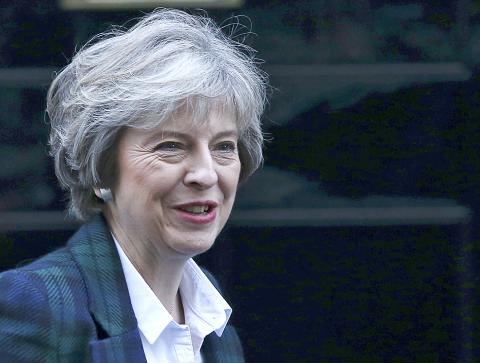
Photo: Reuters
The prime minister also announced that any divorce deal with the remaining EU members must be approved by votes in both chambers of Britain’s parliament.
Britain has two years to negotiate a break-up deal once May triggers Article 50 of the Lisbon Treaty, officially declaring the nation’s intention to quit, or face leaving with no agreement.
May has promised to trigger Article 50 by the end of March, and said that she believed a final settlement and trade deal could be simultaneously negotiated within the time frame.
Foreign partners doubt such a timetable, with Austrian Foreign Minister Hans Joerg Schelling saying Brexit would take five years.
“It is not clear if it will be possible to negotiate the UK’s exit from the EU and the terms of a future cooperation at the same time,” Schelling said.
Seeking to calm fears of a sudden jolt to the economy on abruptly leaving the EU, May said she would seek a “phased process of implementation.”
Her direction will be cheered by those who want to leave the EU, but cause dismay to those who fear the impact on Britain’s economy.
The British pound has endured a rocky ride since the vote last summer to leave the union.
However, sterling responded strongly to May’s speech, wiping out losses earlier in the week to stand at US$1.2340.
British Chancellor of the Exchequer Philip Hammond on Sunday warned that Britain might undercut the EU economically to remain competitive if it faces EU tariffs.
French Minister for the Economy and Finance Michel Sapin yesterday accused May’s government of making up its negotiating policy on the hoof.
“No one was prepared,” Sapin said. “You can see very well that they are improvising, with flip-flopping between accommodating positions... and harder positions.”

Taiwanese Olympic badminton men’s doubles gold medalist Wang Chi-lin (王齊麟) and his new partner, Chiu Hsiang-chieh (邱相榤), clinched the men’s doubles title at the Yonex Taipei Open yesterday, becoming the second Taiwanese team to win a title in the tournament. Ranked 19th in the world, the Taiwanese duo defeated Kang Min-hyuk and Ki Dong-ju of South Korea 21-18, 21-15 in a pulsating 43-minute final to clinch their first doubles title after teaming up last year. Wang, the men’s doubles gold medalist at the 2020 and 2024 Olympics, partnered with Chiu in August last year after the retirement of his teammate Lee Yang

FALSE DOCUMENTS? Actor William Liao said he was ‘voluntarily cooperating’ with police after a suspect was accused of helping to produce false medical certificates Police yesterday questioned at least six entertainers amid allegations of evasion of compulsory military service, with Lee Chuan (李銓), a member of boy band Choc7 (超克7), and actor Daniel Chen (陳大天) among those summoned. The New Taipei City District Prosecutors’ Office in January launched an investigation into a group that was allegedly helping men dodge compulsory military service using falsified medical documents. Actor Darren Wang (王大陸) has been accused of being one of the group’s clients. As the investigation expanded, investigators at New Taipei City’s Yonghe Precinct said that other entertainers commissioned the group to obtain false documents. The main suspect, a man surnamed
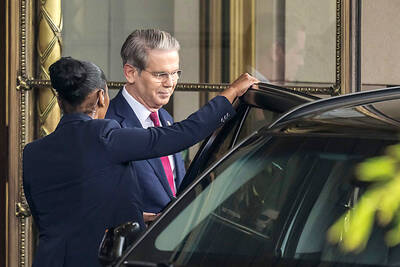
US Secretary of the Treasury Scott Bessent and US Trade Representative Jamieson Greer began talks with high-ranking Chinese officials in Switzerland yesterday aiming to de-escalate a dispute that threatens to cut off trade between the world’s two biggest economies and damage the global economy. The US delegation has begun meetings in Geneva with a Chinese delegation led by Chinese Vice Premier He Lifeng (何立峰), Xinhua News Agency said. Diplomats from both sides also confirmed that the talks have begun, but spoke anonymously and the exact location of the talks was not made public. Prospects for a major breakthrough appear dim, but there is

The number of births in Taiwan fell to an all-time monthly low last month, while the population declined for the 16th consecutive month, Ministry of the Interior data released on Friday showed. The number of newborns totaled 8,684, which is 704 births fewer than in March and the lowest monthly figure on record, the ministry said. That is equivalent to roughly one baby born every five minutes and an annual crude birthrate of 4.52 per 1,000 people, the ministry added. Meanwhile, 17,205 deaths were recorded, resulting in a natural population decrease of 8,521, the data showed. More people are also leaving Taiwan, with net


 RSS
RSS