


China sailing its aircraft carrier near Taiwan has highlighted the need for the nation to go ahead with a plan to build its own submarines, Minister of National Defense Feng Shih-kuan (馮世寬) said yesterday.
The indigenous submarine project would not only protect the nation’s territorial security, but also allow Taiwan to contribute to regional security, Feng said at the opening of an exhibition on the history of the navy’s submarine fleet.
In what was seen by many as saber-rattling by Beijing, the Liaoning, China’s first aircraft carrier, sailed south in the Pacific Ocean off Taiwan’s eastern coast on Christmas Day before entering the South China Sea.
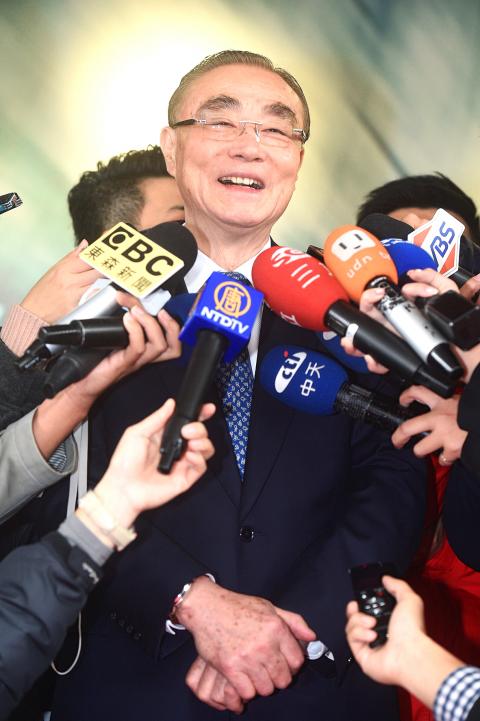
Photo: George Tsorng, Taipei Times
On Wednesday, the Liaoning passed through the Taiwan Strait on its way back to its base in northeastern China after conducting training exercises in the South China Sea.
The last time the aircraft carrier transited the Taiwan Strait was in November 2013.
At the ceremony, Feng said that the Ministry of National Defense publicized information to inform the public on the Liaoning’s movements, but stressed that “no special situations” were detected.
According to standing plans for the manufacturing of submarines, the ministry has been negotiating with CSBC Corp, Taiwan (台灣國際造船), the intended contractor, the ministry said, adding that if all goes according to plan, a prototype for the first submarines would undergo combat trials in 2024 and enter service in 2025.
Separately yesterday, former American Institute in Taiwan director Douglas Paal told the Central News Agency that recent aerial and maritime exercises by China’s armed forces near Taiwan were an example of Beijing showcasing its growing military strength and not a show of force directed at Taipei.
“As long as China’s military capabilities continue to grow, we expect to see Beijing expand its maritime activities in the days ahead,” Paal said.
Asked about saber-rattling by Beijing and demands that US president-elect Donald Trump abide by the “one China” policy, Paal said that as Trump has yet to assume office, all China can do is to issue stern statements to express its displeasure.
However, regarding Beijing’s recent threat to “take revenge” if Trump moves away from the “one China” policy, Paal said that the warning is real.
Asked if he expected Beijing to continue its effort to poach Taiwan’s diplomatic allies, such as the severing of diplomatic relations with Sao Tome and Principe on Dec. 20, Paal said the incident with the west African nation was probably driven by interests other than China’s desire to punish Taiwan.
Additional reporting by Aaron Tu

NO HUMAN ERROR: After the incident, the Coast Guard Administration said it would obtain uncrewed aerial vehicles and vessels to boost its detection capacity Authorities would improve border control to prevent unlawful entry into Taiwan’s waters and safeguard national security, the Mainland Affairs Council (MAC) said yesterday after a Chinese man reached the nation’s coast on an inflatable boat, saying he “defected to freedom.” The man was found on a rubber boat when he was about to set foot on Taiwan at the estuary of Houkeng River (後坑溪) near Taiping Borough (太平) in New Taipei City’s Linkou District (林口), authorities said. The Coast Guard Administration’s (CGA) northern branch said it received a report at 6:30am yesterday morning from the New Taipei City Fire Department about a

IN BEIJING’S FAVOR: A China Coast Guard spokesperson said that the Chinese maritime police would continue to carry out law enforcement activities in waters it claims The Philippines withdrew its coast guard vessel from a South China Sea shoal that has recently been at the center of tensions with Beijing. BRP Teresa Magbanua “was compelled to return to port” from Sabina Shoal (Xianbin Shoal, 仙濱暗沙) due to bad weather, depleted supplies and the need to evacuate personnel requiring medical care, the Philippine Coast Guard (PCG) spokesman Jay Tarriela said yesterday in a post on X. The Philippine vessel “will be in tiptop shape to resume her mission” after it has been resupplied and repaired, Philippine Executive Secretary Lucas Bersamin, who heads the nation’s maritime council, said

CHINA POLICY: At the seventh US-EU Dialogue on China, the two sides issued strong support for Taiwan and condemned China’s actions in the South China Sea The US and EU issued a joint statement on Wednesday supporting Taiwan’s international participation, notably omitting the “one China” policy in a departure from previous similar statements, following high-level talks on China and the Indo-Pacific region. The statement also urged China to show restraint in the Taiwan Strait. US Deputy Secretary of State Kurt Campbell and European External Action Service Secretary-General Stefano Sannino cochaired the seventh US-EU Dialogue on China and the sixth US-EU Indo-Pacific Consultations from Monday to Tuesday. Since the Indo-Pacific consultations were launched in 2021, references to the “one China” policy have appeared in every statement apart from the

More than 500 people on Saturday marched in New York in support of Taiwan’s entry to the UN, significantly more people than previous years. The march, coinciding with the ongoing 79th session of the UN General Assembly, comes close on the heels of growing international discourse regarding the meaning of UN Resolution 2758. Resolution 2758, adopted by the UN General Assembly in 1971, recognizes the People’s Republic of China (PRC) as the “only lawful representative of China.” It resulted in the Republic of China (ROC) losing its seat at the UN to the PRC. Taiwan has since been excluded from


 RSS
RSS