

After China’s sole aircraft carrier yesterday morning sailed out of the Taiwan Strait and continued north on the Chinese side of the Strait’s median line, military analysts said plans are under way to upgrade Taiwan’s missile capabilities to counter military threats.
“Our armed forces were activated and continue to closely monitor the situation. There were no discernible hostile actions and the public can rest assured that national security is being maintained,” the Ministry of National Defense said in a statement.
The Liaoning aircraft carrier and its escorts entered the southern end of the Taiwan Strait at 7am on Wednesday, sailed north on the Chinese side of the median line and exited the Strait at 6:30am yesterday, military officials said.
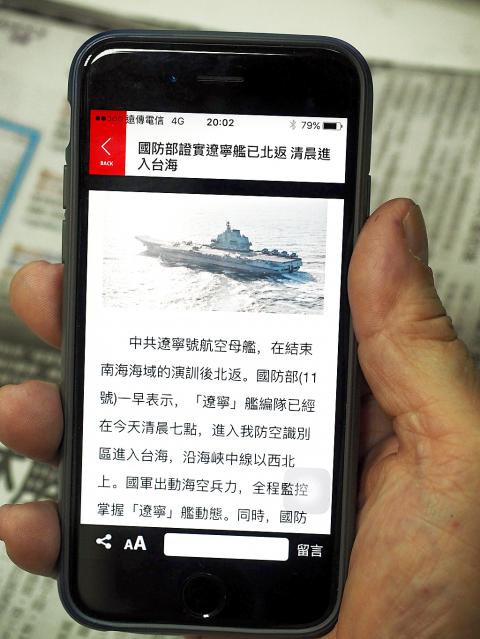
Photo: EPA
The Soviet-built Liaoning, returning from exercises in the disputed South China Sea, had “operated meticulously” during the navigation of the Taiwan Strait, Chinese People’s Liberation Army (PLA) Navy spokesman Liang Yang (梁陽) said.
The Liaoning carrier group, “visiting the South China Sea to conduct cross-maritime region drills and tests, has passed through the Taiwan Strait and continues with its further duties,” Liang said in a short statement on the Chinese Ministry of National Defense’s Web site.
The ships traveled at less than 12 knots per hour (22.2kph), resulting in their passage through the Taiwan Strait taking longer than estimated, naval experts said, adding that warships commonly sail at about 20 to 30 knots per hour.
Some experts said the Liaoning might have deliberately slowed down, while others said the Chinese navy was still conducting trials of the aircraft carrier.
Taiwanese warships, led by a Cheng Kung-class frigate and a Lafayette-class frigate, and military aircraft — including one E-2T airborne early warning aircraft, F-16s and Indigenous Defense Fighters — shadowed the Liaoning during its passage through the Strait, military officials said.
China is reportedly preparing to commission a second aircraft carrier by 2020, while ministry and Chungshan Institute of Science and Technology programs are reportedly under way to upgrade the nation’s missile capabilities to counter the growing Chinese threat.
Local media quoted a senior military official, who spoke on condition of anonymity, as saying that the ministry has readjusted its missile strategy into a “multilayer deterrent” framework composed of the Hsiung Feng, Tien Kung and Tien Chien missile systems.
Defense scientists at the institute are working to improve the range, guidance systems and anti-tracking mechanisms of all three missiles systems, the official said.
The institute reportedly earlier this month successfully tested a new variant of the Hsiung Feng III supersonic anti-ship missile with an extended range of 400km off the nation’s southeast cost.
Dubbed a “carrier killer,” the Hsiung Feng III is reportedly capable of reaching speeds up to three times the speed of sound, skim the surface of the sea to avoid detection and penetrate the thick metal hulls of most warships.
The institute has also reportedly boosted the range of the Hsiung Feng II subsonic anti-ship missile from 120km to 250km.
The military is focused on testing the combined deployment of the Hsiung Feng II and III missiles in response to hostile maneuvers by enemy warships, the official said.
Development is also reportedly under way to increase the range of the Tien Chien missile to 90km and allow Indigenous Defense Fighters to carry four, instead of the current two.
Taiwanese missile systems are one way to counter China’s naval and aerial threats, analysts said, adding that the ministry should accelerate the implementation of an indigenous submarine program and develop stealth technologies for warships.
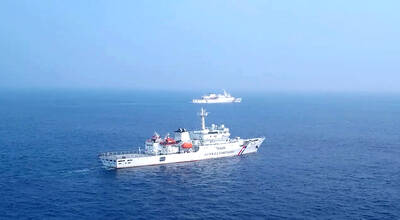
PATROL PARTNERS: The ‘Chiayi’ and the ‘Penghu’ departed for a two-day joint patrol of Palau’s exclusive economic zone, the CGA’s second diplomatic visit to the country The Coast Guard Administration (CGA) set a record for its southernmost deployment of a coast guard vessel as the vessels Chiayi and the Penghu reached Palau’s Pulo Anna Island on Saturday in a cooperative exercise between the two countries. The island, about 217 nautical miles (401km) southwest of Koror in the Palauan state of Sonsorol and 1,220 nautical miles from Taiwan’s southernmost point, Oluanpi (鵝鑾鼻), is the furthest south a CGA vessel has sailed. The two vessels are in Palau for the coast guard’s second diplomatic visit to the country. They docked at Malakal Harbor on Tuesday last week. The coast guard
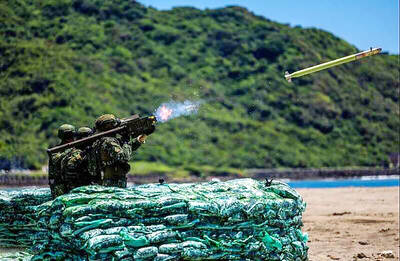
BATCH 1: The military has plans to assign the weapons to the army to defend Taiwan proper, as well as outlying islands and the navy for the Marine Corps, the official said Taiwan is to receive 500 Stinger missiles and 178 launchers from the US by the end of the year, the first batch under a planned two-stage acquisition totaling 2,621 missiles and 763 launchers, a defense official said yesterday on condition of anonymity. The portable missiles would play a vital role in the nation’s air defense capabilities, the source said. The army plans to deploy 2,235 missiles and 657 launchers to defend Taiwan proper and outlying islands, they said, citing military documents. The navy is allotted 295 missiles and 85 launchers to arm the Marine Corps and some surface vessels that lack air defense

The European Parliament on Wednesday adopted a recommendation on EU-China political relations that rejected China’s efforts to restrict Taiwan’s participation in international organizations and exchanges. The recommendation, addressed to the European Council, the European Commission and EU High Representative for Foreign Affairs and Security Policy Kaja Kallas, includes several references to EU-Taiwan relations and expresses support for closer ties, saying they would bring positive benefits and have strategic importance. Describing Taiwan as a valuable partner in trade and technology, the European Parliament said it “rejects China’s attempts to coerce international organizations, third countries and other actors into restricting Taiwan’s international participation and
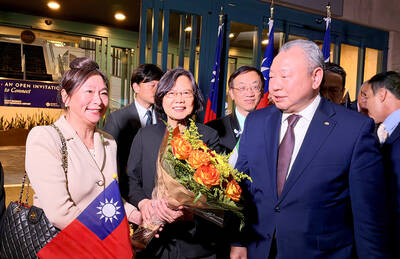
Former president Tsai Ing-wen (蔡英文) on Monday arrived in San Francisco, receiving a warm welcome from hundreds of overseas Taiwanese as she launched a week-long visit. Accompanied by Representative to the US Alexander Yui (俞大?), and head of Taiwan’s San Francisco office Wu Chih-hsiang (伍志翔), Tsai arrived at her hotel, waving, smiling and giving high-fives to Taiwanese compatriots amid cheers of “Taiwan’s democracy involves you and me” to welcome her to the San Francisco Bay Area. It is Tsai’s first visit to the US since she left office in May 2024 after serving two four-year terms as president. Tsai is today to deliver


 RSS
RSS