


More than 600 people were injured by Typhoon Megi, which made landfall on the east coast on Tuesday afternoon.
The Central Weather Bureau (CWB) lifted both land and sea warnings at 5:30pm yesterday after Megi weakened into a tropical storm and landed on China’s Fujian Province.
CWB forecaster Hsieh Ming-chang (謝明昌) said that although the nation was no longer under the storm’s coverage, wind speed in coastal areas still reached level 8 on the Beaufort scale.
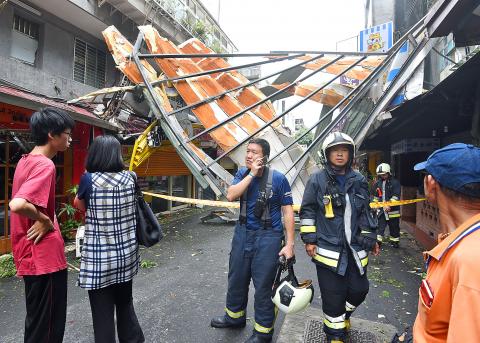
Photo: Liao Chen-huei, Taipei Times
Heavy precipitation continued in some southern regions due to lingering clouds from the storm, which should ease today, he said.
He added that a low-pressure system that is about 500km southeast of Taiwan is likely to move toward the nation between tomorrow and Saturday, which could affect the weather in Hualien, Taitung and southern Taiwan, he said.
Meanwhile, Tropical Storm Chaba formed early yesterday morning, which the bureau forecast would move near Okinawa, Japan, by Monday.

Photo: CNA
Hsieh said the storm was still about 2,860km from Taiwan.
“We are monitoring the movement of Chaba and the force of the Pacific high-pressure system, which would determine when the storm would turn north and in which direction it would go,” he said.
Statistics from the Central Emergency Operation Center as of 5:30pm yesterday showed that Megi left four people dead and 622 injured in the past two days, with more than 4,000 people remaining in shelters.
A total of 2,402 households were still without water supply.
Telecom service providers said they had mobilized thousands of engineers to repair about 13,000 base stations that were damaged. A total of 5,384 base stations had not resumed normal functions.
As of 9:53pm yesterday, 359,927 households were still without power, state-run Taiwan Power Co (台電) said.
The Taiwan Railways Administration (TRA) and Taiwan High Speed Rail Corp resumed train services yesterday afternoon, although TRA canceled operations of the Alishan Forest Railway, as well as the Pingsi (平溪) and Jiji (集集) branch lines.
More than 750 flights departed from the Taiwan Taoyuan International Airport yesterday, as the nation’s largest airport activated a plan to transport about 12,000 passengers whose flights were canceled on Tuesday.
Statistics from the Civil Aeronautics Administration (CAA) showed that 234 domestic flights and 58 international flights were canceled yesterday.
One domestic and 112 international flights were also delayed.
The agency said that it was investigating whether EVA Air (長榮航空) had violated aviation rules when it dispatched flights on Tuesday. Netizens have accused the nation’s second-largest airline of forcing pilots to land under inclement weather.
The standards that the airline company set to dispatch or land a flight on a typhoon day, as well as the amount of fuel that its airplanes were carrying and the number of hours its cabin crew were working would all be under scrutiny, the CAA said.
EVA had 45 flights that were scheduled to land at the Taoyuan Airport on Tuesday. Thirty flights landed at the airport, including those returning to Taoyuan after first landing in Hong Kong or Okinawa. In addition, seven flights landed in Hong Kong, seven in Taichung and one in Macau, the agency said.
The CAA said the airline is supposed to choose at least two backup airports if its flights could not land at their target destinations.
EVA yesterday issued a statement denying the allegations, adding that it would sue individuals spreading unsubstantiated comments online.

SILENCING CRITICS: In addition to blocking Taiwan, China aimed to prevent rights activists from speaking out against authoritarian states, a Cabinet department said The Ministry of Foreign Affairs (MOFA) yesterday condemned transnational repression by Beijing after RightsCon, a major digital human rights conference scheduled to be held in Zambia this week, was abruptly canceled due to Chinese pressure over Taiwanese participation. This year’s RightsCon, the world’s largest conference discussing issues “at the intersection of human rights and technology,” was scheduled to take place from tomorrow to Friday in Lusaka, and expected to draw 2,600 in-person attendees from 150 countries, along with 1,100 online participants. However, organizers were forced to cancel the event due to behind-the-scenes pressure from China, the ministry said, expressing its “strongest condemnation”

DELAYED BUT DETERMINED: The president’s visit highlights Taiwan’s right to international engagement amid regional pressure from China President Willaim Lai (賴清德) yesterday arrived in Eswatini, more than a week after his planned visit to Taiwan’s sole African ally was suspended because of revoked overflight permits. “The visit, originally scheduled for April 22, was postponed due to unforeseen external factors,” Lai wrote on social media. “After several days of careful arrangements by our diplomatic and national security teams, we successfully arrived today.” Lai said he looked forward to further deepening Taiwan-Eswatini relations through closer cooperation in the economy, agriculture, culture and education, as well as advancing the nation’s international partnerships. The president was initially scheduled to arrive in time to celebrate
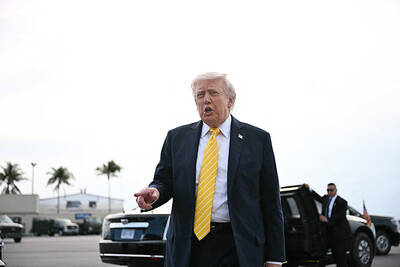
Iran’s Islamic Revolutionary Guard Corp (IRGC) yesterday said the US faced a choice between an “impossible” military operation or a “bad deal” with Tehran, after US President Donald Trump disparaged Iran’s latest peace proposal. Negotiations between the two countries have been deadlocked since a ceasefire came into effect on April 8, with only one round of direct peace talks held so far. Iran’s Tasnim and Fars news agencies reported that Tehran had submitted a 14-point proposal to mediator Pakistan, but Trump was quick to cast doubt on it. “I will soon be reviewing the plan that Iran has just sent to us, but

A group affiliated with indicted Chinese immigrant Xu Chunying (徐春鶯) is to be dissolved for monitoring Chinese immigrants in Taiwan, a source said yesterday. Xu, the secretary-general of the Cross-Strait Marriage and Family Service Alliance, was indicted on March 24 on charges of violating the Anti-Infiltration Act (反滲透法). The alliance “illegally monitored" Chinese immigrants living in Taiwan on behalf of the Chinese Communist Party (CCP) and the Ministry of the Interior is expected to dissolve the organization in the coming days under provisions of the Civil Associations Act (人民團體法), the source said. Xu, who married a Taiwanese in 1993 and became a Republic


 RSS
RSS