


An uncrewed SpaceX Falcon 9 rocket exploded on Thursday on a launch pad during a test in Florida, destroying a satellite that Facebook planned to use to beam high-speed Internet to Africa.
The blast at Cape Canaveral caused no injuries, but it marked a setback for the California-based private space firm and its founder, Internet entrepreneur Elon Musk, who wants to revolutionize the launch industry by making rocket components reusable.
“Loss of Falcon vehicle today during propellant fill operation,” Musk tweeted. “Originated around upper stage oxygen tank. Cause still unknown. More soon.”
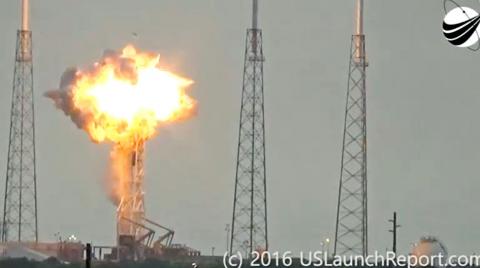
Photo: Reuters
Dramatic footage broadcast by ABC News showed the rocket burst into a roaring ball of flame amid what appeared to be a succession of blasts — sending its payload tumbling to the ground as a dense plume of black smoke filled the air.
“At approximately 9:07am ET [US Eastern Time], during a standard pre-launch static fire test for the Amos-6 mission, there was an anomaly at SpaceX’s Cape Canaveral Space Launch Complex 40 resulting in loss of the vehicle,” the firm said. “Per standard operating procedure, the pad was clear and there were no injuries.”
The explosion destroyed the Israeli communications satellite that the Falcon 9 was to deliver into orbit today — drawing a dismayed reaction from Facebook chief Mark Zuckerberg.
“As I’m here in Africa, I’m deeply disappointed to hear that SpaceX’s launch failure destroyed our satellite that would have provided connectivity to so many entrepreneurs and everyone else across the continent,” Zuckerberg said on Facebook.
Facebook was contracted to use the Amos-6 to provide broadband Internet coverage for large parts of sub-Saharan Africa and other remote parts of the world.
A NASA spokeswoman told reporters that emergency services at the nearby Kennedy Space Center were monitoring the situation and conducting air-quality tests to ensure there was no threat to the health of staff.
Officials at the center advised workers to remain inside until further notice, but Brevard County Emergency Management said there was no threat to the public from the incident.
The Amos-6 was the heaviest payload to date for a SpaceX rocket, with an estimated value of between US$200 million and US$300 million, said John Logsdon, former director of the Space Policy Institute at George Washington University.

‘NO SECURITY RISK’: The Railway Bureau reassured the public that the technicians’ activities were limited to technical guidance and did not involve sensitive systems The Railway Bureau yesterday said it had invited eight Chinese technicians to assist with an airport MRT construction project. The bureau issued the confirmation after an Internet user said Chinese nationals had entered the construction zone of Taiwan Taoyuan International Airport’s Terminal 3 project. They asked why “individuals from an enemy state” were allowed access to such a major national infrastructure project, which raised serious concerns over Taiwan’s industrial safety, sensitive systems and information security. The bureau’s Northern Region Engineering Branch Office said subcontractor Taiwan Handle Industrial Co (台灣手把工業) of the Taoyuan airport MRT’s “Contract No. CU05 Project A14 Station Civil, MEP &

A US uncrewed surface vessel (USV) encountered multiple Chinese warships during an autonomous transit of the Taiwan Strait, US defense company Seasats said in a statement on Wednesday. Seasats announced that a Lightfish USV had completed the first autonomous transit of the Taiwan Strait. Over five days, the USV traversed the entire length of the Strait while constantly monitoring surface vessel traffic, the company said. The Lightfish encountered multiple Chinese warships, one of which was a Chinese People’s Liberation Army Navy (PLAN) Type 056 corvette, it said. The Chinese vessels were operating “well within Taiwan’s exclusive economic zone without transmitting their identity via the
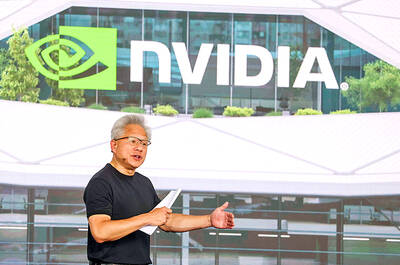
‘BOOMING’: ’ The number of partners we have here is incredible. You can see from their stock prices. They’re doing so well, they’re so happy,’ Jensen Huang said Nvidia Corp’s spending in Taiwan has ballooned to about US$150 billion a year, 10 times the US$10 billion to US$15 billion the company spent five years ago, Nvidia chief executive officer Jensen Huang (黃仁勳) said yesterday, suggesting Taiwan’s strategic importance in the global artificial intelligence (AI) supply chain. “Taiwan is the epicenter of the AI revolution. This is where the chips come, packaging comes. This is where the systems are made. This is where AI supercomputers were created,” Huang said at a meeting for the company’s employees in Beitou-Shilin Technology Park (北投士林科技園區) in Taipei, the planned site of Nvidia’s Taipei headquarters. “Taiwan
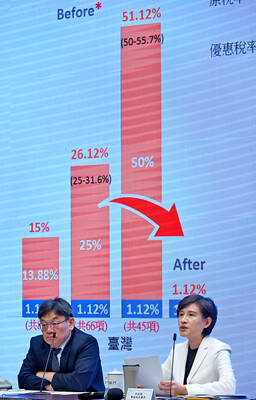
GREATER REACH? Auto parts and wood products would face tariffs of up to 15%, matching those targeting the EU, Japan and South Korea, Vice Premier said The US has announced that preferential tariff treatment for Taiwan’s non-semiconductor Section 232 goods would take effect retroactively from May 1, the Executive Yuan said yesterday. The US government yesterday posted a notice on the Federal Register’s public inspection Web site previewing tariff concessions for Taiwan under a memorandum of understanding (MOU) on Taiwan-US investment after two months of negotiations. The MOU signed on Jan. 15 stipulated three major preferential tariff arrangements: a 15 percent “reciprocal” tariff rate for Taiwan without stacking most-favored nation (MFN) rates; preferential Section 232 treatment for semiconductors and related products; and preferential Section 232 treatment for non-semiconductor


 RSS
RSS