


President Tsai Ing-wen (蔡英文) yesterday issued a formal apology on behalf of the government to Aborigines for the discrimination and neglect they suffered over the past 400 years.
The apology was made after a ceremony in front of the Presidential Office Building in Taipei, where representatives of Taiwan’s 16 recognized Aboriginal communities gathered on Indigenous People’s Day.
Following a Paiwan tradition, the representatives announced their arrival by singing songs and burning stalks of foxtail millet.
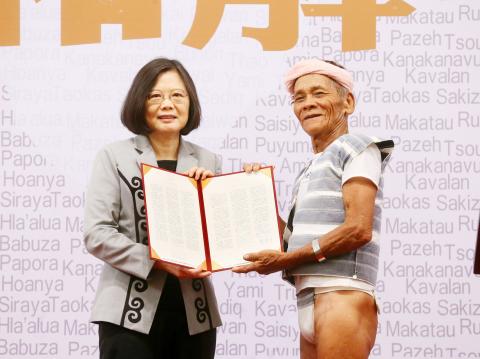
Photo: EPA/Office of the president
Tsai then greeted them at the entrance of the Presidential Office Building and invited them in, where a Bunun blessing ceremony was held and prayers were offered by six Christian priests of Aboriginal heritage.
In her apology on behalf of the government, Tsai said it was a further step toward protecting the social status of Aborigines and promoting their development in education, culture, social welfare and economic development, as laid out in an article of the Constitution that was added on Aug. 1, 1994.
The article also abolished the widely used term shanbao (山胞, “mountain fellow”) to refer to Aborigines, after they campaigned against it for decades because of racist connotations, Tsai said.
“For the unfair treatment and pain suffered by all of you in the past 400 years, I apologize on behalf of the government,” Tsai said. “I believe that even now, there are still some people who think there is no need for such an apology, but that is the main reason why I need to make this apology on behalf of the government today.”
Tsai also announced the establishment of a Presidential Office “commission for historical and transitional justice,” which she is to head.
The commission is to hold discussions with representatives of Aboriginal communities on issues such as national policies toward Aborigines so that their voices can be heard, she said.
Tsai added that the Cabinet would seek to introduce a basic law for Aborigines, revive the historic memories of Aboriginal communities and pay attention to their education, health and economic development.
She said a legal service center would be created to deal with the increasing number of conflicts between existing laws and traditional Aboriginal practices, such as the hunting of non-protected animals.
Tsai also said that before the publication of a final report, she would re-examine a government decision to store nuclear waste on Orchid Island (Lanyu, 蘭嶼) and would offer compensation to members of the Tao community who live there.
She called for efforts to ensure better public understanding of the history and culture of Taiwan’s various ethnic groups to help achieve reconciliation and prosperity for all, and promote justice, diversity and equality.
The apology to Aborigines was one of Tsai’s campaign promises, which she said would signal respect for the early inhabitants of the nation and a move toward solving related issues.
An 80-year-old Tao elder from Orchid Island responded on behalf of the Aboriginal representatives, saying that he hoped the government’s apology on Indigenous People’s Day would mark the beginning of peace and reconciliation.
On behalf of the 16 Aboriginal communities, he accepted a printed copy of Tsai’s apology and offered her foxtail millet in a traditional gesture.

‘NO SECURITY RISK’: The Railway Bureau reassured the public that the technicians’ activities were limited to technical guidance and did not involve sensitive systems The Railway Bureau yesterday said it had invited eight Chinese technicians to assist with an airport MRT construction project. The bureau issued the confirmation after an Internet user said Chinese nationals had entered the construction zone of Taiwan Taoyuan International Airport’s Terminal 3 project. They asked why “individuals from an enemy state” were allowed access to such a major national infrastructure project, which raised serious concerns over Taiwan’s industrial safety, sensitive systems and information security. The bureau’s Northern Region Engineering Branch Office said subcontractor Taiwan Handle Industrial Co (台灣手把工業) of the Taoyuan airport MRT’s “Contract No. CU05 Project A14 Station Civil, MEP &

A US uncrewed surface vessel (USV) encountered multiple Chinese warships during an autonomous transit of the Taiwan Strait, US defense company Seasats said in a statement on Wednesday. Seasats announced that a Lightfish USV had completed the first autonomous transit of the Taiwan Strait. Over five days, the USV traversed the entire length of the Strait while constantly monitoring surface vessel traffic, the company said. The Lightfish encountered multiple Chinese warships, one of which was a Chinese People’s Liberation Army Navy (PLAN) Type 056 corvette, it said. The Chinese vessels were operating “well within Taiwan’s exclusive economic zone without transmitting their identity via the

‘BOOMING’: ’ The number of partners we have here is incredible. You can see from their stock prices. They’re doing so well, they’re so happy,’ Jensen Huang said Nvidia Corp’s spending in Taiwan has ballooned to about US$150 billion a year, 10 times the US$10 billion to US$15 billion the company spent five years ago, Nvidia chief executive officer Jensen Huang (黃仁勳) said yesterday, suggesting Taiwan’s strategic importance in the global artificial intelligence (AI) supply chain. “Taiwan is the epicenter of the AI revolution. This is where the chips come, packaging comes. This is where the systems are made. This is where AI supercomputers were created,” Huang said at a meeting for the company’s employees in Beitou-Shilin Technology Park (北投士林科技園區) in Taipei, the planned site of Nvidia’s Taipei headquarters. “Taiwan
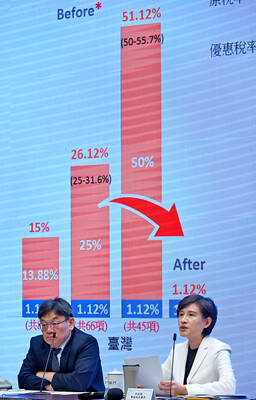
GREATER REACH? Auto parts and wood products would face tariffs of up to 15%, matching those targeting the EU, Japan and South Korea, Vice Premier said The US has announced that preferential tariff treatment for Taiwan’s non-semiconductor Section 232 goods would take effect retroactively from May 1, the Executive Yuan said yesterday. The US government yesterday posted a notice on the Federal Register’s public inspection Web site previewing tariff concessions for Taiwan under a memorandum of understanding (MOU) on Taiwan-US investment after two months of negotiations. The MOU signed on Jan. 15 stipulated three major preferential tariff arrangements: a 15 percent “reciprocal” tariff rate for Taiwan without stacking most-favored nation (MFN) rates; preferential Section 232 treatment for semiconductors and related products; and preferential Section 232 treatment for non-semiconductor


 RSS
RSS