


The pilot who flew missing Malaysia Airlines Flight MH370, which is believed to have gone off route and crashed in the Indian Ocean, conducted a simulation of a similar path just weeks prior, New York magazine reported.
Zaharie Ahmad Shah, the airman at the helm of the plane, used an elaborate home-built flight simulator to steer himself over the Strait of Malacca and into the remote southern Indian Ocean, a course with striking resemblance to the route MH370 is believed to have taken.
The finding, which casts a shadow of suspicion over the 53-year-old pilot, was published on Friday by New York magazine, which said it obtained a confidential document from Malaysian police investigating the incident.
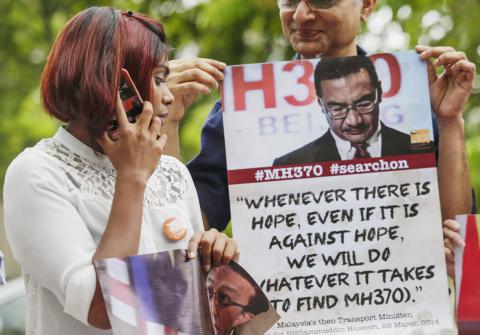
Photo: EPA
According to the document, the FBI recovered deleted data points from the flight simulator on Zaharie’s hard drive.
“We found a flight path that lead to the Southern Indian Ocean among the numerous other flight paths charted on the flight simulator that could be of interest,” the document said, according to the magazine.
Although the paths are similar, the simulated flight’s endpoint is about 1,450km from the area where the plane is believed to have gone down.
The Boeing 777 vanished for unknown reasons on March 8, 2014, en route from Kuala Lumpur to Beijing with 239 people onboard, mostly Chinese nationals. It remains one of the greatest mysteries in aviation history.
The Malaysian government continues to maintain that it does not know what caused the incident.
At the time Zaharie, an opposition supporter, came under scrutiny amid unsubstantiated reports that he was upset over a jail sentence handed to Malaysian opposition leader Anwar Ibrahim hours before the plane took off or was suicidal due to personal problems.
His family and friends strongly reject such claims as baseless.
News of the simulated flight came the same day that Malaysia, Australia and China, the three nations leading the search, said that hope of finding the flight’s final resting place is “fading” and that the massive hunt will be suspended if nothing turns up in the suspected crash zone.
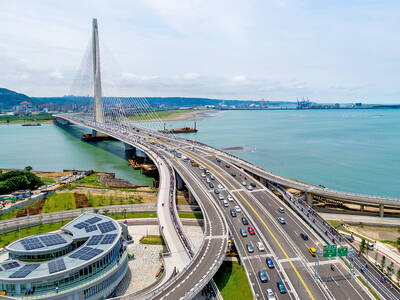
The Ministry of Transportation and Communications yesterday inaugurated the Danjiang Bridge across the Tamsui River in New Taipei City, saying that the structure would be an architectural icon and traffic artery for Taiwan. Feted as a major engineering achievement, the Danjiang Bridge is 920m long, 211m tall at the top of its pylon, and is the longest single-pylon asymmetric cable-stayed bridge in the world, the government’s Web site for the structure said. It was designed by late Iraqi-British architect Zaha Hadid. The structure, with a maximum deck of 70m, accommodates road and light rail traffic, and affords a 200m navigation channel for boats,
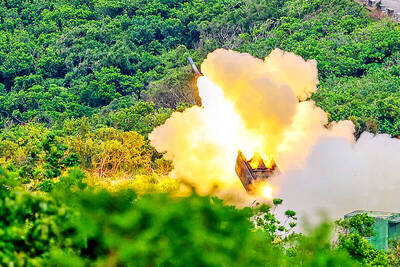
PRECISION STRIKES: The most significant reason to deploy HIMARS to outlying islands is to establish a ‘dead zone’ that the PLA would not dare enter, a source said A High Mobility Artillery Rocket System (HIMARS) would be deployed to Penghu County and Dongyin Island (東引) in Lienchiang County (Matsu) to force the Chinese military to retreat at least 100km from the coastline, a military source said yesterday. Taiwan has been procuring HIMARS and Army Tactical Missile Systems (ATACMS) from the US in batches. Once all batches have been delivered, Taiwan would possess 111 HIMARS units and 504 ATACMS, which have a range of 300km. Considering that “offense is the best defense,” the military plans to forward-deploy the systems to outlying islands such as Penghu and Dongyin so that

WHAT WAS ALL THAT FOR? Jaw Shaw-kong said that Cheng Li-wen had pushed for more drastic cuts and attacked him, just for the outcome to be nearly identical to his bill The legislature yesterday passed a supplementary budget bill to fund the purchase of separate packages of US military equipment, with the combined amount of spending capped at NT$780 billion (US$24.8 billion). The Chinese Nationalist Party (KMT) and Taiwan People’s Party (TPP) used their legislative majority to pass the bill, which runs until 2033 and has two main funding provisions. One was for NT$300 billion of arms sales already approved by the US for Taiwan on Dec. 17 last year, the other was for NT$480 billion for another arms package expected to be announced by Washington. The bill, which fell short of the NT$1.25

‘CLEAR MESSAGE’: The bill would set up an interagency ‘tiger team’ to review sanctions tools and other economic options to help deter any Chinese aggression toward Taiwan US Representative Young Kim has introduced a bill to deter Chinese aggression against Taiwan, calling for an interagency “tiger team” to preplan coordinated sanctions and economic measures in response to possible Chinese military or political action against Taiwan. “[Chinese President] Xi Jinping [習近平] has directed the People’s Liberation Army to be ready to invade Taiwan by 2027. China has a plan. America should have one too,” Kim said in a news release on Thursday last week. She introduced the “Deter PRC [People’s Republic of China] aggression against Taiwan act” to “ensure the US has a coordinated sanctions strategy ready should


 RSS
RSS