


Nearly 700 heads of states, diplomats and foreign dignitaries from 59 countries around the world are to attend president-elect Tsai Ing-wen’s (蔡英文) inauguration today, the Ministry of Foreign Affairs said yesterday.
At a routine news conference yesterday morning, ministry spokeswoman Eleanor Wang (王珮玲) said the 59 include Taiwan’s 22 diplomatic allies and 37 that do not have formal ties with Taipei.
“From my understanding, the number of foreign dignitaries attending Tsai’s inauguration ceremony surpasses those in previous years,” Wang said.
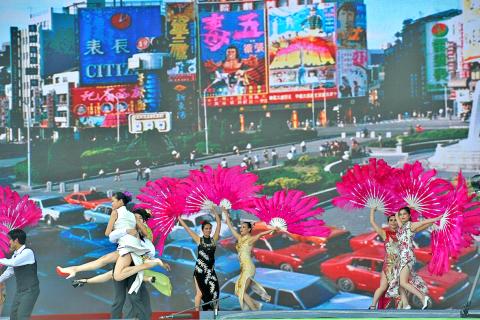
Photo: CNA
She said the invitation process this year went “very smoothly.”
The ministry said the US delegation is to be led by former US trade representative Ron Kirk, who is to be accompanied by former US deputy secretary of state John Negroponte, former US Department of State deputy spokesman Alan Romberg, American Institute in Taiwan (AIT) Chairman Raymond Burghardt and AIT Director Kin Moy.
The Holy See — the nation’s only European diplomatic ally — is sticking with precedent and sending its Apostolic Nuncio to Japan, Archbishop Joseph Chennoth.
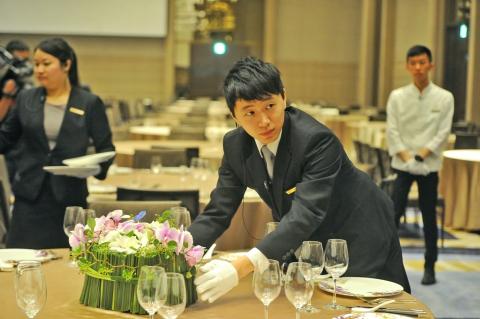
Photo: CNA
Chennoth and Vatican’s charge d’affaires ad interim to Taiwan, Monsignor Sladan Cosic, are also to attend Tsai’s state banquet tonight at Taipei’s Marriott Hotel.
Eighteen delegations from other European nations, including the UK, France, Germany, Italy, Austria, Denmark, Ireland, Slovakia and Hungary, have arrived for a total of 48 people.
One delegation, led by European Parliament-Taiwan Friendship Group vice chairman Dominique Riquet, includes former Dutch prime minister Andreas van Agt, former Slovakian prime minister Iveta Radicova and All-Party Parliamentary British-Taiwanese Group co-chairman Lord Faulkner of Worcester.
As for Japan, a delegation of 252 people arrived in Taipei on Wednesday, including Interchange Association, Japan President Tadashi Imai, as well as chief executive and vice chairman of the Japan-Republic of China (ROC) Diet Members’ Consultative Council, Furuya Keiji and Eto Seishiro.
The leaders of Taiwan’s six Asia-Pacific allies are attending: Marshallese President Hilda Heine, Nauruan President Baron Waqa, Tuvaluan Prime Minister Enele Sosene Sopoaga, Palauan President Tommy Remengesau, Solomon Islands Governor General Frank Ofagioro Kabui and Kiribati President Taneti Maamau.
Other Asian-Pacific states, including South Korea, Australia, Indonesia, the Philippines, Singapore and India, have all sent delegates to the event.
Leaders and high-level officials of the nation’s diplomatic allies in Africa, Latin America and the Caribbean will also attend the ceremony, including Swazi King Mswati III, Burkinabe Prime Minister Paul Kaba Thieba, Sao Tomean Minister of Foreign Affairs Manuel Salvador dos Ramos, Paraguayan President Horacio Cartes, Saint Kitts and Nevis Prime Minister Timothy Harris, Nicaraguan Vice President Moises Omar Halleslevens Acevedo, as well as the deputy prime ministers of Belize and Saint Vincent, and the legislative speaker of Saint Lucian.
Honduran President Juan Orlando Hernandez is not able to attend Tsai’s inauguration ceremony as planned due to “internal affairs.”
Instead, he has sent Honduran Supreme Court President Rolando Edgardo Argueta Perez, said Miguel Tsao (曹立傑), director-general of the ministry’s Department of Latin American and Caribbean Affairs.

‘NO SECURITY RISK’: The Railway Bureau reassured the public that the technicians’ activities were limited to technical guidance and did not involve sensitive systems The Railway Bureau yesterday said it had invited eight Chinese technicians to assist with an airport MRT construction project. The bureau issued the confirmation after an Internet user said Chinese nationals had entered the construction zone of Taiwan Taoyuan International Airport’s Terminal 3 project. They asked why “individuals from an enemy state” were allowed access to such a major national infrastructure project, which raised serious concerns over Taiwan’s industrial safety, sensitive systems and information security. The bureau’s Northern Region Engineering Branch Office said subcontractor Taiwan Handle Industrial Co (台灣手把工業) of the Taoyuan airport MRT’s “Contract No. CU05 Project A14 Station Civil, MEP &

The National Chungshan Institute of Science and Technology yesterday showcased its locally developed variants of the Vision 60 robotic patrol dog, which it plans to deploy on the nation’s outlying territories in the South China Sea. The variants were produced under the Joint Lab project — created by the institute and domestic companies — and assembled with domestically produced motors, lenses and artificial intelligence (AI) systems alongside licensed tech from the US, Missile and Rocket Systems Research Division deputy director Jen Kuo-kang (任國光) told the media event at a military base in Taipei’s Dazhi (大直) area. Taiwan has built up its strengths
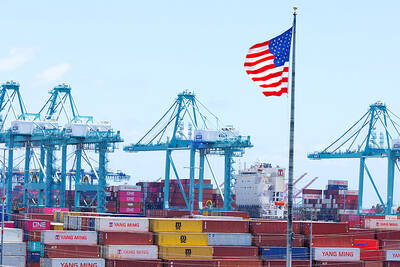
NOT IMMEDIATE: Taiwan has a chance to appeal the proposed 10 percent tariff before it starts, while other countries face a 12.5 percent tariff from the trade office Taiwan is among 60 economies determined by the US to have failed to impose or enforce a ban on the importation of goods produced with forced labor, according to a notice released on Tuesday by the Office of the US Trade Representative (USTR), which proposed imposing an additional 10 percent or more tariff on them. The USTR in a statement said that following an investigation, it had determined under Section 301 of the Trade Act of 1974 that the failure of the 60 economies to impose and effectively enforce a prohibition on the importation of goods produced with forced labor is
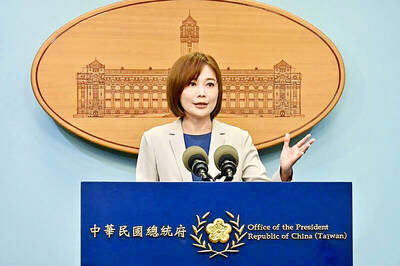
TIT-FOR-TAT: The US allegedly revoked the visa of a Chinese national working at Xinhua News Agency in the US in response to Beijing’s expulsion of Vivian Wang The Presidential Office yesterday condemned China for expelling a New York Times correspondent from Beijing following the newspaper’s interview with President William Lai (賴清德), saying the move highlighted Beijing’s suppression of press freedom and its threat to international news media. Taiwan has noted a series of recent incidents in which Beijing used similar tactics to “threaten and pressure international media outlets and journalists,” Presidential Office spokeswoman Karen Kuo (郭雅慧) said in a statement. “This concerns not only press freedom and freedom of expression, but also the safety of journalists, and Taiwan and relevant partners are paying close attention to the situation,” she


 RSS
RSS