


One of five “missing” Hong Kong booksellers who was detained in mainland China returned to the territory on Friday and met police, the Hong Kong government said, in a case that has provoked fears of increasing Chinese interference in the semi-autonomous region.
Lui Bo (呂波), who had been missing since October last year, was among three booksellers who Hong Kong police earlier this week said would be released on bail.
“Police met with Lui Por [sic], who returned to Hong Kong from the mainland, this morning,” a brief government statement released late on Friday said.
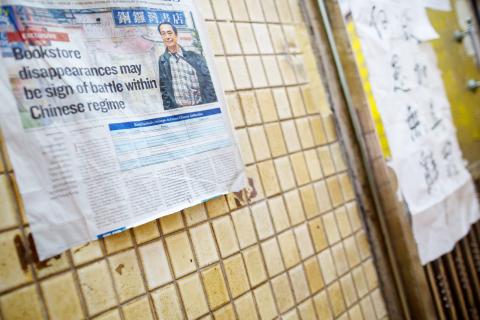
Photo: EPA
“Lui requested to have his missing-persons case closed and expressed that there was no need for assistance from the Hong Kong government or police,” it said, adding he refused to provide any more information.
Hong Kong police had said that Lui and his counterparts, Cheung Chi Ping (張志平) and Lam Wing-kei (林榮基), would all be released on bail.
However, police on Friday were not able to immediately provide information about Lam and Cheung when contacted by reporters.
An unnamed source quoted by the South China Morning Post said Lui was not handed over to the city’s police by mainland authorities.
Instead, Hong Kong police were sent to meet Lui at his Hong Kong home, the newspaper said.
“He told officers that he was safe and he did not need any assistance from the police,” the source said.
The booksellers from Mighty Current (巨流) publishing house, known for its salacious titles critical of Beijing, went missing last year, only to turn up in mainland China. One who apparently disappeared from Hong Kong, Lee Bo (李波), appeared on television on Monday and insisted he had not been abducted by mainland authorities.
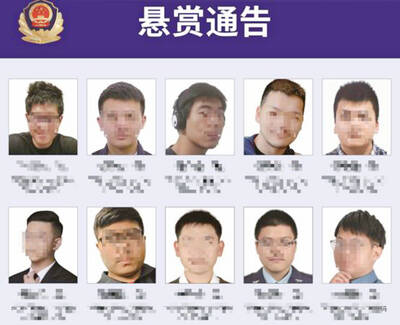
Taiwan yesterday denied Chinese allegations that its military was behind a cyberattack on a technology company in Guangzhou, after city authorities issued warrants for 20 suspects. The Guangzhou Municipal Public Security Bureau earlier yesterday issued warrants for 20 people it identified as members of the Information, Communications and Electronic Force Command (ICEFCOM). The bureau alleged they were behind a May 20 cyberattack targeting the backend system of a self-service facility at the company. “ICEFCOM, under Taiwan’s ruling Democratic Progressive Party, directed the illegal attack,” the warrant says. The bureau placed a bounty of 10,000 yuan (US$1,392) on each of the 20 people named in
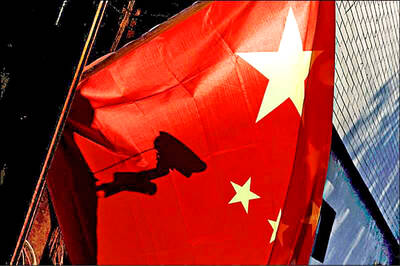
The High Court yesterday found a New Taipei City woman guilty of charges related to helping Beijing secure surrender agreements from military service members. Lee Huei-hsin (李慧馨) was sentenced to six years and eight months in prison for breaching the National Security Act (國家安全法), making illegal compacts with government employees and bribery, the court said. The verdict is final. Lee, the manager of a temple in the city’s Lujhou District (蘆洲), was accused of arranging for eight service members to make surrender pledges to the Chinese People’s Liberation Army in exchange for money, the court said. The pledges, which required them to provide identification
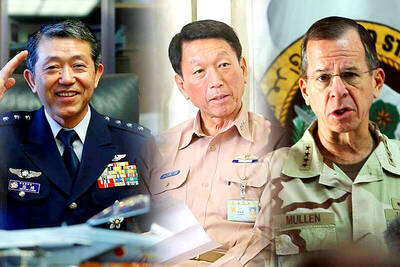
Nine retired generals from Taiwan, Japan and the US have been invited to participate in a tabletop exercise hosted by the Taipei School of Economics and Political Science Foundation tomorrow and Wednesday that simulates a potential Chinese invasion of Taiwan in 2030, the foundation said yesterday. The five retired Taiwanese generals would include retired admiral Lee Hsi-min (李喜明), joined by retired US Navy admiral Michael Mullen and former chief of staff of the Japan Self-Defense Forces general Shigeru Iwasaki, it said. The simulation aims to offer strategic insights into regional security and peace in the Taiwan Strait, it added. Foundation chair Huang Huang-hsiung
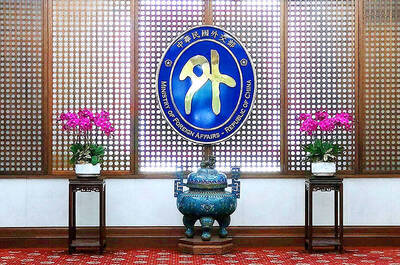
’DISTORTION’: Beijing’s assertion that the US agreed with its position on Taiwan is a recurring tactic it uses to falsely reinforce its sovereignty claims, MOFA said The Ministry of Foreign Affairs (MOFA) yesterday said Chinese state media deliberately distorted Taiwan’s sovereign status, following reports that US President Donald Trump agreed to uphold the “one China” policy in a phone call with Chinese President Xi Jinping (習近平). During the more than one-hour-long call, Xi urged Trump to retreat from trade measures that roiled the global economy and cautioned him against threatening steps on Taiwan, a Chinese government summary of the call said. China’s official Xinhua news agency quoted Xi as saying that the US should handle the Taiwan issue cautiously and avoid the two countries being drawn into dangerous


 RSS
RSS