


After a long and terrifying night, survivors of the collapsed Weiguan Jinlong residential building in Tainan’s Yongkang District (永康) gave a visceral account of their near-death experiences and struggles following a powerful earthquake that hit southern Taiwan early yesterday morning, while neighbors expressed disbelief over the frailty of the building.
The bulk of the 17-story residential building was left lying on its side on Yongda Road (永大路) after a magnitude 6.4 earthquake struck at 3:57am, followed by a series of strong aftershocks.
Rescuers have been racing to find survivors in the rubble, with some pulled to safety from the wreck, while others managed to find their own way out.
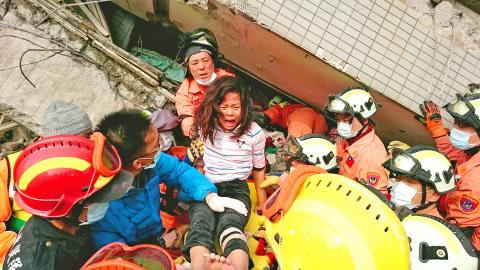
Photo: Yao Yue-hung, Taipei Times, courtesy of the Tainan City Government Fire Bureau
A man lying on a stretcher made a phone call to members of his family to tell them he had survived the quake.
A man who had been hospitalized rushed back to the scene and attempted to enter the collapsed building to look for his wife and children. He was stopped by firefighters as the wait for his family members continued.
Residents said their cellphones could still pick up signals even though they were trapped in the debris.
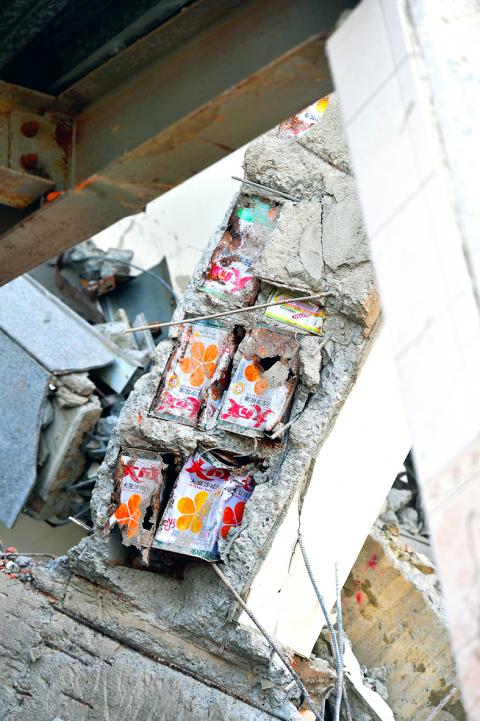
Photo: Chang Chung-i, Taipei Times
A family of four said their faces were all grazed and their clothes were covered with dust.
The father, surnamed Chen (陳), said: “We were shaken awake and the building collapsed in seconds. It was pitch black and I was pinned down. People in the building gasped and screamed for help. It was really scary.”
Chen said he wrapped himself in a blanket and rolled himself toward a flat surface, where he then followed the light filtering through the wreckage and began his climb to safety.
Chen, whose wife and two children also made it out of the rubble safely, said his family lived on the eighth floor, but that his apartment had been reduced to the height of three stories following the quake.
“Now all I have is my family. Where is our future?” he said, adding that he had only bought the apartment in November last year, for which he paid NT$2.7 million (US$80,549).
Since the earthquake ruptured some water and gas pipelines, the site was at one point flooded and the smell of gas permeated the air.
Rescuers went apartment to apartment, drawing red circles near windows of units they had already searched.
“I went to the top floors of the middle part of the building, where we found five people, one of whom was in bed and already dead,” said Liu Wen-bin, a 50-year-old rescuer from Taichung.
“Some people were found in the shower, some in the bedroom,” he said.
Firefighters also combed the site to attend to injured residents, providing care where needed and rushing those with serious injuries to hospitals.
After knocking down a parapet to the south of the building, rescuers managed to pull more people from the rubble, with some survivors pleading with rescuers to save family members who were still trapped inside the wreckage.
The online news Web site ET Today reported that a girl drank her own urine while waiting to be rescued, which happened sooner than expected.
A college student, surnamed Yang (楊), who lives across the building on Nanwan Street (南灣街), said he was still awake when the first earthquake struck.
He said that he heard a thunderous noise 10 seconds later and saw the “unbelievable scene.”
“I cannot believe that a building that looks so sturdy collapsed in 10 seconds,” he said.
Onlookers and relatives of the survivors expressed puzzlement over the quality of the building.
“I wonder why the building collapsed when nearby two-story buildings only had some fallen tiles,” a woman said.
“The building must have been there for almost 20 years. Who would have thought it would suddenly collapse?” another said.
Rescuers said that they had discovered polystyrene alongside reinforced steel in one of the building’s damaged beams, while photos from the scene also showed cans embedded in the concrete.
The Tainan Structural Engineers’ Association said it would investigate whether any shortcuts had been taken during the construction of the building.
Additional reporting by AP

Japan has deployed long-range missiles in a southwestern region near China, the Japanese defense minister said yesterday, at a time when ties with Beijing are at their lowest in recent years. The missiles were installed in Kumamoto in the southern region of Kyushu, as Japan is attempting to shore up its military capacity as China steps up naval activity in the East China Sea. “Standoff defense capabilities enable us to counter the threat of enemy forces attempting to invade our country ... while ensuring the safety of our personnel,” Japanese Minister of Defense Shinjiro Koizumi said. “This is an extremely important initiative for

Chinese Nationalist Party (KMT) Chairwoman Cheng Li-wun (鄭麗文) today accepted an invitation from Chinese President Xi Jinping (習近平) to lead a delegation to China next month, saying she hopes to promote the peaceful development of cross-strait relations and bring stability to the Taiwan Strait. “I am grateful and happy to accept this invitation,” Cheng said in a statement from the KMT chairperson’s office. Cheng said she hopes both sides can work together to promote the peaceful development of cross-strait relations, enhance exchange and cooperation, bring stability to the Taiwan Strait and improve people’s livelihoods. At today's news conference, Cheng said any efforts to

MORE POPULAR: Taiwan Pass sales increased by 59 percent during the first quarter compared with the same period last year, the Tourism Administration said The Tourism Administration yesterday said that it has streamlined the Taiwan Pass, with two versions available for purchase beginning today. The tourism agency has made the pass available to international tourists since 2024, allowing them to access the high-speed rail, Taiwan Railway Corp services, four MRT systems and four Taiwan Tourist Shuttles. Previously, five types of Taiwan Pass were available, but some tourists have said that the offerings were too complicated. The agency said only two types of Taiwan Pass would be available, starting from a three-day pass with the high-speed rail and a three-day pass with Taiwan Railway Corp. The former costs NT$2,800

The nation’s fastest supercomputer, Nano 4 (晶創26), is scheduled to be launched in the third quarter, and would be used to train large language models in finance and national defense sectors, the National Center for High-Performance Computing (NCHC) said. The supercomputer, which would operate at about 86.05 petaflops, is being tested at a new cloud computing center in the Southern Taiwan Science Park in Tainan. The exterior of the server cabinet features chip circuitry patterns overlaid with a map of Taiwan, highlighting the nation’s central position in the semiconductor industry. The center also houses Taiwania 2, Taiwania 3, Forerunner 1 and


 RSS
RSS