


Outgoing Chinese Nationalist Party (KMT) chairman Eric Chu (朱立倫) yesterday appointed KMT vice chairperson Huang Min-hui (黃敏惠) as the party’s interim chairperson, with Chu saying that he would never forget that the party lost the elections under his leadership.
Chu made the remarks before the KMT’s Central Standing Committee (CSC) was set to approve his resignation as party chairman at an extraordinary meeting in Taipei yesterday afternoon.
“I pledged to step down [as KMT chairman] should I be defeated in the elections... The KMT has an established tradition in which its leader takes full responsibility for the party’s loss or victory,” Chu said.
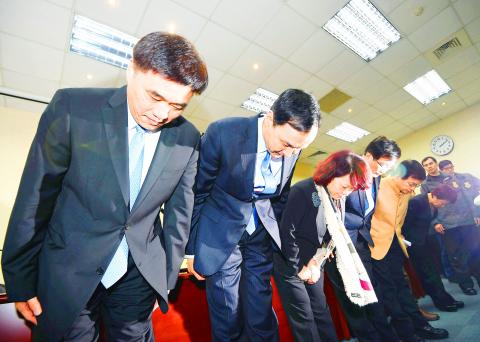
Photo: Fang Pin-chao, Taipei Times
Chu said he would take the largest share of responsibility for the party’s landslide defeat and planned to engage in some serious self-reflection, while apologizing to supporters and all his comrades in the party for letting them down.
“I will never forget that the KMT lost power under my governance,” Chu said.
The KMT would only be able to regain the public’s trust if it learns from its mistakes, Chu said.
The priority for the party’s next chairman would be to formulate reform proposals that could be accepted by the public and the party, Chu said.
“Despite my resignation, I will forever be the KMT’s most loyal member and will stand alongside every party comrade during reforms,” Chu said, adding that he believed Huang would take good care of the party before a chairmanship election was held.
According to the KMT charter, an election for party chairman must be held within three months of the resignation of an incumbent.
Several KMT members have reportedly expressed interest in the post, including Deputy Legislative Speaker Hung Hsiu-chu (洪秀柱), former KMT vice chairman Hau Lung-bin (郝龍斌), Vice President Wu Den-yih (吳敦義), President Ma Ying-jeou (馬英九), former Taichung mayor Jason Hu (胡志強) and Legislative Speaker Wang Jin-pyng (王金平).
Following yesterday’s committee meeting, a dozen KMT members visited Wu at the Presidential Office to try and persuade him to run for the party chairmanship.
“During the KMT’s most difficult time, the party needs someone who can unite its members... Wu once served as the party’s secretary-general and has experience in elections,” CSC member Yao Chiang-lin (姚江臨) said.
Hau — who stepped down as KMT vice chairman on Saturday after failing to secure a legislative seat in Keelung — downplayed the issue yesterday when asked to comment on some party members’ calls for him to take up the post, saying he has not given the matter any thought.
In related news, Taiwan Solidarity Union (TSU) Chairman Huang Kun-huei (黃昆輝) also offered to resign yesterday, following the party’s poor performance in the legislative elections.
The New Power Party’s success at the ballots came as the TSU’s support crumbled, with the union losing all three of its legislator-at-large seats.
Green Party-Social Democratic Party Alliance conveners also resigned yesterday following the alliance’s disappointing showing in Saturday’s legislative elections.
She had to take responsibility for the failure of her party to win any legislative seats, Social Democratic Party convener Fan Yun (范雲) said in her resignation speech.
Green Party Taiwan co-conveners Lee Ken-cheng (李根政) and Chang Yu-ching (張育憬) also resigned.
The two parties founded an electoral alliance in hopes of pooling their votes to cross the 5 percent threshold required to be awarded at-large seats but won only 2.53 percent.
Additional reporting by Abraham Gerber and staff writer

NO HUMAN ERROR: After the incident, the Coast Guard Administration said it would obtain uncrewed aerial vehicles and vessels to boost its detection capacity Authorities would improve border control to prevent unlawful entry into Taiwan’s waters and safeguard national security, the Mainland Affairs Council (MAC) said yesterday after a Chinese man reached the nation’s coast on an inflatable boat, saying he “defected to freedom.” The man was found on a rubber boat when he was about to set foot on Taiwan at the estuary of Houkeng River (後坑溪) near Taiping Borough (太平) in New Taipei City’s Linkou District (林口), authorities said. The Coast Guard Administration’s (CGA) northern branch said it received a report at 6:30am yesterday morning from the New Taipei City Fire Department about a

IN BEIJING’S FAVOR: A China Coast Guard spokesperson said that the Chinese maritime police would continue to carry out law enforcement activities in waters it claims The Philippines withdrew its coast guard vessel from a South China Sea shoal that has recently been at the center of tensions with Beijing. BRP Teresa Magbanua “was compelled to return to port” from Sabina Shoal (Xianbin Shoal, 仙濱暗沙) due to bad weather, depleted supplies and the need to evacuate personnel requiring medical care, the Philippine Coast Guard (PCG) spokesman Jay Tarriela said yesterday in a post on X. The Philippine vessel “will be in tiptop shape to resume her mission” after it has been resupplied and repaired, Philippine Executive Secretary Lucas Bersamin, who heads the nation’s maritime council, said

REGIONAL STABILITY: Taipei thanked the Biden administration for authorizing its 16th sale of military goods and services to uphold Taiwan’s defense and safety The US Department of State has approved the sale of US$228 million of military goods and services to Taiwan, the US Department of Defense said on Monday. The state department “made a determination approving a possible Foreign Military Sale” to the Taipei Economic and Cultural Representative Office in the US for “return, repair and reshipment of spare parts and related equipment,” the defense department’s Defense Security Cooperation Agency said in a news release. Taiwan had requested the purchase of items and services which include the “return, repair and reshipment of classified and unclassified spare parts for aircraft and related equipment; US Government

More than 500 people on Saturday marched in New York in support of Taiwan’s entry to the UN, significantly more people than previous years. The march, coinciding with the ongoing 79th session of the UN General Assembly, comes close on the heels of growing international discourse regarding the meaning of UN Resolution 2758. Resolution 2758, adopted by the UN General Assembly in 1971, recognizes the People’s Republic of China (PRC) as the “only lawful representative of China.” It resulted in the Republic of China (ROC) losing its seat at the UN to the PRC. Taiwan has since been excluded from


 RSS
RSS