


The two people responsible for defacing the artworks donated by Hong Kong actor Jackie Chan (成龍) to the National Palace Museum Southern Branch yesterday defended their actions as a protest against China’s cultural “united front” strategy.
“As far as China is concerned, the 12 zodiac animal heads are antiquities looted from them by foreigners and they must be returned to their rightful owner. Putting copies of the sculptures in Taiwan insinuates that ‘Taiwan is China’s lost property,’” 19-year-old Chen Miao-ting (陳妙婷) and 33-year-old Chen Yi-ting (陳儀庭) said in a statement issued yesterday.
The pair said the statues serve as an expression of China’s political message that “both sides of the Taiwan Strait belong to one family” and that “there is bound to be unification after prolonged division.”
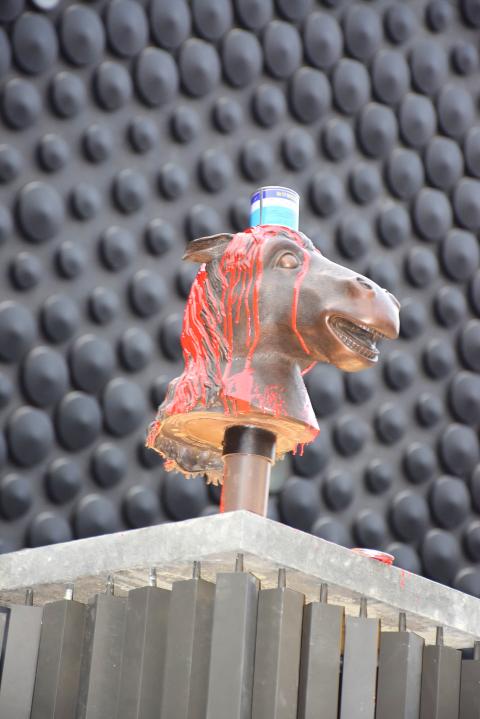
Photo: Wu Shih-tsung, Taipei Times
In addition, the existence of the museum is not only meant to demonstrate the superiority of Zhonghua culture (中華文化) and paint Taiwanese as barbarians, it also signifies foreign colonization, the pair said.
“We refuse to let any objects indicating [China’s] cultural united front strategy or replicas from other cultures be displayed in our arts and cultural palace,” they said.
They demanded that the replicas of the 12 zodiac animal heads be immediately removed from the National Palace Museum Southern Branch, while urging Democratic Progressive Party (DPP) presidential candidate Tsai Ing-wen (蔡英文) to dismiss National Palace Museum Director Feng Ming-chu (馮明珠) should she take office.
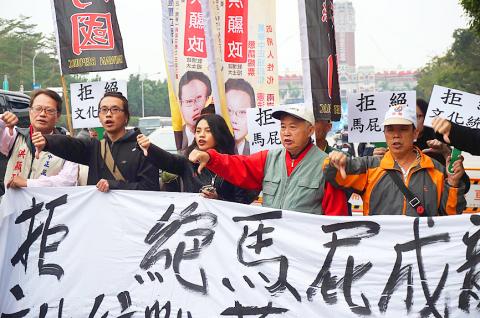
Photo: Tu Chu-min, Taipei Times
Chen Miao-ting and Chen Yi-ting were taken in for questioning by the police on Wednesday evening, hours after they allegedly vandalized the bronze dragon and horse heads with red paint, and sprayed the Chinese characters for “cultural united front” (文化統戰) onto their pedestals.
They were then charged with vandalism and obstructing public officials and referred to the Chiayi District Prosecutors’ Office, which later released them.
The statues are two of the replicas of 12 zodiac sculptures donated by Chan, a member of the Chinese People’s Political Consultative Conference (CPPCC). The originals were looted from China’s Old Summer Palace by British and French forces in 1860.
The animal heads have been on display in the courtyard of the museum in Chiayi County since the venue’s soft opening on Monday.
After the incident, the museum issued a statement on Wednesday saying most of the antiquities it has amassed originated from the Qing Dynasty, which would naturally make them Zhonghua culture artworks.
“If displaying antiquities of Zhonghua culture is tantamount to launching an united front, how are we ever going to run a national museum?” the museum asked, vowing to hold the responsible parties accountable.
Museum official Wang Shih-sheng (王士聖) yesterday said that staff had removed the paint from the statues.
“As the statues are displayed in an open area, it is almost impossible to prevent this sort of vandalism. We urge everyone to adopt a rational attitude toward the museum,” Wang said.
Meanwhile, Hakka hip-hop group Kou Chou Ching (拷秋勤) yesterday defended Chen Miao-ting and Chen Yi-ting on Facebook, saying they should be applauded.
“It was the opening of Taiwan’s new cultural site and you asked Chan, a CPPCC member, to join the opening ceremony? May I ask: What do Chan’s replica animal heads have to do with Taiwanese culture?” Kou Chou Ching wrote.
Additional reporting by CNA

Tropical Storm Gaemi strengthened into a typhoon at 2pm yesterday, and could make landfall in Yilan County tomorrow, the Central Weather Administration (CWA) said yesterday. The agency was scheduled to issue a sea warning at 11:30pm yesterday, and could issue a land warning later today. Gaemi was moving north-northwest at 4kph, carrying maximum sustained winds near its center of up to 118.8kph and gusts of 154.8kph. The circumference is forecast to reach eastern Taiwan tomorrow morning, with the center making landfall in Yilan County later that night before departing from the north coast, CWA weather forecaster Kuan Shin-ping (官欣平) said yesterday. Uncertainty remains and

SEA WARNING LIKELY: The storm, named Gaemi, could become a moderate typhoon on Wednesday or Thursday, with the Taipei City Government preparing for flooding A tropical depression east of the Philippines developed into a tropical storm named Gaemi at 2pm yesterday, and was moving toward eastern Taiwan, the Central Weather Administration (CWA) said. Gaemi could begin to affect Taiwan proper on Tuesday, lasting until Friday, and could develop into a moderate typhoon on Wednesday or Thursday, it said. A sea warning for Gaemi could be issued as early as Tuesday morning, it added. Gaemi, the third tropical storm in the Pacific Ocean this typhoon season, is projected to begin moving northwest today, and be closest to Taiwan on Wednesday or Thursday, the agency said. Today, there would likely

DISRUPTIONS: The high-speed rail is to operate as normal, while several airlines either canceled flights or announced early departures or late arrivals Schools and offices in 15 cities and counties are to be closed today due to Typhoon Gaemi, local governments announced last night. The 15 are: Taipei, New Taipei City, Taoyuan, Tainan, Keelung, Hsinchu and Kaohsiung, as well as Yilan, Hualien, Hsinchu, Miaoli, Chiayi, Pingtung, Penghu and Lienchiang counties. People should brace for torrential rainfall brought by the storm, with its center forecast to make landfall on the east coast between tonight and tomorrow morning, the Central Weather Administration (CWA) said. The agency issued a sea warning for the typhoon at 11:30pm on Monday, followed by a land warning at 11:30am yesterday. As of

CASUALTY: A 70-year-old woman was killed by a falling tree in Kaohsiung as the premier warned all government agencies to remain on high alert for the next 24 hours Schools and offices nationwide are to be closed for a second day today as Typhoon Gaemi crosses over the nation, bringing torrential rain and whipping winds. Gaemi was forecast to make landfall late last night. From Tuesday night, its outer band brought substantial rainfall and strong winds to the nation. As of 6:15pm last night, the typhoon’s center was 20km southeast of Hualien County, Central Weather Administration (CWA) data showed. It was moving at 19kph and had a radius of 250km. As of 3pm yesterday, one woman had died, while 58 people were injured, the Central Emergency Operation Center said. The 70-year-old


 RSS
RSS