


Japanese opposition groups yesterday vowed to challenge laws passed overnight that clear Japanese troops to fight abroad for the first time since World War II, while Beijing voiced concern.
Japan’s ruling coalition, led by Japanese Prime Minister Shinzo Abe, pushed the laws through in the early hours of the morning after days of tortuous debate that at points descended into physical scuffles in parliament.
For the first time in 70 years, the new regulations are to give the Japanese government the power to send the military into overseas conflicts to defend allies, even if the nation itself is not under attack.
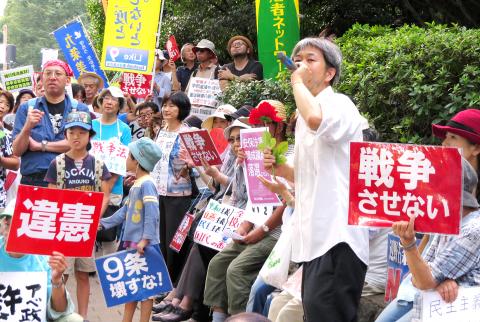
Photo: AFP
Abe said the laws are necessary to protect against threats from an increasingly belligerent China and unstable North Korea, but opponents fear the vague wording could see Japan dragged into far-flung foreign wars.
“This is not an end,” said Renho, a senior lawmaker from the main opposition Democratic Party of Japan, who goes by one name.
“Let us make it the beginning of the beginning,” she said on Twitter.
Social Democratic Party senior lawmaker Mizuho Fukushima told a crowd who gathered outside parliament during the debate: “Abe’s Cabinet criminals... Let us get them out of here.”
China voiced its concerns, with its Ministry of Foreign Affairs saying the changes are an “unprecedented” change in Japan’s military stance since World War II, and urged Tokyo to “pay attention to security concerns of its neighbors.”
“We solemnly urge Japan to learn the lessons of history ... uphold the path of peaceful development and act cautiously in the areas of the military and security, and do more to help push regional peace and stability rather than the opposite,” it said.
Speaking after the vote, Abe said the changes were “necessary in order to protect people’s lives and peaceful way of life.”
“This is designed to prevent wars,” he told journalists.
A group of about 300 protesters gathered outside parliament, calling for the legislation to be abolished and vowing never to stop their fight against Abe.
“Our battle will never end. This is just the beginning,” said Keisuke Yamamoto, an organizer from one of the citizen groups that have been leading weeks of rallies. “We will resort to every possible measure, including bringing the case to the courts... We cannot let this movement fizzle out now.”

Tropical Storm Gaemi strengthened into a typhoon at 2pm yesterday, and could make landfall in Yilan County tomorrow, the Central Weather Administration (CWA) said yesterday. The agency was scheduled to issue a sea warning at 11:30pm yesterday, and could issue a land warning later today. Gaemi was moving north-northwest at 4kph, carrying maximum sustained winds near its center of up to 118.8kph and gusts of 154.8kph. The circumference is forecast to reach eastern Taiwan tomorrow morning, with the center making landfall in Yilan County later that night before departing from the north coast, CWA weather forecaster Kuan Shin-ping (官欣平) said yesterday. Uncertainty remains and

SEA WARNING LIKELY: The storm, named Gaemi, could become a moderate typhoon on Wednesday or Thursday, with the Taipei City Government preparing for flooding A tropical depression east of the Philippines developed into a tropical storm named Gaemi at 2pm yesterday, and was moving toward eastern Taiwan, the Central Weather Administration (CWA) said. Gaemi could begin to affect Taiwan proper on Tuesday, lasting until Friday, and could develop into a moderate typhoon on Wednesday or Thursday, it said. A sea warning for Gaemi could be issued as early as Tuesday morning, it added. Gaemi, the third tropical storm in the Pacific Ocean this typhoon season, is projected to begin moving northwest today, and be closest to Taiwan on Wednesday or Thursday, the agency said. Today, there would likely

DISRUPTIONS: The high-speed rail is to operate as normal, while several airlines either canceled flights or announced early departures or late arrivals Schools and offices in 15 cities and counties are to be closed today due to Typhoon Gaemi, local governments announced last night. The 15 are: Taipei, New Taipei City, Taoyuan, Tainan, Keelung, Hsinchu and Kaohsiung, as well as Yilan, Hualien, Hsinchu, Miaoli, Chiayi, Pingtung, Penghu and Lienchiang counties. People should brace for torrential rainfall brought by the storm, with its center forecast to make landfall on the east coast between tonight and tomorrow morning, the Central Weather Administration (CWA) said. The agency issued a sea warning for the typhoon at 11:30pm on Monday, followed by a land warning at 11:30am yesterday. As of

CASUALTY: A 70-year-old woman was killed by a falling tree in Kaohsiung as the premier warned all government agencies to remain on high alert for the next 24 hours Schools and offices nationwide are to be closed for a second day today as Typhoon Gaemi crosses over the nation, bringing torrential rain and whipping winds. Gaemi was forecast to make landfall late last night. From Tuesday night, its outer band brought substantial rainfall and strong winds to the nation. As of 6:15pm last night, the typhoon’s center was 20km southeast of Hualien County, Central Weather Administration (CWA) data showed. It was moving at 19kph and had a radius of 250km. As of 3pm yesterday, one woman had died, while 58 people were injured, the Central Emergency Operation Center said. The 70-year-old


 RSS
RSS