


A new arms package for Taiwan is making its way through the complex channels of the US political system, US-Taiwan Business Council president Rupert Hammond-Chambers said on Wednesday.
It follows an unprecedented period of no new US arms sales to Taipei.
“I would characterize the programs that are being looked at now — and these have all popped up in the last year or so — as house cleaning,” Hammond-Chambers said.
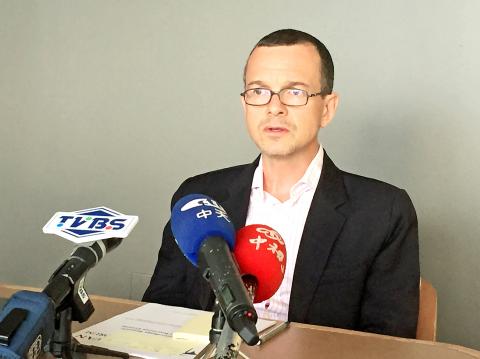
Photo: CNA
However, the new package is to consist of nothing much more than second-hand equipment, upgraded equipment and munitions.
Such a sale is unlikely to come before the fourth quarter of next year.
“Any new capabilities under consideration for Taiwan will be left almost certainly to the next US administration,” Hammond-Chambers said.
He was speaking at a Washington press conference following the release of a new report by the US-Taiwan Business Forum.
Hammond-Chambers said that by the end of next year, up to 24 of Taiwan’s frontline F-16 jets would be taken out of service for upgrades.
“In my view, this will exacerbate the debate over what to do about the future of Taiwan’s air force and put further strain on it,” he said.
The natural conclusion to Taiwan not receiving new fighters is that Taiwan would not have an air force, Hammond-Chambers said.
“At some point, the fighters have to be replaced and that should be an ongoing process,” he said.
He said that the likely next platform for Taiwan should be an upgraded fourth-generation F-16.
He said submarines and fighters are “incredibly expensive,” but Taiwan needs an undersea force and a robust modern fighter force to provide security, and the money is going to have to come from somewhere.
Hammond-Chambers said a limited purchase of F-16C/Ds — not the 66 originally wanted, but a more modest group of between 24 and 33 — might be considered by the next president of Taiwan and the next US president.
“That issue of the fighter replacement is going to be very much about who wins the presidential election here in the US,” he said.
Any such sale would likely come in the first year of a new administration, because after that it becomes more difficult politically, he said.
“History suggests that a Republican administration would be more likely to sell arms to Taiwan, but if [former US secretary of state] Hillary [Rodham] Clinton were to win the Democratic Party nomination and be elected, her national security team would have some strong voices for Taiwan,” Hammond-Chambers said.
“I would say to the Taiwan people that national security is expensive, modern weapons are expensive. Taiwan can develop some of them domestically, but some capabilities they will have to procure,” he said.
Hammond-Chambers said that returning to a period where the US sells arms to Taiwan on a regular basis would be “very difficult,” given the long freeze.

Tropical Storm Gaemi strengthened into a typhoon at 2pm yesterday, and could make landfall in Yilan County tomorrow, the Central Weather Administration (CWA) said yesterday. The agency was scheduled to issue a sea warning at 11:30pm yesterday, and could issue a land warning later today. Gaemi was moving north-northwest at 4kph, carrying maximum sustained winds near its center of up to 118.8kph and gusts of 154.8kph. The circumference is forecast to reach eastern Taiwan tomorrow morning, with the center making landfall in Yilan County later that night before departing from the north coast, CWA weather forecaster Kuan Shin-ping (官欣平) said yesterday. Uncertainty remains and

SEA WARNING LIKELY: The storm, named Gaemi, could become a moderate typhoon on Wednesday or Thursday, with the Taipei City Government preparing for flooding A tropical depression east of the Philippines developed into a tropical storm named Gaemi at 2pm yesterday, and was moving toward eastern Taiwan, the Central Weather Administration (CWA) said. Gaemi could begin to affect Taiwan proper on Tuesday, lasting until Friday, and could develop into a moderate typhoon on Wednesday or Thursday, it said. A sea warning for Gaemi could be issued as early as Tuesday morning, it added. Gaemi, the third tropical storm in the Pacific Ocean this typhoon season, is projected to begin moving northwest today, and be closest to Taiwan on Wednesday or Thursday, the agency said. Today, there would likely

DISRUPTIONS: The high-speed rail is to operate as normal, while several airlines either canceled flights or announced early departures or late arrivals Schools and offices in 15 cities and counties are to be closed today due to Typhoon Gaemi, local governments announced last night. The 15 are: Taipei, New Taipei City, Taoyuan, Tainan, Keelung, Hsinchu and Kaohsiung, as well as Yilan, Hualien, Hsinchu, Miaoli, Chiayi, Pingtung, Penghu and Lienchiang counties. People should brace for torrential rainfall brought by the storm, with its center forecast to make landfall on the east coast between tonight and tomorrow morning, the Central Weather Administration (CWA) said. The agency issued a sea warning for the typhoon at 11:30pm on Monday, followed by a land warning at 11:30am yesterday. As of

CASUALTY: A 70-year-old woman was killed by a falling tree in Kaohsiung as the premier warned all government agencies to remain on high alert for the next 24 hours Schools and offices nationwide are to be closed for a second day today as Typhoon Gaemi crosses over the nation, bringing torrential rain and whipping winds. Gaemi was forecast to make landfall late last night. From Tuesday night, its outer band brought substantial rainfall and strong winds to the nation. As of 6:15pm last night, the typhoon’s center was 20km southeast of Hualien County, Central Weather Administration (CWA) data showed. It was moving at 19kph and had a radius of 250km. As of 3pm yesterday, one woman had died, while 58 people were injured, the Central Emergency Operation Center said. The 70-year-old


 RSS
RSS