


It is a historical fact that the then-Chinese Nationalist Party (KMT) government led the war against Japanese aggression from 1937 to 1945, whether on the front lines or behind enemy lines, Presidential Office spokesperson Charles Chen (陳以信) said yesterday.
Chen was responding to remarks by former vice president Lien Chan (連戰), who said during a meeting with Chinese President Xi Jinping (習近平) in Beijing yesterday that the KMT under the leadership of former president Chiang Kai-shek (蔣介石) engaged directly with Japanese troops in major battles, handing the latter a major setback, and that Chinese Communist Party (CCP) troops led by former Chinese leader Mao Zedong (毛澤東) also tied down the enemy behind their lines and eventually defeated the Japanese aggressors.
“The Nationalist forces ... fought a series of decisive and major battles on the front lines and dealt the Japanese military a heavy blow,” Lien told Xi, according to Shanghai news Web site guancha.cn.
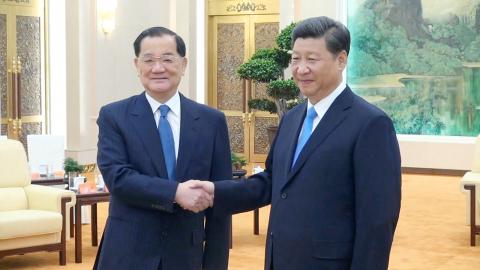
Photo: CNA
“The Chinese Communist Party forces led by Mao Zedong effectively pinned down and intercepted the Japanese and the collaborationist militaries on the battlefield behind enemy lines,” added Lien, a former KMT chairman.
Xi said Nationalists and Communists “cooperated and coordinated” in the campaign and that “both made significant contributions to the victory of [the so-called ‘Chinese People’s War of Resistance Against Japanese Aggression and the World Anti-Fascist War’],” China’s Xinhua news agency reported.
“Chinese across the Taiwan Strait must keep history in mind, remember national heroes and become united to savor the fruits of victory and jointly advance the peaceful development of our relations,” Xinhua quoted Xi as saying.
The Presidential Office said that the CCP did little to resist Japanese aggression during the Second Sino-Japanese War.
“Whether it came to engaging in combat with Japanese troops on the front lines or behind enemy lines, it was all led by the Nationalist government, which is a historical fact that cannot be denied,” Chen said.
Chen said that the government’s stance is that “it is inappropriate” for Taiwanese to attend China’s military parade tomorrow — at which Lien is expected to be present.
Beijing has held a series of events to mark the 70th anniversary of the end of World War II, with tomorrow’s military parade considered to be the highlight of the festivities.
The CCP — which defeated the KMT in the Chinese Civil War, forcing the latter to flee to Taiwan — depicts itself as having played the lead role in defeating Japan.
Taiwan said events being held by Beijing distort historical facts, as it was the KMT who fought all the major battles against Japan during an eight-year war before Allied forces intervened.
KMT presidential candidate Hung Hsiu-chu (洪秀柱) yesterday said that she has great respect for Lien, who she said has made significant contributions toward cross-strait peace.
However, Hung added that, given his position, Lien should consider the Taiwanese perspective when making public comments.
Additional reporting by Chang Hsiao-ti

PROVOCATIVE: Chinese Deputy Ambassador to the UN Sun Lei accused Japan of sending military vessels to deliberately provoke tensions in the Taiwan Strait China denounced remarks by Japan and the EU about the South China Sea at a UN Security Council meeting on Monday, and accused Tokyo of provocative behavior in the Taiwan Strait and planning military expansion. Ayano Kunimitsu, a Japanese vice foreign minister, told the Council meeting on maritime security that Tokyo was seriously concerned about the situation in the East China and South China seas, and reiterated Japan’s opposition to any attempt to change the “status quo” by force, and obstruction of freedom of navigation and overflight. Stavros Lambrinidis, head of the EU delegation to the UN, also highlighted South China Sea

SILENCING CRITICS: In addition to blocking Taiwan, China aimed to prevent rights activists from speaking out against authoritarian states, a Cabinet department said The Ministry of Foreign Affairs (MOFA) yesterday condemned transnational repression by Beijing after RightsCon, a major digital human rights conference scheduled to be held in Zambia this week, was abruptly canceled due to Chinese pressure over Taiwanese participation. This year’s RightsCon, the world’s largest conference discussing issues “at the intersection of human rights and technology,” was scheduled to take place from tomorrow to Friday in Lusaka, and expected to draw 2,600 in-person attendees from 150 countries, along with 1,100 online participants. However, organizers were forced to cancel the event due to behind-the-scenes pressure from China, the ministry said, expressing its “strongest condemnation”

Taiwan Semiconductor Manufacturing Co (TSMC, 台積電), the world’s largest contract chipmaker, said it expects its 2-nanometer (2nm) chip capacity to grow at a compound annual rate of 70 percent from this year to 2028. The projection comes as five fabs begin volume production of 2-nanometer chips this year — two in Hsinchu and three in Kaohsiung — TSMC senior vice president and deputy cochief operating officer Cliff Hou (侯永清) said at the company’s annual technology symposium in Silicon Valley, California, last week. Output in the first year of 2-nanometer production, which began in the fourth quarter of last year, is expected to
Taiwan’s economy grew far faster than expected in the first quarter, as booming demand for artificial intelligence (AI) applications drove a surge in exports, spilling over into investment and consumption, the Directorate-General of Budget, Accounting and Statistics (DGBAS) said yesterday. GDP growth was 13.69 percent year-on-year during the January-to-March period, beating the DGBAS’ February forecast by 2.23 percentage points and marking the most robust growth in nearly four decades, DGBAS senior official Chiang Hsin-yi (江心怡) told a news conference in Taipei. The result was powered by exports, which remain the backbone of Taiwan’s economy, Chiang said. Outbound shipments jumped 51.12 percent year-on-year to


 RSS
RSS