

After a nearly eight-month-long boycott, Tainan Mayor William Lai (賴清德) yesterday delivered a policy address at the Tainan City Council as the city grapples with an outbreak of dengue fever that has infected more than 2,500 people and killed four this year.
In an unexpected move, Lai, accompanied by his top administration officials, attended the second regular council session, putting an end to his 234-day boycott of council meetings sparked by accusations of vote-buying against Tainan Council Speaker Lee Chuan-chiao (李全教) of the Chinese Nationalist Party (KMT).
Lai was greeted by several Democratic Progressive Party (DPP) councilors waiting for him at the front entrance, who chanted: “Go, mayor.”
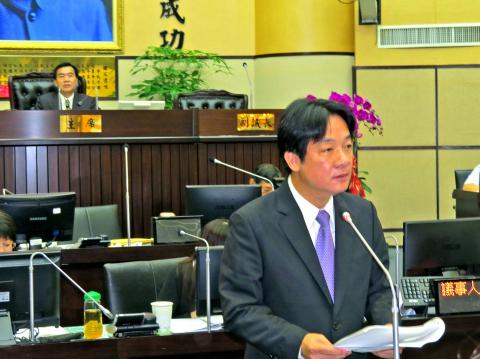
Photo: Tsai Wen-chu, Taipei Times
“Insisting on pushing for reforms and safeguarding Taiwan have always been an unshakable belief of mine since I took off my doctor’s robe and entered politics. I believe a nation can only continue to move forward through repeated reforms,” Lai told an impromptu press conference.
Lai said that in the face of the graft cases involving Lee, which have devastated Tainan’s spirit of democracy, he felt that as the mayor of the city, he was obligated to shoulder the responsibility of defending the city’s dignity and thus chose to stake his political career on his Jan. 6 decision not to attend any city council meetings until the investigation into the council speaker election yielded conclusive results.
While a verdict on Lee’s case might not be forthcoming in the foreseeable future because of his repeated attempts to use “underhanded” means to recuse judges, the city has seen a glimmer of hope for clean politics in light of the severe sentences handed out to the speaker’s campaign director and vote brokers, Lai said.
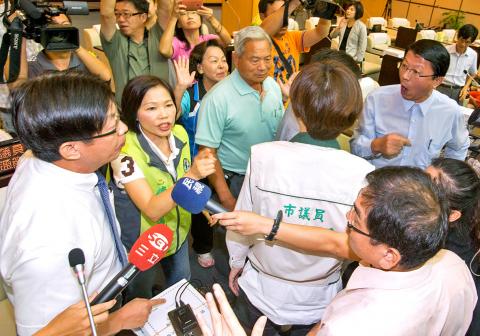
Photo: CNA
“Accordingly, I choose today [yesterday] to enter the council and deliver my policy report,” the mayor said, adding that the decision did not mean an end to his administration’s efforts to promote reforms or equate it with him succumbing to vicious powers.
“It signifies the beginning of a new stage. Let us keep on pushing reforms until we succeed,” Lai said.
Lee’s top aide, Huang Teng-ching (黃澄清), was found guilty of vote-buying in last year’s nine-in-one elections and sentenced to five years in prison by the Tainan District Court on July 31.
Two other people believed to be the council speaker’s vote brokers, Lee Li-hua (李麗華) and Kang Ching-liang (康清良), were also found guilty and given suspended two-year and 19-month sentences respectively.
Asked to describe his mood after sitting on the mayoral chair in the council, Lai said he would handle everything with equanimity.
The DPP mayor had suffered several setbacks in what he called his endeavors to ensure a clean city council. He was impeached by the Control Yuan with a 7-to-2 vote on Aug. 4 for “gross negligence” for not fulfilling his duty to attend question-and-answer sessions at the council.
He was referred to the Public Functionary Disciplinary Sanction Commission for disciplinary action, which could include revocation of his mayorship.
Separately yesterday, DPP spokesman Juan Chao-hsiung (阮昭雄) issued a statement recognizing Lai’s endeavors in fighting “black gold politics,” which he said was the responsibility of the entire society and required long-term efforts and systematic reforms.
“The DPP will not leave Mayor Lai fighting the battle alone. We plan to list amendments to the Local Government Act (地方制度法) as a priority bill in the next legislative session to avoid a second Lee Chuan-chiao,” Juan said in the statement.
Juan also expressed regret over delays in handling the corruption cases against Lee Chuan-chiao, calling on judicial agencies to expedite the process to preserve democracy.
However, KMT Legislator Lin Te-fu (林德福) said that Lai was clearly forced into the council by “mosquitoes.”
“Lai is apparently at his wits’ end in the face of the city’s dengue fever outbreak, which has spiraled out of control. More ridiculous is that his deputy, Yen Chun-tso (顏純左), even tried to reassure the public by saying that only one in 8,000 deaths nationwide last year was caused by dengue fever,” Lin said.
KMT Legislator Wu Yu-sheng (吳育昇) said the fact that Lai only attended council meetings after people died because of dengue fever indicated that the excuses he had used for not going did not stand.
“It also proves that the Control Yuan’s impeachment of Lai was a right call,” Wu said, urging Lai to apologize for his past conduct.


PATROL PARTNERS: The ‘Chiayi’ and the ‘Penghu’ departed for a two-day joint patrol of Palau’s exclusive economic zone, the CGA’s second diplomatic visit to the country The Coast Guard Administration (CGA) set a record for its southernmost deployment of a coast guard vessel as the vessels Chiayi and the Penghu reached Palau’s Pulo Anna Island on Saturday in a cooperative exercise between the two countries. The island, about 217 nautical miles (401km) southwest of Koror in the Palauan state of Sonsorol and 1,220 nautical miles from Taiwan’s southernmost point, Oluanpi (鵝鑾鼻), is the furthest south a CGA vessel has sailed. The two vessels are in Palau for the coast guard’s second diplomatic visit to the country. They docked at Malakal Harbor on Tuesday last week. The coast guard
The government is monitoring online rumors that a pneumonic plague outbreak has spread from Russia into China, and it might enhance quarantine measures, Premier Cho Jung-tai (卓榮泰) said yesterday. During a legislative meeting, Democratic Progressive Party Legislator Wang Ting-yu (王定宇) said that rumors had circulated that the disease had spread across several Chinese provinces. He asked Cho whether the government was prepared to prevent the disease spreading to Taiwan, given the volume of traffic between the two sides, and how concerned the government was about the alleged outbreak. The Ministry of Health and Welfare had implemented border quarantine measures after briefing the Executive

BATCH 1: The military has plans to assign the weapons to the army to defend Taiwan proper, as well as outlying islands and the navy for the Marine Corps, the official said Taiwan is to receive 500 Stinger missiles and 178 launchers from the US by the end of the year, the first batch under a planned two-stage acquisition totaling 2,621 missiles and 763 launchers, a defense official said yesterday on condition of anonymity. The portable missiles would play a vital role in the nation’s air defense capabilities, the source said. The army plans to deploy 2,235 missiles and 657 launchers to defend Taiwan proper and outlying islands, they said, citing military documents. The navy is allotted 295 missiles and 85 launchers to arm the Marine Corps and some surface vessels that lack air defense

The European Parliament on Wednesday adopted a recommendation on EU-China political relations that rejected China’s efforts to restrict Taiwan’s participation in international organizations and exchanges. The recommendation, addressed to the European Council, the European Commission and EU High Representative for Foreign Affairs and Security Policy Kaja Kallas, includes several references to EU-Taiwan relations and expresses support for closer ties, saying they would bring positive benefits and have strategic importance. Describing Taiwan as a valuable partner in trade and technology, the European Parliament said it “rejects China’s attempts to coerce international organizations, third countries and other actors into restricting Taiwan’s international participation and


 RSS
RSS