


China plans to build nearly 42,000 military drones over the next eight years, a Pentagon report estimated on Friday.
The land and sea-based drones are expected to cost about US$10.5 billion.
While the US Department of Defense’s annual report to US Congress on the Chinese military did not detail the potential impact of such a huge drone fleet on Taiwan, an analyst at a Washington-based think tank said it would be “substantial.”
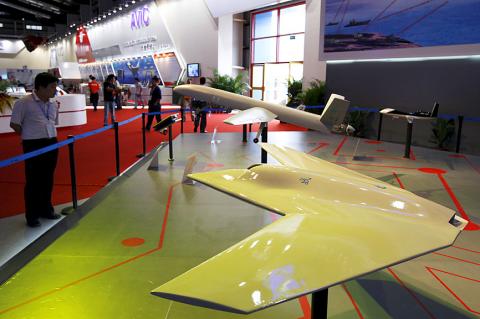
Photo: Reuters
He said the autonomous aerial vehicles would be used to gather intelligence on a constant basis,and in the case of military conflict, could fill the skies over Taiwan to stage bombing and missile attacks.
Extensive references in the report to the Chinese threat to Taiwan are carried in separate Taipei Times coverage.
Three of the drones now under development, the Yilong, Sky Saber and Lijian, are to be configured to fire precision weapons, the report said.
“The acquisition and development of longer-range [drones] will increase China’s ability to conduct long-range reconnaissance and strike operations,” the report said. “China is working on a range of technologies to attempt to counter US and other countries’ ballistic missile defense systems, including maneuverable re-entry vehicles; multiple, independently targetable re-entry vehicles; decoys, chaff, jamming and thermal shielding... The US and China acknowledge that the Chinese tested a hypersonic glide vehicle [last year].”
This last weapon can travel at 10 times the speed of sound and is designed to carry nuclear warheads, reports showed.
It added that China is increasing the lethality of its conventional missile force by fielding a new ballistic missile, the CSS-11 (DF-16) which possesses an estimated range of 800km to 1,000km.
“The CSS-11, coupled with the already deployed conventional variant of the CSS-5 (DF-21) medium-range ballistic missile will improve China’s ability to strike not only Taiwan, but other regional targets,” the report said.
It said that the Chinese military is an arm of the Chinese Communist Party (CCP) and its top priority is not to defend the nation, but to preserve the power of the party.

Tropical Storm Gaemi strengthened into a typhoon at 2pm yesterday, and could make landfall in Yilan County tomorrow, the Central Weather Administration (CWA) said yesterday. The agency was scheduled to issue a sea warning at 11:30pm yesterday, and could issue a land warning later today. Gaemi was moving north-northwest at 4kph, carrying maximum sustained winds near its center of up to 118.8kph and gusts of 154.8kph. The circumference is forecast to reach eastern Taiwan tomorrow morning, with the center making landfall in Yilan County later that night before departing from the north coast, CWA weather forecaster Kuan Shin-ping (官欣平) said yesterday. Uncertainty remains and

SEA WARNING LIKELY: The storm, named Gaemi, could become a moderate typhoon on Wednesday or Thursday, with the Taipei City Government preparing for flooding A tropical depression east of the Philippines developed into a tropical storm named Gaemi at 2pm yesterday, and was moving toward eastern Taiwan, the Central Weather Administration (CWA) said. Gaemi could begin to affect Taiwan proper on Tuesday, lasting until Friday, and could develop into a moderate typhoon on Wednesday or Thursday, it said. A sea warning for Gaemi could be issued as early as Tuesday morning, it added. Gaemi, the third tropical storm in the Pacific Ocean this typhoon season, is projected to begin moving northwest today, and be closest to Taiwan on Wednesday or Thursday, the agency said. Today, there would likely

DISRUPTIONS: The high-speed rail is to operate as normal, while several airlines either canceled flights or announced early departures or late arrivals Schools and offices in 15 cities and counties are to be closed today due to Typhoon Gaemi, local governments announced last night. The 15 are: Taipei, New Taipei City, Taoyuan, Tainan, Keelung, Hsinchu and Kaohsiung, as well as Yilan, Hualien, Hsinchu, Miaoli, Chiayi, Pingtung, Penghu and Lienchiang counties. People should brace for torrential rainfall brought by the storm, with its center forecast to make landfall on the east coast between tonight and tomorrow morning, the Central Weather Administration (CWA) said. The agency issued a sea warning for the typhoon at 11:30pm on Monday, followed by a land warning at 11:30am yesterday. As of

CASUALTY: A 70-year-old woman was killed by a falling tree in Kaohsiung as the premier warned all government agencies to remain on high alert for the next 24 hours Schools and offices nationwide are to be closed for a second day today as Typhoon Gaemi crosses over the nation, bringing torrential rain and whipping winds. Gaemi was forecast to make landfall late last night. From Tuesday night, its outer band brought substantial rainfall and strong winds to the nation. As of 6:15pm last night, the typhoon’s center was 20km southeast of Hualien County, Central Weather Administration (CWA) data showed. It was moving at 19kph and had a radius of 250km. As of 3pm yesterday, one woman had died, while 58 people were injured, the Central Emergency Operation Center said. The 70-year-old


 RSS
RSS