


The nation was struck by a magnitude 6.3 earthquake and four large aftershocks yesterday, killing one person and damaging infrastructure and private properties in the north.
After the main earthquake hit at 9:42am, an aftershock measuring magnitude 5.0 occurred seven minutes later, with the two epicenters only 13.2km apart.
A magnitude 5.5 aftershock struck southeast of Hualien at 7:20pm, which was measured at Level 4 intensity along the east coast. At 7:45pm, a magnitude 5.8 aftershock hit, generating Level 3 tremors in Yilan, Hualien and New Taipei City. Another aftershock came 15 minutes afterward, which was measured at magnitude 5.7.
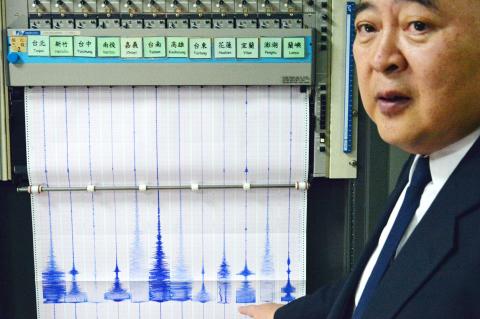
Photo: CNA
The Central Weather Bureau said the offshore earthquake occurred at 9:42am, with the epicenter identified as being near the east coast of Taiwan. It was categorized as a shallow earthquake, with the hypocenter 17.5km below the ground.
An 84-year-old man in Sinjhuang (新莊) died in a fire in his apartment building that was reportedly caused by an explosion of an electricity transformer box nearby. Another tenant in the building was injured in the fire.
The earthquake caused 11 cars to fall from a parking tower on Songjiang Road in Taipei, damaging some bebeyond repair.
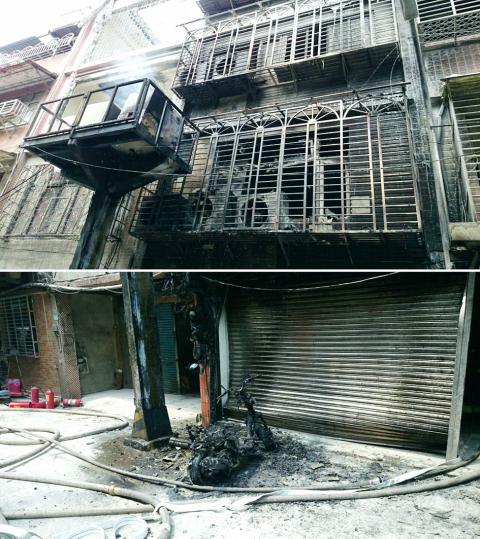
Photo courtesy of the New Taipei City Fire Department
Flooding was reported in New Taipei City’s Shulin District (樹林) after the earthquake, due to a broken underground water pipeline.
The Ministry of Education reported damage to facilities in nine institutions, including five schools in Yilan and four schools in Taipei, New Taipei City, Tainan and Hualien City. The financial losses were estimated at more than NT$290,000.
While the earthquake did not damage railway tracks, it forced 32 trains in operation to temporarily reduce speed. About 8,000 passengers were delayed.

Photo: Wang Yi-sung, Taipei Times
Statistics from the bureau showed the greatest intensity of shaking generated by the tremors, Level 4, was in Yilan and New Taipei City.
Meanwhile, Taipei, Hualien, Nantou, Taoyuan, Hsinchu, Changhua, Taichung and Yunlin recorded Level 3 intensity. Intensity levels across the rest of the nation reached Level 2 and Level 1.
People in New Taipei City’s Banciao District (板橋) felt the strongest effects of the earthquake, with the earthquake continuing at Level 4 intensity for about 0.12 seconds. The shaking continued at Level 3 intensity for about 16 seconds and at Level 2 intensity for about 1 minute and 2 seconds, the bureau said.
Bureau seismology center director Kuo Kai-wen (郭鎧紋) explained why an earthquake occurring off the nation’s east coast would be felt so strongly in New Taipei City.
“The sediments in the soil in Banciao are thick, but soft, which amplifies the effects generated by earthquakes. The earthquake’s waves would have bounced back and forth in the Taipei Basin, making people in Taipei more aware of the tremors than in other regions of the nation,” he said.
Kuo said the earthquake yesterday morning occurred at the Nanao Sea Basin (南澳海盆), which is a major source of earthquakes in Taiwan.
He added that its epicenter was close to that of the magnitude 6.8 earthquake that occurred on March 31, 2002, which killed 15 people.
The earthquake yesterday morning was caused as the Philippine Plate was subducted north into the Eurasian Plate. It was the third earthquake this year with a magnitude of more than 6.
“We do not exclude the possibility that another earthquake measuring magnitude 6 or above would occur this year,” Kuo said.
A magnitude 6.8 earthquake occurred in December last year, the only magnitude 6 earthquake last year, he added.

Tropical Storm Gaemi strengthened into a typhoon at 2pm yesterday, and could make landfall in Yilan County tomorrow, the Central Weather Administration (CWA) said yesterday. The agency was scheduled to issue a sea warning at 11:30pm yesterday, and could issue a land warning later today. Gaemi was moving north-northwest at 4kph, carrying maximum sustained winds near its center of up to 118.8kph and gusts of 154.8kph. The circumference is forecast to reach eastern Taiwan tomorrow morning, with the center making landfall in Yilan County later that night before departing from the north coast, CWA weather forecaster Kuan Shin-ping (官欣平) said yesterday. Uncertainty remains and

SEA WARNING LIKELY: The storm, named Gaemi, could become a moderate typhoon on Wednesday or Thursday, with the Taipei City Government preparing for flooding A tropical depression east of the Philippines developed into a tropical storm named Gaemi at 2pm yesterday, and was moving toward eastern Taiwan, the Central Weather Administration (CWA) said. Gaemi could begin to affect Taiwan proper on Tuesday, lasting until Friday, and could develop into a moderate typhoon on Wednesday or Thursday, it said. A sea warning for Gaemi could be issued as early as Tuesday morning, it added. Gaemi, the third tropical storm in the Pacific Ocean this typhoon season, is projected to begin moving northwest today, and be closest to Taiwan on Wednesday or Thursday, the agency said. Today, there would likely

DISRUPTIONS: The high-speed rail is to operate as normal, while several airlines either canceled flights or announced early departures or late arrivals Schools and offices in 15 cities and counties are to be closed today due to Typhoon Gaemi, local governments announced last night. The 15 are: Taipei, New Taipei City, Taoyuan, Tainan, Keelung, Hsinchu and Kaohsiung, as well as Yilan, Hualien, Hsinchu, Miaoli, Chiayi, Pingtung, Penghu and Lienchiang counties. People should brace for torrential rainfall brought by the storm, with its center forecast to make landfall on the east coast between tonight and tomorrow morning, the Central Weather Administration (CWA) said. The agency issued a sea warning for the typhoon at 11:30pm on Monday, followed by a land warning at 11:30am yesterday. As of

CASUALTY: A 70-year-old woman was killed by a falling tree in Kaohsiung as the premier warned all government agencies to remain on high alert for the next 24 hours Schools and offices nationwide are to be closed for a second day today as Typhoon Gaemi crosses over the nation, bringing torrential rain and whipping winds. Gaemi was forecast to make landfall late last night. From Tuesday night, its outer band brought substantial rainfall and strong winds to the nation. As of 6:15pm last night, the typhoon’s center was 20km southeast of Hualien County, Central Weather Administration (CWA) data showed. It was moving at 19kph and had a radius of 250km. As of 3pm yesterday, one woman had died, while 58 people were injured, the Central Emergency Operation Center said. The 70-year-old


 RSS
RSS