


The US Office of Naval Intelligence has released a new report on the Chinese People’s Liberation Army Navy (PLAN) saying that its “central priority” is to force the “unification” of Taiwan and China.
Given the pace of Chinese military modernization, the gap in military capability between Beijing and Taipei will continue to widen in China’s favor over the coming years, the report said.
Titled The PLA Navy: New Capabilities and Missions for the 21st Century, the report is the first of its kind issued by US Naval Intelligence in six years.
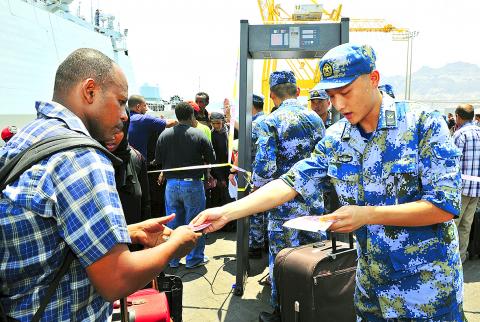
Photo: Reuters
“In addition to improving the traditional destroyer and frigate backbone of its fleet, the PLAN is on the verge of incorporating very different platforms that will greatly influence the operations of its future fleet,” the report found.
Nuclear-armed Jin-class submarines are poised to begin strategic patrols in the near future, putting Chinese intercontinental ballistic missiles to sea for the first time, it said.
“Against this backdrop of increasing military capability, China’s leaders appear increasingly willing to assert China’s maritime claims, even when such actions risk exacerbating tension with China’s neighbors,” the report said.
Chinese President Xi Jinping (習近平) continues to emphasize the importance of maritime power to enable China’s development, it added.
“Taiwan ‘reunification’ remains the main driver for military modernization,” it said.
According to the report, China views unification with Taiwan as an “immutable long-term goal and hopes to prevent any third party from intervening in what China asserts is an internal matter.”
China’s leaders have long emphasized their preference for peaceful unification, but also say that China is not prepared to wait indefinitely for a political resolution, the report said.
“For several decades, China’s naval investments have focused heavily on capabilities to deter Taiwan’s moves toward independence, to successfully reverse Taiwan’s actions should deterrence fail and — if necessary — to force ‘unification,’ even if the United States were to become militarily involved,” it said.
To achieve unification, the report says that China has built or acquired a wide array of advanced platforms, including submarines, major surface vessels, missile patrol craft, maritime strike aircraft and land-based systems employing new anti-ship cruise missiles and surface-to-air missiles.
China has also developed the world’s first anti-ship ballistic missile, specifically designed to attack enemy aircraft carriers.
“Chinese leaders hope that simply possessing these military capabilities will deter pro-independence moves or — should deterrence fail — permit a range of military options that can be tailored to the specific situation,” the report said.
It concludes that in contrast to its narrow focus of just a decade ago, the PLAN is evolving to meet a wide range of missions, including conflict with Taiwan, enforcement of maritime claims, protection of economic interests as well as counterpiracy and humanitarian missions.
“In the next decade, China will complete its transition from a coastal navy to a navy capable of multiple missions around the world,” the report said.
Although being prepared to “forcibly reunify [sic] Taiwan with the mainland” will remain a “driving force” behind China’s naval modernization, the report says the PLAN is simultaneously focusing resources on a growing array of other challenges.
It says: “Friction between China and its neighbors appears increasingly likely as Beijing seeks to deter rival activities and assert its own claimed rights and interests.”

Tropical Storm Gaemi strengthened into a typhoon at 2pm yesterday, and could make landfall in Yilan County tomorrow, the Central Weather Administration (CWA) said yesterday. The agency was scheduled to issue a sea warning at 11:30pm yesterday, and could issue a land warning later today. Gaemi was moving north-northwest at 4kph, carrying maximum sustained winds near its center of up to 118.8kph and gusts of 154.8kph. The circumference is forecast to reach eastern Taiwan tomorrow morning, with the center making landfall in Yilan County later that night before departing from the north coast, CWA weather forecaster Kuan Shin-ping (官欣平) said yesterday. Uncertainty remains and

SEA WARNING LIKELY: The storm, named Gaemi, could become a moderate typhoon on Wednesday or Thursday, with the Taipei City Government preparing for flooding A tropical depression east of the Philippines developed into a tropical storm named Gaemi at 2pm yesterday, and was moving toward eastern Taiwan, the Central Weather Administration (CWA) said. Gaemi could begin to affect Taiwan proper on Tuesday, lasting until Friday, and could develop into a moderate typhoon on Wednesday or Thursday, it said. A sea warning for Gaemi could be issued as early as Tuesday morning, it added. Gaemi, the third tropical storm in the Pacific Ocean this typhoon season, is projected to begin moving northwest today, and be closest to Taiwan on Wednesday or Thursday, the agency said. Today, there would likely

DISRUPTIONS: The high-speed rail is to operate as normal, while several airlines either canceled flights or announced early departures or late arrivals Schools and offices in 15 cities and counties are to be closed today due to Typhoon Gaemi, local governments announced last night. The 15 are: Taipei, New Taipei City, Taoyuan, Tainan, Keelung, Hsinchu and Kaohsiung, as well as Yilan, Hualien, Hsinchu, Miaoli, Chiayi, Pingtung, Penghu and Lienchiang counties. People should brace for torrential rainfall brought by the storm, with its center forecast to make landfall on the east coast between tonight and tomorrow morning, the Central Weather Administration (CWA) said. The agency issued a sea warning for the typhoon at 11:30pm on Monday, followed by a land warning at 11:30am yesterday. As of

CASUALTY: A 70-year-old woman was killed by a falling tree in Kaohsiung as the premier warned all government agencies to remain on high alert for the next 24 hours Schools and offices nationwide are to be closed for a second day today as Typhoon Gaemi crosses over the nation, bringing torrential rain and whipping winds. Gaemi was forecast to make landfall late last night. From Tuesday night, its outer band brought substantial rainfall and strong winds to the nation. As of 6:15pm last night, the typhoon’s center was 20km southeast of Hualien County, Central Weather Administration (CWA) data showed. It was moving at 19kph and had a radius of 250km. As of 3pm yesterday, one woman had died, while 58 people were injured, the Central Emergency Operation Center said. The 70-year-old


 RSS
RSS