


Union representatives from South Korea’s Hydis Technologies have launched a second wave of protests in Taipei, calling on Taiwan’s E Ink Holdings Inc (EIH, 元太科技) — of which Hydis is a subsidiary — to revoke its decision to shut down two factories in South Korea.
Traversing national boundaries, the heated labor dispute has raged since January, when EIH — which supplies e-paper displays for Amazon.com Inc and Sony Corp — announced its intention to dismiss more than 350 Hydis workers.
About 30 South Korean workers yesterday rallied in front of the Ministry of Labor building, urging authorities to facilitate talks between the workers and the Yuen Foong Yu (YFY Group) — with which EIH is affiliated.
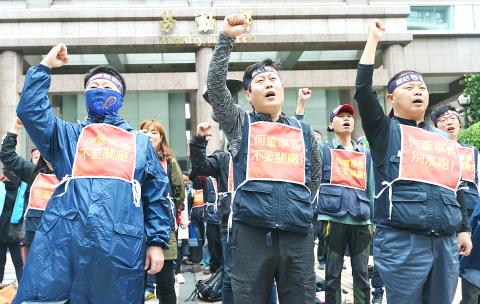
Photo: Chang Chia-ming, Taipei Times
Union representatives rebuked EIH’s claims that Hydis was unprofitable, saying that Hydis made more than NT$2.8 billion (US$89.81 million) last year from its patent royalties in Fringe Field Switching (FFS) — a key technology in the LCD electronics industry.
They said the closures would cost the jobs of more than 350 Hydis workers, adding that it was against South Korean labor regulations for a profitable company to engage in a mass layoff of its employees.
Hydis union president Woo Boo-ki said the workers intend to continue their protests until they are allowed to keep their jobs.
The workers accused EIH of stripping investment after absorbing the South Korean company’s key technologies.
“When the dismissals were announced, we felt robbed of our heritage, as FFS was something we worked hard together to build; how would you feel if somebody took away your national treasures from a museum?” said Sean Kim, an assistant manager in international sales.
Hydis has experienced a turbulent recent history since it was acquired by China’s BOE Technology Group Co (京東方) in 2003. The troubled company later filed for court receivership in 2006 after BOE executives were accused of leaking key patented technologies to China. It was acquired by EIH in 2008.
South Korean labor activist Chong Hye-won called on Taiwanese authorities to step in over the case, as YFY Group chairman Ho Shou-chuan (何壽川) is a national policy adviser to President Ma Ying-jeou (馬英九) and is seen as well-connected with the current administration.
Despite repeated efforts, the workers’ demands to arrange a meeting with Ho and YFY Group board members have failed to materialize, Chong said.
The activists said it was within the Ministry of Labor’s power to ensure that the YFY Group does not evade its responsibilities in negotiating with the South Korean workers.
However, the ministry’s Union Affairs section head Hsu Ken-kuei (許根魁) said that the Collective Agreement Act (團體協約法) does not hold binding authority over labor disputes that occur overseas.
He said the ministry would continue to facilitate talks between the workers and YFY Group, adding that the two parties need to overcome their disparate views on the company’s financial wellbeing.
EIH said in a statement that its decision to close down its South Korean factories was obliged by local law.
“The accusation is not true. It is a rumor from certain union representatives, which have caused social unrest in Taiwan,” EIH said in the statement.
The company again urged Hydis employees to return to the negotiation table.
E Ink plans to shut down two factories in Icheon, South Korea, at the end of this month after its multi-year turnaround efforts failed.
The company said it is offering a new early retirement program for Hydis employees, job relocation and education subsidies for children of Hydis workers, which is better than its standard offering.
“The board decided to shut down factories that are uncompetitive because of high manufacturing costs,” EIH said. “The closure is fully obliged by South Korean law.”
Hydis has lost more than US$100 million since 2008, primarily due to low factory utilization and a poor yield rate, EIH said.

SECURITY: As China is ‘reshaping’ Hong Kong’s population, Taiwan must raise the eligibility threshold for applications from Hong Kongers, Chiu Chui-cheng said When Hong Kong and Macau citizens apply for residency in Taiwan, it would be under a new category that includes a “national security observation period,” Mainland Affairs Council (MAC) Minister Chiu Chui-cheng (邱垂正) said yesterday. President William Lai (賴清德) on March 13 announced 17 strategies to counter China’s aggression toward Taiwan, including incorporating national security considerations into the review process for residency applications from Hong Kong and Macau citizens. The situation in Hong Kong is constantly changing, Chiu said to media yesterday on the sidelines of the Taipei Technology Run hosted by the Taipei Neihu Technology Park Development Association. With

CARROT AND STICK: While unrelenting in its military threats, China attracted nearly 40,000 Taiwanese to over 400 business events last year Nearly 40,000 Taiwanese last year joined industry events in China, such as conferences and trade fairs, supported by the Chinese government, a study showed yesterday, as Beijing ramps up a charm offensive toward Taipei alongside military pressure. China has long taken a carrot-and-stick approach to Taiwan, threatening it with the prospect of military action while reaching out to those it believes are amenable to Beijing’s point of view. Taiwanese security officials are wary of what they see as Beijing’s influence campaigns to sway public opinion after Taipei and Beijing gradually resumed travel links halted by the COVID-19 pandemic, but the scale of
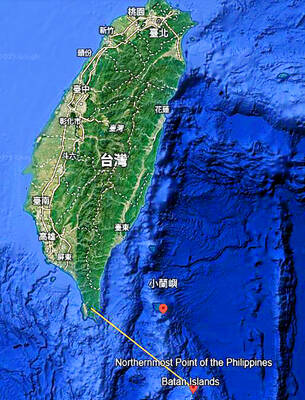
A US Marine Corps regiment equipped with Naval Strike Missiles (NSM) is set to participate in the upcoming Balikatan 25 exercise in the Luzon Strait, marking the system’s first-ever deployment in the Philippines. US and Philippine officials have separately confirmed that the Navy Marine Expeditionary Ship Interdiction System (NMESIS) — the mobile launch platform for the Naval Strike Missile — would take part in the joint exercise. The missiles are being deployed to “a strategic first island chain chokepoint” in the waters between Taiwan proper and the Philippines, US-based Naval News reported. “The Luzon Strait and Bashi Channel represent a critical access

Pope Francis is be laid to rest on Saturday after lying in state for three days in St Peter’s Basilica, where the faithful are expected to flock to pay their respects to history’s first Latin American pontiff. The cardinals met yesterday in the Vatican’s synod hall to chart the next steps before a conclave begins to choose Francis’ successor, as condolences poured in from around the world. According to current norms, the conclave must begin between May 5 and 10. The cardinals set the funeral for Saturday at 10am in St Peter’s Square, to be celebrated by the dean of the College


 RSS
RSS