


The Central Election Commission (CEC) yesterday announced its final decision to combine the presidential and legislative elections next year, to save money and increase voter turnout.
“CEC members decided during a meeting today that the 14th presidential and the 9th legislative elections [next year] shall be held on the same day,” CEC Chairman Liu I-chou (劉義周) told a press conference after the meeting. “As for the date of the elections, the CEC will call a meeting with local election commissions to decide.”
Although a date has not been set, the elections are likely to be held in January next year, before the start of a new legislative session the following month.
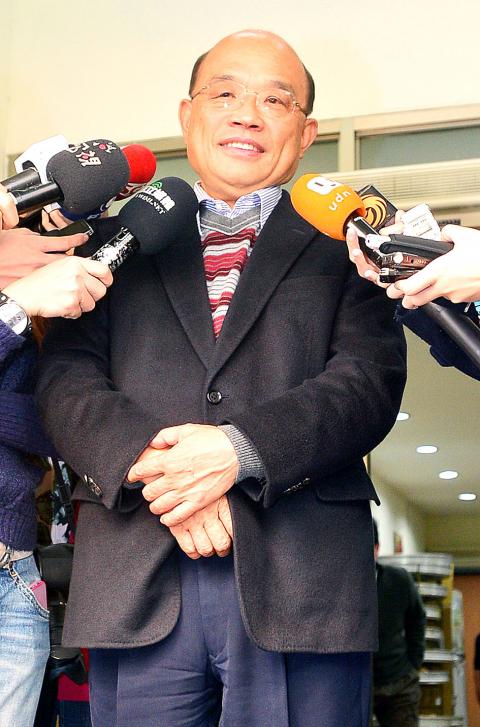
Photo: Wang Yi-sung, Taipei Times
Liu said that according to three public hearings and an opinion poll, most people support combining the elections.
“Holding the two elections on the same day can help save money and social resources by avoiding repeated large-scale political mobilizations within a short time,” he said. “Moreover, compared with the 2008 presidential and legislative elections — which were held separately — the number of voters in the 2012 combined elections rose by about 3.3 million.”
Liu said the decision was also made to ensure policy continuity, since the 2012 presidential and legislative elections were held on the same day, as were last year’s nine-in-one elections.
Liu said concerns raised by Chinese Nationalist Party (KMT) Chairman Eric Chu (朱立倫) over the large gap between the elections in January and the presidential inauguration on May 20 would not be a problem.
“The nation has its own laws and systems to deal with the issue,” Liu said. “Besides, there would also be an empty period if the presidential election is postponed.”
Democratic Progressive Party (DPP) Legislator Wu Ping-jui (吳秉叡) welcomed the decision, saying that combined elections might save the nation up to NT$500 million (US$15 million).
Meanwhile, DPP spokesperson Cheng Yun-peng (鄭運鵬) urged the commission to draft laws and regulations to institutionalize combined legislative and presidential elections to avoid more debates on the issue.
KMT Legislator Lai Shyh-bao (賴士葆) said he respected the commission’s decision, adding that he did not think the change would make much difference to the party.

Tropical Storm Gaemi strengthened into a typhoon at 2pm yesterday, and could make landfall in Yilan County tomorrow, the Central Weather Administration (CWA) said yesterday. The agency was scheduled to issue a sea warning at 11:30pm yesterday, and could issue a land warning later today. Gaemi was moving north-northwest at 4kph, carrying maximum sustained winds near its center of up to 118.8kph and gusts of 154.8kph. The circumference is forecast to reach eastern Taiwan tomorrow morning, with the center making landfall in Yilan County later that night before departing from the north coast, CWA weather forecaster Kuan Shin-ping (官欣平) said yesterday. Uncertainty remains and

SEA WARNING LIKELY: The storm, named Gaemi, could become a moderate typhoon on Wednesday or Thursday, with the Taipei City Government preparing for flooding A tropical depression east of the Philippines developed into a tropical storm named Gaemi at 2pm yesterday, and was moving toward eastern Taiwan, the Central Weather Administration (CWA) said. Gaemi could begin to affect Taiwan proper on Tuesday, lasting until Friday, and could develop into a moderate typhoon on Wednesday or Thursday, it said. A sea warning for Gaemi could be issued as early as Tuesday morning, it added. Gaemi, the third tropical storm in the Pacific Ocean this typhoon season, is projected to begin moving northwest today, and be closest to Taiwan on Wednesday or Thursday, the agency said. Today, there would likely

DISRUPTIONS: The high-speed rail is to operate as normal, while several airlines either canceled flights or announced early departures or late arrivals Schools and offices in 15 cities and counties are to be closed today due to Typhoon Gaemi, local governments announced last night. The 15 are: Taipei, New Taipei City, Taoyuan, Tainan, Keelung, Hsinchu and Kaohsiung, as well as Yilan, Hualien, Hsinchu, Miaoli, Chiayi, Pingtung, Penghu and Lienchiang counties. People should brace for torrential rainfall brought by the storm, with its center forecast to make landfall on the east coast between tonight and tomorrow morning, the Central Weather Administration (CWA) said. The agency issued a sea warning for the typhoon at 11:30pm on Monday, followed by a land warning at 11:30am yesterday. As of

CASUALTY: A 70-year-old woman was killed by a falling tree in Kaohsiung as the premier warned all government agencies to remain on high alert for the next 24 hours Schools and offices nationwide are to be closed for a second day today as Typhoon Gaemi crosses over the nation, bringing torrential rain and whipping winds. Gaemi was forecast to make landfall late last night. From Tuesday night, its outer band brought substantial rainfall and strong winds to the nation. As of 6:15pm last night, the typhoon’s center was 20km southeast of Hualien County, Central Weather Administration (CWA) data showed. It was moving at 19kph and had a radius of 250km. As of 3pm yesterday, one woman had died, while 58 people were injured, the Central Emergency Operation Center said. The 70-year-old


 RSS
RSS