


Saudi Arabia’s King Abdullah died yesterday and was replaced by his half-brother Salman as the absolute ruler of the world’s top oil exporter and the spiritual home of Islam.
Abdullah, believed to be about 90, died at 1am, the royal court said in a statement, expressing its “great sadness and mourning.”
Salman, 79, had been Saudi Arabian minister of defense and previously governor of Riyadh.
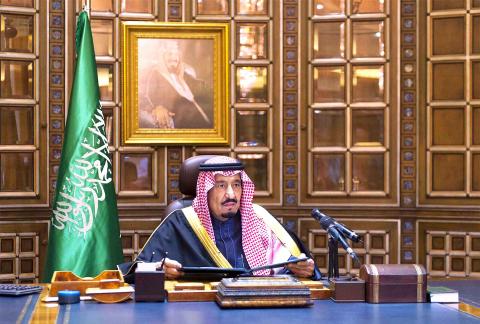
Photo: EPA
Another half-brother of the late monarch, Moqren, was named the new crown prince.
Abdullah was to be buried later yesterday following afternoon prayers, and citizens would be invited to pledge allegiance to the new monarch and the crown prince at the royal palace, the statement said.
The royal court did not disclose the cause of Abdullah’s death, but he was hospitalized last month because of pneumonia and had been breathing with the aid of a tube.
Under Abdullah, who took the throne in 2005, Saudi Arabia has been a key ally of Washington in the Arab world, most recently joining the US-led coalition to carry out air strikes against the Islamic State group in Syria and Iraq.
US President Barack Obama was quick to pay tribute to Abdullah as a valued ally.
“As our countries worked together to confront many challenges, I always valued King Abdullah’s perspective and appreciated our genuine and warm friendship,” Obama said in a written statement after the monarch’s death.
“The closeness and strength of the partnership between our two countries is part of King Abdullah’s legacy,” he said.
Abdullah had a shrewd grasp of regional politics.
Wary of the rising influence of extremist movements, Saudi Arabia has been a generous supporter of Egyptian President Abdel Fattah al-Sisi since the army’s ouster of former Egyptian president Mohamed Morsi of the Muslim Brotherhood.
It has also played a key role in supporting opposition to Syrian President Bashar al-Assad, allowing US troops to use its territory to train rebel fighters.
Salman is widely expected to follow closely in Abdullah’s footsteps, in foreign and energy policy as well as in making moderate reforms to the deeply conservative kingdom.
Saudi Arabia is still strongly criticized over its human rights record, including the imprisonment of dissidents. It is also the only country in the world that does not allow women to drive.

SECURITY: As China is ‘reshaping’ Hong Kong’s population, Taiwan must raise the eligibility threshold for applications from Hong Kongers, Chiu Chui-cheng said When Hong Kong and Macau citizens apply for residency in Taiwan, it would be under a new category that includes a “national security observation period,” Mainland Affairs Council (MAC) Minister Chiu Chui-cheng (邱垂正) said yesterday. President William Lai (賴清德) on March 13 announced 17 strategies to counter China’s aggression toward Taiwan, including incorporating national security considerations into the review process for residency applications from Hong Kong and Macau citizens. The situation in Hong Kong is constantly changing, Chiu said to media yesterday on the sidelines of the Taipei Technology Run hosted by the Taipei Neihu Technology Park Development Association. With

CARROT AND STICK: While unrelenting in its military threats, China attracted nearly 40,000 Taiwanese to over 400 business events last year Nearly 40,000 Taiwanese last year joined industry events in China, such as conferences and trade fairs, supported by the Chinese government, a study showed yesterday, as Beijing ramps up a charm offensive toward Taipei alongside military pressure. China has long taken a carrot-and-stick approach to Taiwan, threatening it with the prospect of military action while reaching out to those it believes are amenable to Beijing’s point of view. Taiwanese security officials are wary of what they see as Beijing’s influence campaigns to sway public opinion after Taipei and Beijing gradually resumed travel links halted by the COVID-19 pandemic, but the scale of
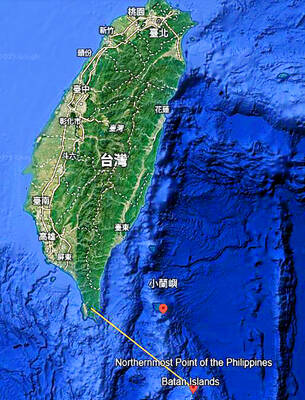
A US Marine Corps regiment equipped with Naval Strike Missiles (NSM) is set to participate in the upcoming Balikatan 25 exercise in the Luzon Strait, marking the system’s first-ever deployment in the Philippines. US and Philippine officials have separately confirmed that the Navy Marine Expeditionary Ship Interdiction System (NMESIS) — the mobile launch platform for the Naval Strike Missile — would take part in the joint exercise. The missiles are being deployed to “a strategic first island chain chokepoint” in the waters between Taiwan proper and the Philippines, US-based Naval News reported. “The Luzon Strait and Bashi Channel represent a critical access
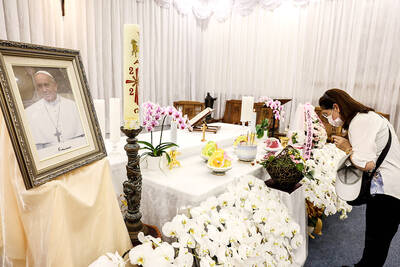
Pope Francis is be laid to rest on Saturday after lying in state for three days in St Peter’s Basilica, where the faithful are expected to flock to pay their respects to history’s first Latin American pontiff. The cardinals met yesterday in the Vatican’s synod hall to chart the next steps before a conclave begins to choose Francis’ successor, as condolences poured in from around the world. According to current norms, the conclave must begin between May 5 and 10. The cardinals set the funeral for Saturday at 10am in St Peter’s Square, to be celebrated by the dean of the College


 RSS
RSS