


In a landmark ruling that is expected to have wide political ramifications, the Taiwan High Court handed down a “not guilty” verdict to 10 then-New Taipei City councilors who “flashed ballots” to show observers their votes in the city council’s 2010 speaker election.
The ruling upheld the decision by the New Taipei City District Court in May last year, which found the 10 Democratic Progressive Party (DPP) councilors, including Lee Wan-yu (李婉鈺) and Sheng Fa-hui (沈發惠), who were charged with disclosure of state secrets and related offenses arising from the case, not guilty.
Yesterday’s ruling is seen by senior DPP officials and some civic groups as a positive development, as they have long advocated for changes to institute “recorded voting,” or “roll call voting,” instead of the current “secret ballots” in local councils.
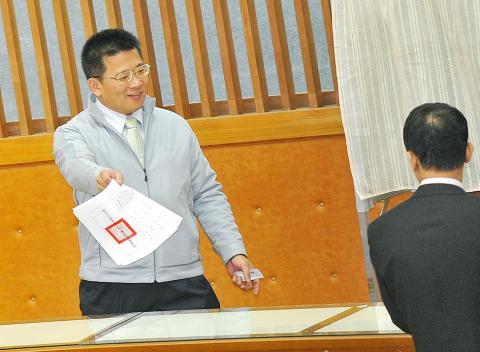
Photo: Liu Hsin-de, Taipei Times
They see “recorded voting” as a better political reform measure to counter potential bribery and vote-buying, and to monitor councilors who vote against the majority of their constituents’ wishes.
The High Court ruling states that city and county council speakers and deputy speakers have job functions that entail important political and administrative policies, and previous court decisions cited Article 132 of the Criminal Code, which covers public officials’ disclosure of documents or information of a secret nature on matters outside of national defense.
In this decision, the judges said that in the case of the election of speaker and deputy speaker by councilors, the voting and balloting process in itself is not concerned with national political and administrative policies, and as such, the “ballot flashing” was not in violation of Article 132, and therefore the councilors were found not guilty.
The decision is final and cannot be appealed.
Following the High Court’s decision, Supreme Prosecutors’ Office Prosecutor-General Yen Ta-ho (顏大和) cited the different rulings between the 2010 council speaker election in Greater Kaohsiung and the then-Taichung City election in 1994.
Yen said he would make an “extraordinary appeal” to the Supreme Court on the not-guilty ruling in the “ballot flashing” case of Greater Kaohsiung councilors in the 2010 council speaker election, because he noted the court found Taichung City councilors guilty in a similar situation in 1994.
DPP spokesperson Huang Di-ying (黃帝穎) and legal counsel Wellington Koo (顧立雄) urged the judiciary to focus on bribery and vote-buying in local council elections, and to not waste resources going after councilors who cast the ballots.

Tropical Storm Gaemi strengthened into a typhoon at 2pm yesterday, and could make landfall in Yilan County tomorrow, the Central Weather Administration (CWA) said yesterday. The agency was scheduled to issue a sea warning at 11:30pm yesterday, and could issue a land warning later today. Gaemi was moving north-northwest at 4kph, carrying maximum sustained winds near its center of up to 118.8kph and gusts of 154.8kph. The circumference is forecast to reach eastern Taiwan tomorrow morning, with the center making landfall in Yilan County later that night before departing from the north coast, CWA weather forecaster Kuan Shin-ping (官欣平) said yesterday. Uncertainty remains and

SEA WARNING LIKELY: The storm, named Gaemi, could become a moderate typhoon on Wednesday or Thursday, with the Taipei City Government preparing for flooding A tropical depression east of the Philippines developed into a tropical storm named Gaemi at 2pm yesterday, and was moving toward eastern Taiwan, the Central Weather Administration (CWA) said. Gaemi could begin to affect Taiwan proper on Tuesday, lasting until Friday, and could develop into a moderate typhoon on Wednesday or Thursday, it said. A sea warning for Gaemi could be issued as early as Tuesday morning, it added. Gaemi, the third tropical storm in the Pacific Ocean this typhoon season, is projected to begin moving northwest today, and be closest to Taiwan on Wednesday or Thursday, the agency said. Today, there would likely

DISRUPTIONS: The high-speed rail is to operate as normal, while several airlines either canceled flights or announced early departures or late arrivals Schools and offices in 15 cities and counties are to be closed today due to Typhoon Gaemi, local governments announced last night. The 15 are: Taipei, New Taipei City, Taoyuan, Tainan, Keelung, Hsinchu and Kaohsiung, as well as Yilan, Hualien, Hsinchu, Miaoli, Chiayi, Pingtung, Penghu and Lienchiang counties. People should brace for torrential rainfall brought by the storm, with its center forecast to make landfall on the east coast between tonight and tomorrow morning, the Central Weather Administration (CWA) said. The agency issued a sea warning for the typhoon at 11:30pm on Monday, followed by a land warning at 11:30am yesterday. As of

CASUALTY: A 70-year-old woman was killed by a falling tree in Kaohsiung as the premier warned all government agencies to remain on high alert for the next 24 hours Schools and offices nationwide are to be closed for a second day today as Typhoon Gaemi crosses over the nation, bringing torrential rain and whipping winds. Gaemi was forecast to make landfall late last night. From Tuesday night, its outer band brought substantial rainfall and strong winds to the nation. As of 6:15pm last night, the typhoon’s center was 20km southeast of Hualien County, Central Weather Administration (CWA) data showed. It was moving at 19kph and had a radius of 250km. As of 3pm yesterday, one woman had died, while 58 people were injured, the Central Emergency Operation Center said. The 70-year-old


 RSS
RSS