


A handshake between President Ma Ying-jeou (馬英九) and Taipei Mayor Ko Wen-je (柯文哲) at a New Year’s Day flag-raising ceremony has gone viral online because Ko told reporters that he had been thinking of Ma’s so-called “death grip” during the event.
Ko was among a line of people with whom Ma shook hands before the ceremony on Ketagalan Boulevard in front of the Presidential Office Building. However, Ko was holding a miniature Republic of China flag in his right hand — the hand he used to greet the president with a brief clasp.
After the ceremony, reporters asked the mayor what he was thinking during the handshake and why continued holding the flag.
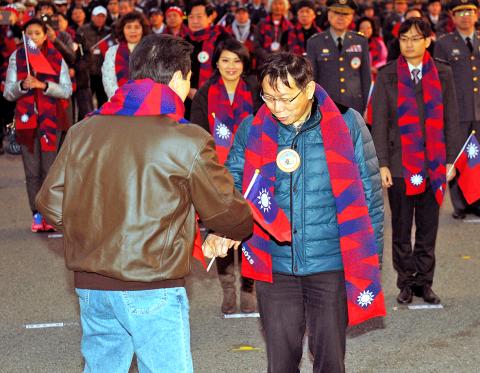
Photo: CNA
“I was thinking about the ‘death-grip handshake (死亡之握)’ and ‘healing hands (回春之手)’; which would get the better of the other?” Ko said, before erupting into laughter.
He added that the flag remained in his hand because he could not shift it to his other quickly enough.
Online commenters started riffing on Ko’s responses, mentioning a so-called “curse of bad luck” said to be associated with shaking hands with the president. Netizens referred to several athletes who they said saw a downturn in their performances after shaking hands with Ma.
In response to the widespread media coverage of the handshake, long-term Ma aide and former Presidential Office deputy secretary-general Lo Chih-chiang (羅智強) posted comments on Facebook on Friday and yesterday about the innuendo.
Lo described the “death-grip handshake” as among the most malicious rumors circulated against the president, attributing it to the pan-green political camp and netizens who were “not tenderhearted” enough to sympathize with people who encounter misfortune between three months and a year after interacting with Ma.
Lo said that linking Ma to misfortune not only characterizes the president as a source of bad luck, but also harms society, since it teaches the public to respond to other people’s hardships not with empathy and respect, but to instead use them for political gain.
Lo acknowledged that some commenters might think there is no need to take a joke so seriously, before offering a counterexample involving the opposition and Japan’s 2011 earthquake, tsunami and nuclear power plant disaster.
“Yes, maybe I take it too seriously, but if it is a joke, why not play it on [Democratic Progressive Party Chairperson] Tsai Ing-wen (蔡英文)?” Lo said.
The day that Japan was hit by an earthquake — March 11, 2011 — which triggered a devastating tsunami, was the day that Tsai declared her candidacy for the 2012 presidential election, but no one from the pan-blue camp ever said that there was a link between the two, Lo said.
“That is the biggest difference between the blue and green camps,” he added.
Fu Jen Catholic University assistant professor Chou Wei-hang (周偉航), known online as Ninjia Text (人渣文本), said the “death-grip handshake” theory was just a facetious remark.
Scientifically speaking, it applies to every politician, because politicians shake hands with people all the time, putting the chance of death among people who have shaken hands with politicians above average, Chou said.
Ma had his handshake jokingly dubbed the “death-grip handshake” because he failed to show compassion to people under his governance in the first place, Chou said.
“If this remains unresolved, he will always be the president who people make jokes about,” Chou added.
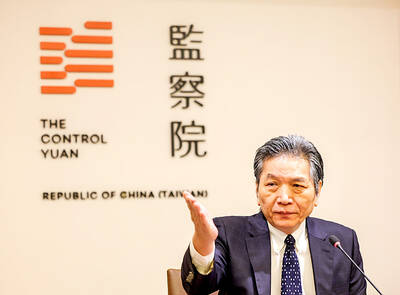
‘ABUSE OF POWER’: Lee Chun-yi allegedly used a Control Yuan vehicle to transport his dog to a pet grooming salon and take his wife to restaurants, media reports said Control Yuan Secretary-General Lee Chun-yi (李俊俋) resigned on Sunday night, admitting that he had misused a government vehicle, as reported by the media. Control Yuan Vice President Lee Hung-chun (李鴻鈞) yesterday apologized to the public over the issue. The watchdog body would follow up on similar accusations made by the Chinese Nationalist Party (KMT) and would investigate the alleged misuse of government vehicles by three other Control Yuan members: Su Li-chiung (蘇麗瓊), Lin Yu-jung (林郁容) and Wang Jung-chang (王榮璋), Lee Hung-chun said. Lee Chun-yi in a statement apologized for using a Control Yuan vehicle to transport his dog to a
BEIJING’S ‘PAWN’: ‘We, as Chinese, should never forget our roots, history, culture,’ Want Want Holdings general manager Tsai Wang-ting said at a summit in China The Mainland Affairs Council (MAC) yesterday condemned Want Want China Times Media Group (旺旺中時媒體集團) for making comments at the Cross-Strait Chinese Culture Summit that it said have damaged Taiwan’s sovereignty, adding that it would investigate if the group had colluded with China in the matter and contravened cross-strait regulations. The council issued a statement after Want Want Holdings (旺旺集團有限公司) general manager Tsai Wang-ting (蔡旺庭), the third son of the group’s founder, Tsai Eng-meng (蔡衍明), said at the summit last week that the group originated in “Chinese Taiwan,” and has developed and prospered in “the motherland.” “We, as Chinese, should never
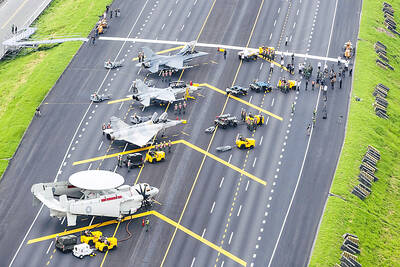
‘A SURVIVAL QUESTION’: US officials have been urging the opposition KMT and TPP not to block defense spending, especially the special defense budget, an official said The US plans to ramp up weapons sales to Taiwan to a level exceeding US President Donald Trump’s first term as part of an effort to deter China as it intensifies military pressure on the nation, two US officials said on condition of anonymity. If US arms sales do accelerate, it could ease worries about the extent of Trump’s commitment to Taiwan. It would also add new friction to the tense US-China relationship. The officials said they expect US approvals for weapons sales to Taiwan over the next four years to surpass those in Trump’s first term, with one of them saying
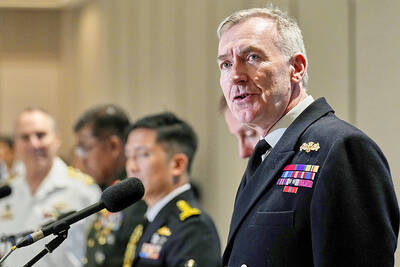
INDO-PACIFIC REGION: Royal Navy ships exercise the right of freedom of navigation, including in the Taiwan Strait and South China Sea, the UK’s Tony Radakin told a summit Freedom of navigation in the Indo-Pacific region is as important as it is in the English Channel, British Chief of the Defence Staff Admiral Tony Radakin said at a summit in Singapore on Saturday. The remark came as the British Royal Navy’s flagship aircraft carrier, the HMS Prince of Wales, is on an eight-month deployment to the Indo-Pacific region as head of an international carrier strike group. “Upholding the UN Convention on the Law of the Sea, and with it, the principles of the freedom of navigation, in this part of the world matters to us just as it matters in the


 RSS
RSS