


Hong Kong student leaders of pro-democracy protests were blocked from flying to Beijing as they sought to meet with Chinese leaders to press their case for open elections for the territory’s chief executive in 2017.
Three members of the Hong Kong Federation of Students were told by airline personnel that they could not board because Chinese authorities canceled their so-called “home return permits,” federation Secretary-General Alex Chow told reporters at Hong Kong International Airport yesterday, in comments broadcast live on Cable TV Hong Kong.
The students had planned to seek talks with Chinese officials on their own after requests to former Hong Kong chief executive Tung Chee-hwa (董建華) and Rita Fan (范徐麗泰), a Hong Kong deputy to China’s National People’s Congress, to arrange a meeting apparently went unheeded. The federation wants Beijing to reverse its decision to vet candidates for Hong Kong’s chief executive election in 2017, the group said in a statement on Facebook.
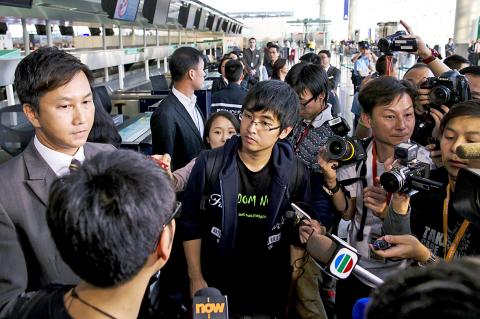
Photo: Reuters
Hong Kong Police Commissioner Andrew Tsang (曾偉雄) yesterday said that his force would help clear protest sites that have blocked main roads and disrupted the territory for more than seven weeks after a judge dismissed demonstrators’ appeals against orders to remove them.
The street occupations are illegal and protesters should not interfere when the removal of blockades begins, Tsang said in a press briefing broadcast live on Cable TV Hong Kong. He did not say when that would be.
Hong Kong High Court Chief Judge Andrew Cheung Kui-nung’s (張舉能) ruling means that bailiffs can remove obstructions at two protest sites in Mong Kok on the north side of Victoria Harbour. An injunction was also granted against protesters in Admiralty, where the city’s government headquarters are located. Under the injunctions, police are authorized to assist in the clearing and to arrest anyone who interferes.
The ruling risks reigniting violent clashes between police and protesters as government talks with student leaders are stalled. Chinese President Xi Jinping (習近平) last week expressed support for Hong Kong Chief Executive Leung Chun-ying (梁振英) while hosting the APEC summit in Beijing.
The protests were sparked by China’s decision to control the nomination process for the city’s first leadership election in 2017, issuing the biggest challenge that Hong Kong has posed for China since its resumption of sovereignty over the territory in 1997.
The protest movement that has occupied Hong Kong’s streets in main commercial districts since September is losing momentum amid dissent among its leaders and dwindling crowds. Hong Kong Chief Secretary Carrie Lam (林鄭月娥) has ruled out more talks with the students.
The Mong Kok injunctions were brought by taxi and bus drivers who said that their business has been impaired by the blockage of key roads by the students.

Tropical Storm Gaemi strengthened into a typhoon at 2pm yesterday, and could make landfall in Yilan County tomorrow, the Central Weather Administration (CWA) said yesterday. The agency was scheduled to issue a sea warning at 11:30pm yesterday, and could issue a land warning later today. Gaemi was moving north-northwest at 4kph, carrying maximum sustained winds near its center of up to 118.8kph and gusts of 154.8kph. The circumference is forecast to reach eastern Taiwan tomorrow morning, with the center making landfall in Yilan County later that night before departing from the north coast, CWA weather forecaster Kuan Shin-ping (官欣平) said yesterday. Uncertainty remains and

SEA WARNING LIKELY: The storm, named Gaemi, could become a moderate typhoon on Wednesday or Thursday, with the Taipei City Government preparing for flooding A tropical depression east of the Philippines developed into a tropical storm named Gaemi at 2pm yesterday, and was moving toward eastern Taiwan, the Central Weather Administration (CWA) said. Gaemi could begin to affect Taiwan proper on Tuesday, lasting until Friday, and could develop into a moderate typhoon on Wednesday or Thursday, it said. A sea warning for Gaemi could be issued as early as Tuesday morning, it added. Gaemi, the third tropical storm in the Pacific Ocean this typhoon season, is projected to begin moving northwest today, and be closest to Taiwan on Wednesday or Thursday, the agency said. Today, there would likely

DISRUPTIONS: The high-speed rail is to operate as normal, while several airlines either canceled flights or announced early departures or late arrivals Schools and offices in 15 cities and counties are to be closed today due to Typhoon Gaemi, local governments announced last night. The 15 are: Taipei, New Taipei City, Taoyuan, Tainan, Keelung, Hsinchu and Kaohsiung, as well as Yilan, Hualien, Hsinchu, Miaoli, Chiayi, Pingtung, Penghu and Lienchiang counties. People should brace for torrential rainfall brought by the storm, with its center forecast to make landfall on the east coast between tonight and tomorrow morning, the Central Weather Administration (CWA) said. The agency issued a sea warning for the typhoon at 11:30pm on Monday, followed by a land warning at 11:30am yesterday. As of

CASUALTY: A 70-year-old woman was killed by a falling tree in Kaohsiung as the premier warned all government agencies to remain on high alert for the next 24 hours Schools and offices nationwide are to be closed for a second day today as Typhoon Gaemi crosses over the nation, bringing torrential rain and whipping winds. Gaemi was forecast to make landfall late last night. From Tuesday night, its outer band brought substantial rainfall and strong winds to the nation. As of 6:15pm last night, the typhoon’s center was 20km southeast of Hualien County, Central Weather Administration (CWA) data showed. It was moving at 19kph and had a radius of 250km. As of 3pm yesterday, one woman had died, while 58 people were injured, the Central Emergency Operation Center said. The 70-year-old


 RSS
RSS