


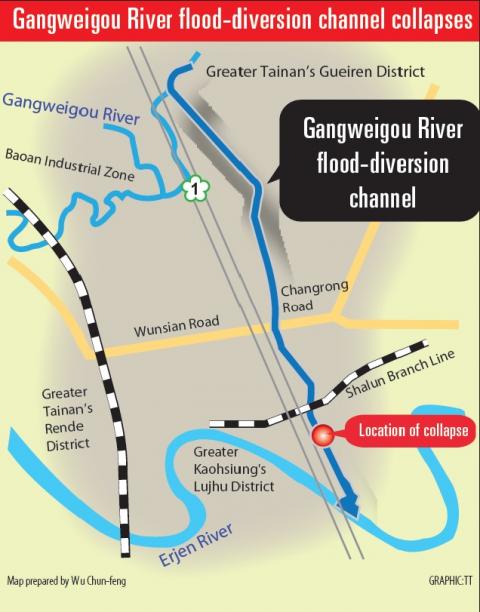
A 170m stretch of the Gangweigou River (港尾溝溪) flood-diversion channel in Greater Tainan collapsed in the early hours of Friday after torrential rains that hit the south on Tuesday, prompting concerns over the sturdiness of the structure, which had been inaugurated three weeks ago.
The Gangweigou diversion channel, constructed by the Ministry of Economic Affairs’ Water Resources Agency, spans 3.8km and cost about NT$1.5 billion (US$49.9 million). The project was launched in March 2012 and was only recently completed, with an inauguration ceremony held on July 26 this year.
The Water Resources Agency’s Sixth River Management Office yesterday said it would complete emergency repair tasks in the ruptured area before Wednesday.
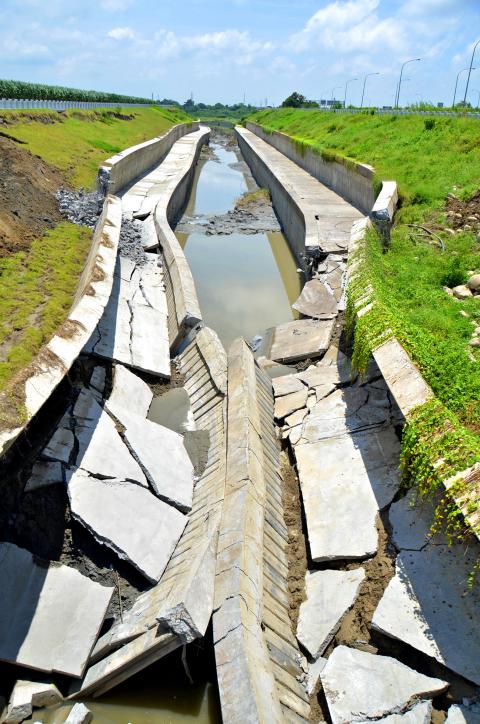
Photo: Wu Chun-feng, Taipei Times
Sixth River Management Office director Tsai Tsung-hsien (蔡宗憲) said the Gangweigou diversion channel was designed to withstand 175 tonnes of water per second, as seen in once-a-generation events. However, the rainwater in the channel on Tuesday flowed as rapidly as 250 tonnes per second, resulting in structural damage, he said.
Unconvinced, Greater Tainan City Councilor Wang Ting-yu (王定宇) of the Democratic Progressive Party said the flood-diversion channel was “the most expensive ‘tofu-dreg’ project in history,” adding that it could endanger the nearby National Sun Yat-sen Freeway (Freeway No. 1).
He also called into question the soundness of the construction materials used in the channel, alleging that contractors may have cut corners during construction and demanding that authorities investigate.
Tsai responded to Wang’s suspicions by saying that the flood-diversion channel was built of concrete sheet piles, which are bound together by a cap beam.
He also denied that the facility would pose a threat to the nearby freeway, saying there is about 10m of space between the two.
Meanwhile, Greater Tainan Mayor William Lai (賴清德) interceded for the Water Resources Agency, saying the channel served its purpose because it prevented the Baoan Industrial Zone (保安工業區) from flooding.
Although some problems have occured following the wet weather, the facility is still “under warranty” and the city government would demand that the contractor fix it as soon as possible, he said, adding that no extra payment will be made by the city government for repairs.
However, some residents near the channel said they had noticed a deformity in its structure before the storms, saying the catchment basin had begun slanting as early as Aug. 8, which they said could have resulted from the concrete sheet piles having bases that are too shallow.
The Water Resources Agency said it would perform a thorough investigation along the canal and would demand compensation from its contractors if they were found to be responsible.
The Gangweigou diversion channel was built to prevent the Gangweigou River from flooding the low-lying Rende District (仁德) — near where it joins the Erjen River (二仁溪) — and is said to be capable of reducing a flood-prone area by 626 hectares.
Additional Reporting by Tsai Wen-chu

The National Chungshan Institute of Science and Technology yesterday showcased its locally developed variants of the Vision 60 robotic patrol dog, which it plans to deploy on the nation’s outlying territories in the South China Sea. The variants were produced under the Joint Lab project — created by the institute and domestic companies — and assembled with domestically produced motors, lenses and artificial intelligence (AI) systems alongside licensed tech from the US, Missile and Rocket Systems Research Division deputy director Jen Kuo-kang (任國光) told the media event at a military base in Taipei’s Dazhi (大直) area. Taiwan has built up its strengths

RIGHT DIRECTION: Taiwan’s efforts to prevent forced labor include a proposal to ‘fully prohibit’ employers from withholding workers’ documents, an official said Taiwan is to establish a mechanism to restrict imports of goods linked to forced labor, the Executive Yuan said yesterday, after the US proposed imposing additional tariffs on Taiwanese goods over labor concerns. “The Ministry of Labor and the Ministry of Economic Affairs are to establish an interministerial review procedure,” Executive Yuan spokesperson Michelle Lee (李慧芝) said at a news briefing in Taipei. “The government is to use the Foreign Trade Act [貿易法] as the legal basis to restrict imports of goods produced with forced labor” and bring its supply chain governance more in line with international standards on human rights, resilience

NOT IMMEDIATE: Taiwan has a chance to appeal the proposed 10 percent tariff before it starts, while other countries face a 12.5 percent tariff from the trade office Taiwan is among 60 economies determined by the US to have failed to impose or enforce a ban on the importation of goods produced with forced labor, according to a notice released on Tuesday by the Office of the US Trade Representative (USTR), which proposed imposing an additional 10 percent or more tariff on them. The USTR in a statement said that following an investigation, it had determined under Section 301 of the Trade Act of 1974 that the failure of the 60 economies to impose and effectively enforce a prohibition on the importation of goods produced with forced labor is

TIT-FOR-TAT: The US allegedly revoked the visa of a Chinese national working at Xinhua News Agency in the US in response to Beijing’s expulsion of Vivian Wang The Presidential Office yesterday condemned China for expelling a New York Times correspondent from Beijing following the newspaper’s interview with President William Lai (賴清德), saying the move highlighted Beijing’s suppression of press freedom and its threat to international news media. Taiwan has noted a series of recent incidents in which Beijing used similar tactics to “threaten and pressure international media outlets and journalists,” Presidential Office spokeswoman Karen Kuo (郭雅慧) said in a statement. “This concerns not only press freedom and freedom of expression, but also the safety of journalists, and Taiwan and relevant partners are paying close attention to the situation,” she


 RSS
RSS