


A girl born early yesterday has officially pushed the population of the Philippines to 100 million, highlighting the challenge of providing for more people in the impoverished nation.
The newborn, Jennalyn Sentino, was one of 100 babies born in state hospitals all over the archipelago who received the symbolic designation of “100,000,000th baby.”
“This is both an opportunity and a challenge ... an opportunity we should take advantage of and a challenge we recognize,” said Juan Antonio Perez, executive director of the Philippine Commission on Population.
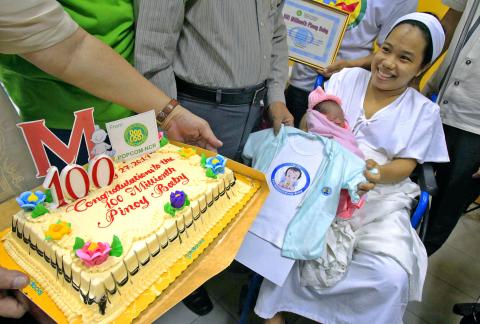
Photo: Reuters
While a growing population means a larger workforce, it also means more dependents in a country where about 25 percent of people live in poverty, he said.
He said the Philippines had to find a way to bring services to the poorest families, while also lowering the average number of children that fertile women will bear in their lifetimes.
“We’d like to push the fertility rate down to two children per [woman’s] lifetime,” from the current level of three per woman on average, he said.
While celebrating the birth of the babies with cake and gifts of clothing and blankets, the government will also monitor each of the designated 100 children over the coming years to see if they are receiving the required health services, Perez added.
Jennalyn’s father, 45-year-old van driver Clemente Sentino, said he was grateful for government aid, but expressed confidence that he could support his child and partner.
He and the child’s mother, Dailin Cabigayan, 27, are not yet married.
“She just happened to get pregnant, but we do have plans to get married,” he told reporters. “I make just enough to get by, but at least my job pays regularly. We will find a way to make it fit.”
Efforts to control the Philippines’ population growth have long been hampered by the influence of the Roman Catholic Church, which counts about 80 percent of Filipinos as followers and which disapproves of all forms of artificial birth control.
It was only in April that the government finally overcame over a decade of church opposition to implement a reproductive health law providing the poor with birth-control services.
Perez said with the law’s implementation, about 2 million to 3 million women who previously did not have access to family planning now do.
Meanwhile, Father Melvin Castro, head of the commission on family and life of the country’s Catholic bishops, was quoted by a church-run radio station as praising the ballooning population, as there would be more “young workers” to power the economy.
Philippine President Benigno Aquino III spokesman Herminio Coloma said the milestone showed the importance of making “the right investments in people.”
The government has prepared for this by spending more on “human development,” particularly education, he told reporters.
Meanwhile, Klaus Beck, the country representative of the UN Population Fund, endorsed the Philippines’ new focus on family planning in a statement issued to coincide with the population landmark.
“Governments that are serious about eradicating poverty should also be serious about providing the services, supplies, information that women, men and young people need to exercise their reproductive rights,” he said.

PROVOCATIVE: Chinese Deputy Ambassador to the UN Sun Lei accused Japan of sending military vessels to deliberately provoke tensions in the Taiwan Strait China denounced remarks by Japan and the EU about the South China Sea at a UN Security Council meeting on Monday, and accused Tokyo of provocative behavior in the Taiwan Strait and planning military expansion. Ayano Kunimitsu, a Japanese vice foreign minister, told the Council meeting on maritime security that Tokyo was seriously concerned about the situation in the East China and South China seas, and reiterated Japan’s opposition to any attempt to change the “status quo” by force, and obstruction of freedom of navigation and overflight. Stavros Lambrinidis, head of the EU delegation to the UN, also highlighted South China Sea

The final batch of 28 M1A2T Abrams tanks purchased from the US arrived at Taipei Port last night and were transported to the Armor Training Command in Hsinchu County’s Hukou Township (湖口), completing the military’s multi-year procurement of 108 of the tanks. Starting at 12:10am today, reporters observed more than a dozen civilian flatbed trailers departing from Taipei Port, each carrying an M1A2T tank covered with black waterproof tarps. Escorted by military vehicles, the convoy traveled via the West Coast Expressway to the Armor Training Command, with police implementing traffic control. The army operates about 1,000 tanks, including CM-11 Brave Tiger
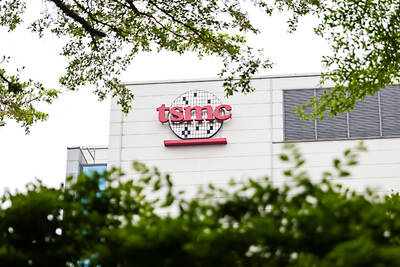
Taiwan Semiconductor Manufacturing Co (TSMC, 台積電), the world’s largest contract chipmaker, said it expects its 2-nanometer (2nm) chip capacity to grow at a compound annual rate of 70 percent from this year to 2028. The projection comes as five fabs begin volume production of 2-nanometer chips this year — two in Hsinchu and three in Kaohsiung — TSMC senior vice president and deputy cochief operating officer Cliff Hou (侯永清) said at the company’s annual technology symposium in Silicon Valley, California, last week. Output in the first year of 2-nanometer production, which began in the fourth quarter of last year, is expected to
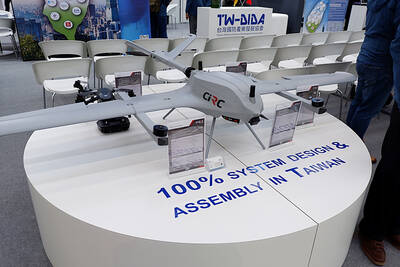
Taiwan’s drone exports surged past US$100 million in the first quarter, exceeding last year’s full-year total, with the Czech Republic emerging as the largest buyer, the Ministry of Economic Affairs said. Exports of complete drones reached US$115.85 million in the period, about 1.2 times the total recorded for all of last year, the ministry said in a report. Exports to the Czech Republic accounted for about US$100 million, far outpacing other markets. Poland, last year’s top destination, recorded about US$11.75 million in the first quarter. Taiwan’s drone exports have expanded rapidly in the past few years, with last year’s total


 RSS
RSS