


Premier Jiang Yi-huah (江宜樺) yesterday vowed to address all the concerns over public security highlighted by the random slaying spree on a train of the Taipei MRT system’s Bannan Line on Wednesday as he called for enhanced security at public venues and on public transportation networks.
Among the concerns was the shortage of police manpower voiced by Taipei Deputy Mayor Timothy Ting (丁庭宇) when Jiang was briefed yesterday by Cabinet members with the Ministry of the Interior, the Ministry of Transportation and Communications and the Ministry of Education about proposed measures to prevent similar attacks.
Ting requested at the meeting that the National Police Agency (NPA) deploy more police officers to the city to assist with security, while Directorate-General of Personnel Administration Minister Frank Huang (黃富源) said that the shortage of police is a problem facing every city and county, Executive Yuan spokesperson Sun Lih-chyun (孫立群) said.
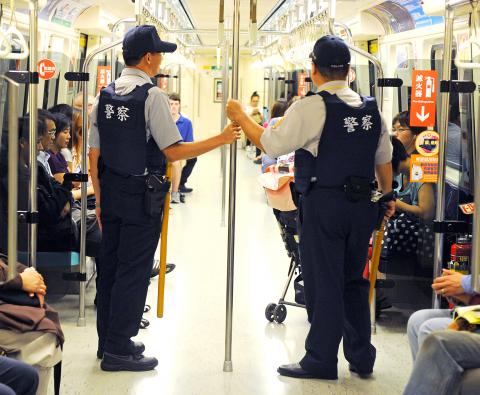
Photo: CNA
Huang put the nationwide shortage of police at 7,000 officers, Sun said.
Jiang also demanded that the police and prosecutorial authority determine the motive of the alleged killer at the earliest possible time and punish him, Sun said.
In the wake of the MRT killings, Taipei Mayor Hau Lung-bin (郝龍斌) said yesterday that the city government has proposed raising the quota of police stationed in the MRT from the current 160 to at least 240.
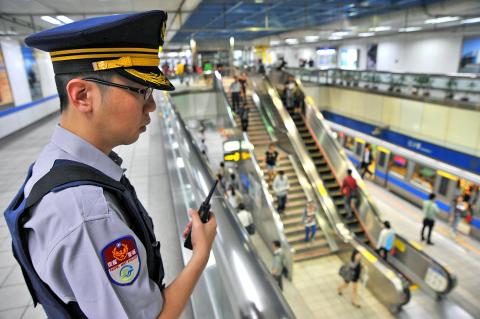
Photo: AFP
Hau told a press conference that the National Police Agency has agreed to lend support to the city in the short term by dispatching 80 special police to reinforce patrols on trains and at stations in the next two weeks.
He added that the city government would ask the central government to expand the MRT police quota, with 80 as the baseline.
Having taken the MRT to work yesterday morning, Hau said that many passengers told him that they are afraid that something similar might happen again and suggested that trains be equipped with self-defense equipment in case of emergencies. The mayor said the suggestion would be carefully assessed and considered.
Hau added that counterterrorism drills would be conducted in the MRT to prepare the system for any possible incident.
Meanwhile, Taipei Rapid Transit Corp (台北捷運公司) general manager Tan Gwa-guang (譚國光) rebuffed an allegation that there were delays in reporting and reaction on the part of the corporation during the incident.
Tan said that after the carriage’s emergency communication button was pressed, the train operator immediately informed the traffic control center, which then informed the station chief and security guards at Jiangzicui Station before the train pulled into the station.
The center again contacted the district police after the train arrived.
According to the general manager, the first district police arrived within five minutes after the report.
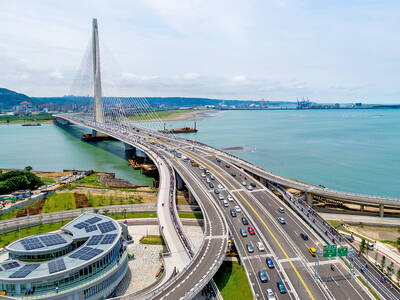
The Ministry of Transportation and Communications yesterday inaugurated the Danjiang Bridge across the Tamsui River in New Taipei City, saying that the structure would be an architectural icon and traffic artery for Taiwan. Feted as a major engineering achievement, the Danjiang Bridge is 920m long, 211m tall at the top of its pylon, and is the longest single-pylon asymmetric cable-stayed bridge in the world, the government’s Web site for the structure said. It was designed by late Iraqi-British architect Zaha Hadid. The structure, with a maximum deck of 70m, accommodates road and light rail traffic, and affords a 200m navigation channel for boats,
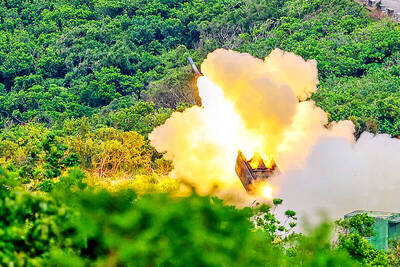
PRECISION STRIKES: The most significant reason to deploy HIMARS to outlying islands is to establish a ‘dead zone’ that the PLA would not dare enter, a source said A High Mobility Artillery Rocket System (HIMARS) would be deployed to Penghu County and Dongyin Island (東引) in Lienchiang County (Matsu) to force the Chinese military to retreat at least 100km from the coastline, a military source said yesterday. Taiwan has been procuring HIMARS and Army Tactical Missile Systems (ATACMS) from the US in batches. Once all batches have been delivered, Taiwan would possess 111 HIMARS units and 504 ATACMS, which have a range of 300km. Considering that “offense is the best defense,” the military plans to forward-deploy the systems to outlying islands such as Penghu and Dongyin so that

Taiwan Semiconductor Manufacturing Co (TSMC, 台積電), the world’s largest foundry service provider, yesterday said that global semiconductor revenue is projected to hit US$1.5 trillion in 2030, after the figure exceeds US$1 trillion this year, as artificial intelligence (AI) demand boosts consumption of token and compute power. “We are still at the beginning of the AI revolution, but we already see a significant impact across the whole semiconductor ecosystem,” TSMC deputy cochief operating officer Kevin Zhang (張曉強) said at the company’s annual technology symposium in Hsinchu City. “It is fair to say that in the past decade, smartphones and other mobile devices were

‘CLEAR MESSAGE’: The bill would set up an interagency ‘tiger team’ to review sanctions tools and other economic options to help deter any Chinese aggression toward Taiwan US Representative Young Kim has introduced a bill to deter Chinese aggression against Taiwan, calling for an interagency “tiger team” to preplan coordinated sanctions and economic measures in response to possible Chinese military or political action against Taiwan. “[Chinese President] Xi Jinping [習近平] has directed the People’s Liberation Army to be ready to invade Taiwan by 2027. China has a plan. America should have one too,” Kim said in a news release on Thursday last week. She introduced the “Deter PRC [People’s Republic of China] aggression against Taiwan act” to “ensure the US has a coordinated sanctions strategy ready should


 RSS
RSS