


Showing unity against North Korean provocations, US President Barack Obama yesterday said it may be time to consider sanctions with “even more bite”’ against North Korea as its threatens its fourth nuclear test.
South Korean President Park Geun-hye said any test would trigger a regional nuclear arms race.
At a joint news conference with Park, Obama said North Korea will get “nothing except further isolation” if it proceeds with its threatened test. However, he also acknowledged there are limits to what effects additional penalties can have on the country.
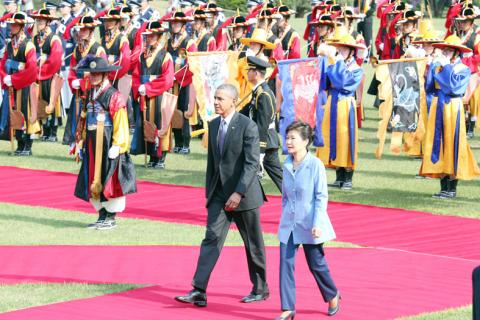
Photo: EPA
“North Korea already is the most isolated country in the world, by far,” Obama said. “Its people suffer terribly because of the decisions its leaders have made. And we are not going to find a magic bullet that solves this problem overnight.”
Park struck a harsher tone, saying such a test would bring “fundamental change” to the region’s security landscape and trigger a nuclear arms race as countries hurry to match the North’s nuclear capabilities. She said such an outcome would make it fruitless to resume negotiations with the North aimed at getting it to abandon its nuclear weapons and its nuclear program.
Park said Seoul has assessed that the North is “fully ready now” to conduct another nuclear test.
“This is a very tense situation,” she said through a translator. “President Obama’s visit to South Korea sends a strong message to North Korea that its provocative acts cannot be tolerated.”
Obama said the missile technology and nuclear weapons that the North is developing pose a direct threat to South Korea and Japan, as well as to the US.
“We can’t waver in our intention. We have to make sure that, in strong concert with our allies, that we are continuing to press North Korea to change its approach,” Obama said.
Touching on another sensitive regional issue, Obama gave voice to South Korea’s grievances with Japan by calling Japan’s use of Korean “comfort women” during World War II a terrible and egregious violation of human rights.
“Those women were violated in ways that even in the midst of war was shocking,” the US leader said. “They deserve to be heard, they deserve to be respected.”
At the same time, he said Japanese Prime Minister Shinzo Abe recognizes that the past must be acknowledged in full.
Obama also noted that he was visiting at a time of “great sorrow”’ and offered the US’ deepest condolences to his host over the recent ferry disaster. He said he was donating a magnolia tree from the White House lawn to the high school in honor of the lives that were lost and as a symbol of decades of friendship between the two nations.

Tropical Storm Gaemi strengthened into a typhoon at 2pm yesterday, and could make landfall in Yilan County tomorrow, the Central Weather Administration (CWA) said yesterday. The agency was scheduled to issue a sea warning at 11:30pm yesterday, and could issue a land warning later today. Gaemi was moving north-northwest at 4kph, carrying maximum sustained winds near its center of up to 118.8kph and gusts of 154.8kph. The circumference is forecast to reach eastern Taiwan tomorrow morning, with the center making landfall in Yilan County later that night before departing from the north coast, CWA weather forecaster Kuan Shin-ping (官欣平) said yesterday. Uncertainty remains and

SEA WARNING LIKELY: The storm, named Gaemi, could become a moderate typhoon on Wednesday or Thursday, with the Taipei City Government preparing for flooding A tropical depression east of the Philippines developed into a tropical storm named Gaemi at 2pm yesterday, and was moving toward eastern Taiwan, the Central Weather Administration (CWA) said. Gaemi could begin to affect Taiwan proper on Tuesday, lasting until Friday, and could develop into a moderate typhoon on Wednesday or Thursday, it said. A sea warning for Gaemi could be issued as early as Tuesday morning, it added. Gaemi, the third tropical storm in the Pacific Ocean this typhoon season, is projected to begin moving northwest today, and be closest to Taiwan on Wednesday or Thursday, the agency said. Today, there would likely

DISRUPTIONS: The high-speed rail is to operate as normal, while several airlines either canceled flights or announced early departures or late arrivals Schools and offices in 15 cities and counties are to be closed today due to Typhoon Gaemi, local governments announced last night. The 15 are: Taipei, New Taipei City, Taoyuan, Tainan, Keelung, Hsinchu and Kaohsiung, as well as Yilan, Hualien, Hsinchu, Miaoli, Chiayi, Pingtung, Penghu and Lienchiang counties. People should brace for torrential rainfall brought by the storm, with its center forecast to make landfall on the east coast between tonight and tomorrow morning, the Central Weather Administration (CWA) said. The agency issued a sea warning for the typhoon at 11:30pm on Monday, followed by a land warning at 11:30am yesterday. As of

CASUALTY: A 70-year-old woman was killed by a falling tree in Kaohsiung as the premier warned all government agencies to remain on high alert for the next 24 hours Schools and offices nationwide are to be closed for a second day today as Typhoon Gaemi crosses over the nation, bringing torrential rain and whipping winds. Gaemi was forecast to make landfall late last night. From Tuesday night, its outer band brought substantial rainfall and strong winds to the nation. As of 6:15pm last night, the typhoon’s center was 20km southeast of Hualien County, Central Weather Administration (CWA) data showed. It was moving at 19kph and had a radius of 250km. As of 3pm yesterday, one woman had died, while 58 people were injured, the Central Emergency Operation Center said. The 70-year-old


 RSS
RSS