


A Chinese court rejected an appeal by fallen politician Bo Xilai (薄熙來) against his corruption conviction and confirmed his life sentence yesterday, as authorities looked to draw a line under a damaging scandal.
Until last year Bo headed the southwestern city of Chongqing and was one of the highest-ranked politicians in the Chinese Communist Party, but was engulfed by a controversy that saw his wife convicted of murdering a British businessman.
He was condemned to life imprisonment on charges of bribery, embezzlement and abuse of power last month, and analysts said yesterday’s decision meant there was no comeback for a man once tipped for the top echelons of power.
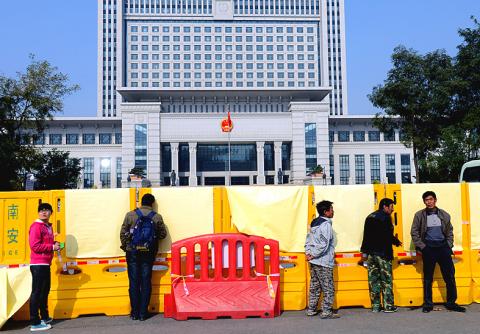
Photo: AFP
“The facts of the first instance verdict are clear, the evidence is reliable, sufficient, and the sentence is appropriate,” the Shandong Province High Court said in its ruling. “The court rules as follows: reject the appeal, uphold the original verdict. This verdict is the final ruling.”
Bo had presented 11 grounds for appeal, it said, including that his confessions in custody were “produced under pressure from officials handling the case, and as illegal evidence should be disregarded.”
State broadcaster CCTV showed a smiling Bo handcuffed in court flanked by two policemen.
At the end of the hearing they frogmarched him away, each gripping an arm and a shoulder.
Security was heavy around the courthouse in Jinan, the capital of Shandong Province, with hundreds of police officers stationed around the building.
The courts have no further obligation to reconsider his case after the appeal, lawyers said, and Bo is unlikely to appear in public again.
The appeal was considered in a “closed hearing” earlier this month without Bo present, a lawyer with direct knowledge of the case said, adding that yesterday’s announcement “will be the final verdict. After that, the process is over.”
According to Chinese law, Bo will not be able to lodge any further formal appeals, and while he can submit a “petition” to China’s supreme court, it is not required to take further action.

Nvidia Corp yesterday unveiled its new high-speed interconnect technology, NVLink Fusion, with Taiwanese application-specific IC (ASIC) designers Alchip Technologies Ltd (世芯) and MediaTek Inc (聯發科) among the first to adopt the technology to help build semi-custom artificial intelligence (AI) infrastructure for hyperscalers. Nvidia has opened its technology to outside users, as hyperscalers and cloud service providers are building their own cost-effective AI chips, or accelerators, used in AI servers by leveraging ASIC firms’ designing capabilities to reduce their dependence on Nvidia. Previously, NVLink technology was only available for Nvidia’s own AI platform. “NVLink Fusion opens Nvidia’s AI platform and rich ecosystem for
WARNING: From Jan. 1 last year to the end of last month, 89 Taiwanese have gone missing or been detained in China, the MAC said, urging people to carefully consider travel to China Lax enforcement had made virtually moot regulations banning civil servants from making unauthorized visits to China, the Control Yuan said yesterday. Several agencies allowed personnel to travel to China after they submitted explanations for the trip written using artificial intelligence or provided no reason at all, the Control Yuan said in a statement, following an investigation headed by Control Yuan member Lin Wen-cheng (林文程). The probe identified 318 civil servants who traveled to China without permission in the past 10 years, but the true number could be close to 1,000, the Control Yuan said. The public employees investigated were not engaged in national

ALL TOGETHER: Only by including Taiwan can the WHA fully exemplify its commitment to ‘One World for Health,’ the representative offices of eight nations in Taiwan said The representative offices in Taiwan of eight nations yesterday issued a joint statement reiterating their support for Taiwan’s meaningful engagement with the WHO and for Taipei’s participation as an observer at the World Health Assembly (WHA). The joint statement came as Taiwan has not received an invitation to this year’s WHA, which started yesterday and runs until Tuesday next week. This year’s meeting of the decisionmaking body of the WHO in Geneva, Switzerland, would be the ninth consecutive year Taiwan has been excluded. The eight offices, which reaffirmed their support for Taiwan, are the British Office Taipei, the Australian Office Taipei, the

DANGEROUS DRIVERS: The proposal follows a fatal incident on Monday involving a 78-year-old driver, which killed three people and injured 12 The Ministry of Transportation and Communications yesterday said it would lower the age for elderly drivers to renew their license from 75 to 70 as part of efforts to address safety issues caused by senior motorists. The new policy was proposed in light of a deadly incident on Monday in New Taipei City’s Sansia District (三峽), in which a 78-year-old motorist surnamed Yu (余) sped through a school zone, killing three people and injuring 12. Last night, another driver sped down a street in Tainan’s Yuching District (玉井), killing one pedestrian and injuring two. The incidents have sparked public discussion over whether seniors


 RSS
RSS