


Former Chinese Nationalist Party (KMT) chairman Lien Chan (連戰) yesterday expressed his willingness to resolve the political battle between President Ma Ying-jeou (馬英九) and Legislative Speaker Wang Jin-pyng (王金平), amid calls within the KMT for a reconciliation meeting between the two KMT heavyweights.
“I can’t guarantee ... but everyone will be willing to smooth things out [between Ma and Wang] if given a chance,” he said at Taiwan Taoyuan International Airport before embarking on a private visit to China.
Lien has voiced his support for Wang in the wake of Wang’s alleged improper lobbying. His comments yesterday echoed the calls of another KMT heavyweight, former KMT chairman Wu Poh-hsiung (吳伯雄), for Ma and Wang to sit down and resolve their dispute over the incident.
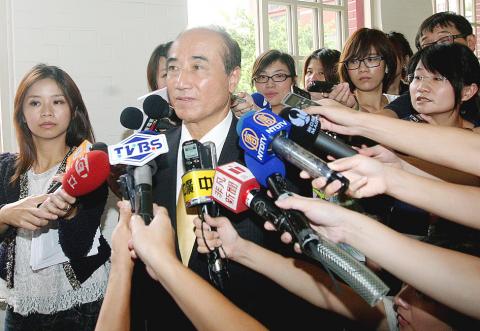
Photo: CNA
The rift in the KMT has caused great concerns within the party about party unity. Several KMT politicians, including Taipei Mayor Hau Lung-bin (郝龍斌) and New Taipei City (新北市) Mayor Eric Chu (朱立倫), have voiced support for a proposed Ma-Wang meeting and said they expect the matter to be resolved as soon as possible.
“It would be good for the two to meet ... I also expect Speaker Wang to allow Premier Jiang Yi-huah (江宜樺) to present a performance report on the legislative floor, and that the administrative and legislative branches will function normally,” Hau said.
Chu, on the other hand, said while the dispute is being addressed via legal procedures, Ma and Wang should have the “wisdom” to resolve the political rift and interact with each other “in a natural way.”
Ma, who has dismissed suggestions of a so-called “elimination plan” targeting Wang, yesterday declined to comment on the lobbying dispute and his problematic relations with the legislative speaker.
The Presidential Office said Ma has learned about party heavyweights’ call for a Ma-Wang meeting, but insisted that there are also calls for the incident to be settled through legal means.
Amid calls for a reconciliation between Ma and Wang, the legal battle over Wang’s party membership and speakership status continued, as the Taiwan High Court yesterday assigned a courtroom to hear the KMT’s appeal against the decision by a lower court to allow Wang to keep his party membership for the time being.
While there has been no plans for a formal meeting between Ma and Wang, the two could meet on Friday next week if both decide to attend an annual ceremony celebrating Confucius’ birthday in Taipei.
The KMT has also dismissed allegations that it withdrew its invitation for Wang to attend the 19th party congress on Sunday next week.
It remains uncertain whether Wang will attend the event.
Meanwhile, the High Court announced the names of the three judges who will hear an appeal filed by the KMT.
High Court spokesman Hung Kuang-tsan (洪光燦) told a press conference that Presiding Judge Wang Li-li (王麗莉), Judge Lee Yuan-yuan (李媛媛) and Judge Wei Li-chuan (魏莉娟) would hear the appeal.
Hung said the selection of a civil court with its three judges was done by a computer drawing lots, which is a regular practice for the High Court’s civil courts.
Three presiding judges and two judges of the civil courts formed a task force to monitor the computerized drawing of lots, which was transparent and fair, he added.
Wang’s attorney on Tuesday requested that the High Court hold a public drawing of lots to decide which court would hear the appeal and requested that attorneys for both sides be allowed to watch the process.
Hung said a computer drawing lots with senior judges monitoring the process was in accordance with the Judges’ Act (法官法).
The KMT’s attorneys on Monday filed an appeal with the High Court against the ruling handed down on Friday by the Taipei District Court in favor of Wang.
Wang last week requested an injunction from the Taipei District Court against the KMT’s decision to revoke his party membership, over his alleged role in attempting to influence a prosecutor in a legal case involving Democratic Progressive Party caucus whip Ker Chien-ming (柯建銘).
The district court ruled that Wang may keep his rights as a KMT member until a final ruling, on condition that he pays NT$9.38 million (US$315,000) as a collateral deposit.
The court’s ruling took effect on Saturday after it had been delivered to the KMT, the Central Election Commission and the legislature.

Tropical Storm Gaemi strengthened into a typhoon at 2pm yesterday, and could make landfall in Yilan County tomorrow, the Central Weather Administration (CWA) said yesterday. The agency was scheduled to issue a sea warning at 11:30pm yesterday, and could issue a land warning later today. Gaemi was moving north-northwest at 4kph, carrying maximum sustained winds near its center of up to 118.8kph and gusts of 154.8kph. The circumference is forecast to reach eastern Taiwan tomorrow morning, with the center making landfall in Yilan County later that night before departing from the north coast, CWA weather forecaster Kuan Shin-ping (官欣平) said yesterday. Uncertainty remains and

SEA WARNING LIKELY: The storm, named Gaemi, could become a moderate typhoon on Wednesday or Thursday, with the Taipei City Government preparing for flooding A tropical depression east of the Philippines developed into a tropical storm named Gaemi at 2pm yesterday, and was moving toward eastern Taiwan, the Central Weather Administration (CWA) said. Gaemi could begin to affect Taiwan proper on Tuesday, lasting until Friday, and could develop into a moderate typhoon on Wednesday or Thursday, it said. A sea warning for Gaemi could be issued as early as Tuesday morning, it added. Gaemi, the third tropical storm in the Pacific Ocean this typhoon season, is projected to begin moving northwest today, and be closest to Taiwan on Wednesday or Thursday, the agency said. Today, there would likely

DISRUPTIONS: The high-speed rail is to operate as normal, while several airlines either canceled flights or announced early departures or late arrivals Schools and offices in 15 cities and counties are to be closed today due to Typhoon Gaemi, local governments announced last night. The 15 are: Taipei, New Taipei City, Taoyuan, Tainan, Keelung, Hsinchu and Kaohsiung, as well as Yilan, Hualien, Hsinchu, Miaoli, Chiayi, Pingtung, Penghu and Lienchiang counties. People should brace for torrential rainfall brought by the storm, with its center forecast to make landfall on the east coast between tonight and tomorrow morning, the Central Weather Administration (CWA) said. The agency issued a sea warning for the typhoon at 11:30pm on Monday, followed by a land warning at 11:30am yesterday. As of

CASUALTY: A 70-year-old woman was killed by a falling tree in Kaohsiung as the premier warned all government agencies to remain on high alert for the next 24 hours Schools and offices nationwide are to be closed for a second day today as Typhoon Gaemi crosses over the nation, bringing torrential rain and whipping winds. Gaemi was forecast to make landfall late last night. From Tuesday night, its outer band brought substantial rainfall and strong winds to the nation. As of 6:15pm last night, the typhoon’s center was 20km southeast of Hualien County, Central Weather Administration (CWA) data showed. It was moving at 19kph and had a radius of 250km. As of 3pm yesterday, one woman had died, while 58 people were injured, the Central Emergency Operation Center said. The 70-year-old


 RSS
RSS