


The Taipei District Court yesterday ruled in favor of Legislative Speaker Wang Jin-pyng’s (王金平) provisional injunction seeking to retain his Chinese Nationalist Party (KMT) membership and position as head of the legislature.
The court ruled that Wang would be able to retain his membership and rights as a KMT member after submitting a guarantee of about NT$9.38 million (US$314,300), Taipei District Court spokesperson Lai Chien-yi (賴劍毅) told reporters.
The guarantee was calculated based on Wang’s monthly salary and the remainder of his current term of about two-and-a-half years, Lai said.
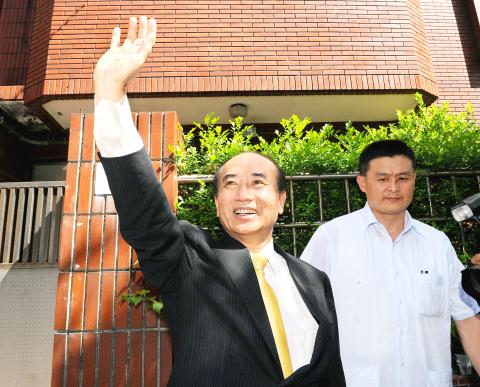
Photo: Fang Pin-chao, Taipei Times
The ruling was considered a victory for Wang in his battle with President Ma Ying-jeou (馬英九) to keep his political power.
‘ILLEGAL LOBBYING’
The 72-year-old senior politician, who has been accused of being involved in illegal lobbying of the judiciary, had his KMT membership revoked on Wednesday, which the party said should invalidate his status as a KMT legislator-at-large and as legislative speaker.
Wang decided to take the matter to court after the KMT failed to grant him a 20-day appeal period and immediately notified the Central Election Commission (CEC) about Wang’s party membership being revoked.
The court rejected the KMT’s offer of a counter guarantee in its challenge to Wang’s claim, Lai said.
Wang’s injunction was accepted because his loss of position as legislative speaker and a legislator-at-large would be irreversible if the injunction was rejected, Lai said, adding that Wang’s membership would not be affected before another civil lawsuit that Wang had filed said otherwise.
An additional temporary restraining order filed by the Wang camp late on Thursday night, which argued that Wang should retain his position as speaker, was dismissed, the spokesperson said.
Wang’s lawyer, Hsu Ying-chieh (許英傑), told reporters that the ruling was “a complete victory” in terms of the provisional injunction, despite dismissal of the restraining order.
“We are glad the judges have made a critical decision in this historic case,” Hsu said.
The lawyer said the court’s upholding of Wang’s claim was crucial because the KMT’s decision was a revocation of his party membership rather than as a lawmaker or speaker.
“As the revocation of Wang’s party membership was invalidated, the KMT’s moves after the revocation have been nullified as well, which means the CEC’s notification to void Wang’s speaker position was ineffective,” Hsu said.
Chen Ming (陳明), the KMT’s lawyer, told reporters that his client planned to file an appeal within 10 days.
Chen claimed that Wang was disqualified as a KMT legislator-at-large and as legislative speaker immediately after his party membership was revoked.
At around 9:30pm last night, Wang delivered a short statement calling for unity within the party “under the leadership of President Ma Ying-jeou” to work together to meet shared challenges.
Wang reiterated that he will be a KMT member “forever and ever.”

Tropical Storm Gaemi strengthened into a typhoon at 2pm yesterday, and could make landfall in Yilan County tomorrow, the Central Weather Administration (CWA) said yesterday. The agency was scheduled to issue a sea warning at 11:30pm yesterday, and could issue a land warning later today. Gaemi was moving north-northwest at 4kph, carrying maximum sustained winds near its center of up to 118.8kph and gusts of 154.8kph. The circumference is forecast to reach eastern Taiwan tomorrow morning, with the center making landfall in Yilan County later that night before departing from the north coast, CWA weather forecaster Kuan Shin-ping (官欣平) said yesterday. Uncertainty remains and

SEA WARNING LIKELY: The storm, named Gaemi, could become a moderate typhoon on Wednesday or Thursday, with the Taipei City Government preparing for flooding A tropical depression east of the Philippines developed into a tropical storm named Gaemi at 2pm yesterday, and was moving toward eastern Taiwan, the Central Weather Administration (CWA) said. Gaemi could begin to affect Taiwan proper on Tuesday, lasting until Friday, and could develop into a moderate typhoon on Wednesday or Thursday, it said. A sea warning for Gaemi could be issued as early as Tuesday morning, it added. Gaemi, the third tropical storm in the Pacific Ocean this typhoon season, is projected to begin moving northwest today, and be closest to Taiwan on Wednesday or Thursday, the agency said. Today, there would likely

DISRUPTIONS: The high-speed rail is to operate as normal, while several airlines either canceled flights or announced early departures or late arrivals Schools and offices in 15 cities and counties are to be closed today due to Typhoon Gaemi, local governments announced last night. The 15 are: Taipei, New Taipei City, Taoyuan, Tainan, Keelung, Hsinchu and Kaohsiung, as well as Yilan, Hualien, Hsinchu, Miaoli, Chiayi, Pingtung, Penghu and Lienchiang counties. People should brace for torrential rainfall brought by the storm, with its center forecast to make landfall on the east coast between tonight and tomorrow morning, the Central Weather Administration (CWA) said. The agency issued a sea warning for the typhoon at 11:30pm on Monday, followed by a land warning at 11:30am yesterday. As of

CASUALTY: A 70-year-old woman was killed by a falling tree in Kaohsiung as the premier warned all government agencies to remain on high alert for the next 24 hours Schools and offices nationwide are to be closed for a second day today as Typhoon Gaemi crosses over the nation, bringing torrential rain and whipping winds. Gaemi was forecast to make landfall late last night. From Tuesday night, its outer band brought substantial rainfall and strong winds to the nation. As of 6:15pm last night, the typhoon’s center was 20km southeast of Hualien County, Central Weather Administration (CWA) data showed. It was moving at 19kph and had a radius of 250km. As of 3pm yesterday, one woman had died, while 58 people were injured, the Central Emergency Operation Center said. The 70-year-old


 RSS
RSS