


Prosecutor-General Huang Shih-ming (黃世銘) should be immediately suspended and placed under investigation while the Taipei Prosecutors’ Office processes accusations that Huang was party to illegal practices in the influence-peddling case involving several government officials, the Democratic Progressive Party (DPP) caucus said yesterday.
Civic groups and former deputy minister of justice Lee Chin-yung (李進勇) on Monday filed lawsuits against Huang and the Special Investigation Division (SID), accusing him of violating the Communication Security and Surveillance Act (通訊保障及監察法), the Personal Information Protection Act (個人資料保護法) and the Civil Servant Service Act (公務人員服務法) and leaking information, DPP Legislator Gao Jyh-peng (高志鵬) told a news conference.
“If Huang, the head of the prosecutorial system, is not suspended immediately pending further investigation, it will be difficult for prosecutors to probe the allegations against him,” Gao said.
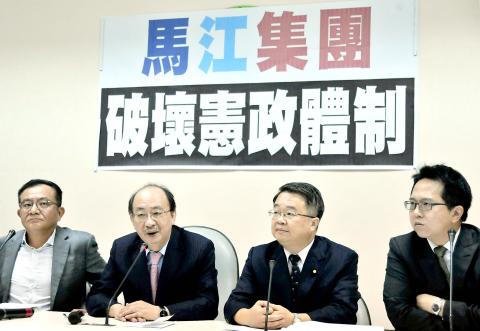
Photo: Mandy Cheng, AFP
The division on Friday accused Legislative Speaker Wang Jin-pyng (王金平), former minister of justice Tseng Yung-fu (曾勇夫) and High Prosecutors’ Office Head Prosecutor Chen Shou-huang (陳守煌) of influence peddling on behalf of DPP Legislator Ker Chien-ming (柯建銘) in a breach of trust case against Ker.
The probe has sparked widespread public debate about politicians’ lobbying activities and condemnation from many who say amounted to a political persecution against Wang.
Tseng subsequently announced his resignation, but maintained that he is innocent.
Wiretapping Ker’s mobile phone — which is how the SID reportedly discovered the officials’ alleged misconduct — and the decision to announce the case while Wang was out of the country showed that the investigation is a politically motivated affair in which Huang is playing the role of a thug hired by politicians, DPP Legislator Wu Ping-jui (吳秉叡) said.
Ker again extended his apologies to Wang, a close friend of his, for “dragging him into the political storm.”
He declined to comment on media reports about Deputy Legislative Speaker Hung Hsiu-chu’s (洪秀柱) possible nomination as Wang’s replacement.
Separately, DPP lawmaker Cheng Li-chiun (鄭麗君) called on President Ma Ying-jeou (馬英九) to resign as KMT chairman because he had interfered with congressional affairs in his capacity as party leader.
“Not only did Ma launch a political vendetta against Wang, the president also hinted at possible candidates for a new legislative speaker. These actions violate the principle of separation of powers,” Cheng said.
Premier Jiang Yi-huah (江宜樺) has also made comments that were unconstitutional, DPP Legislator Chen Ming-wen (陳明文) said in a press release.
Jiang was quoted by media as saying that it would be “inappropriate” for Wang to retain his post as legislative speaker amid the scandal.
The premier’s comment infringed on the legislature’s autonomy and violated the separation of powers, Chen Shou-huang said, adding that Jiang should apologize for his remarks.
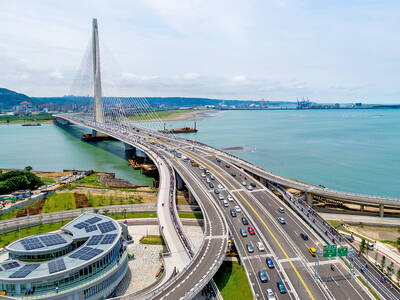
The Ministry of Transportation and Communications yesterday inaugurated the Danjiang Bridge across the Tamsui River in New Taipei City, saying that the structure would be an architectural icon and traffic artery for Taiwan. Feted as a major engineering achievement, the Danjiang Bridge is 920m long, 211m tall at the top of its pylon, and is the longest single-pylon asymmetric cable-stayed bridge in the world, the government’s Web site for the structure said. It was designed by late Iraqi-British architect Zaha Hadid. The structure, with a maximum deck of 70m, accommodates road and light rail traffic, and affords a 200m navigation channel for boats,
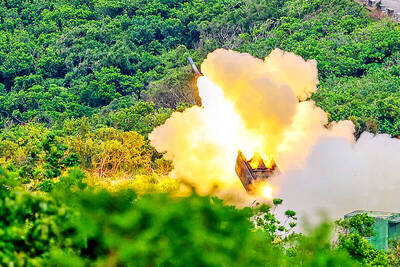
PRECISION STRIKES: The most significant reason to deploy HIMARS to outlying islands is to establish a ‘dead zone’ that the PLA would not dare enter, a source said A High Mobility Artillery Rocket System (HIMARS) would be deployed to Penghu County and Dongyin Island (東引) in Lienchiang County (Matsu) to force the Chinese military to retreat at least 100km from the coastline, a military source said yesterday. Taiwan has been procuring HIMARS and Army Tactical Missile Systems (ATACMS) from the US in batches. Once all batches have been delivered, Taiwan would possess 111 HIMARS units and 504 ATACMS, which have a range of 300km. Considering that “offense is the best defense,” the military plans to forward-deploy the systems to outlying islands such as Penghu and Dongyin so that

Taiwan Semiconductor Manufacturing Co (TSMC, 台積電), the world’s largest foundry service provider, yesterday said that global semiconductor revenue is projected to hit US$1.5 trillion in 2030, after the figure exceeds US$1 trillion this year, as artificial intelligence (AI) demand boosts consumption of token and compute power. “We are still at the beginning of the AI revolution, but we already see a significant impact across the whole semiconductor ecosystem,” TSMC deputy cochief operating officer Kevin Zhang (張曉強) said at the company’s annual technology symposium in Hsinchu City. “It is fair to say that in the past decade, smartphones and other mobile devices were

‘CLEAR MESSAGE’: The bill would set up an interagency ‘tiger team’ to review sanctions tools and other economic options to help deter any Chinese aggression toward Taiwan US Representative Young Kim has introduced a bill to deter Chinese aggression against Taiwan, calling for an interagency “tiger team” to preplan coordinated sanctions and economic measures in response to possible Chinese military or political action against Taiwan. “[Chinese President] Xi Jinping [習近平] has directed the People’s Liberation Army to be ready to invade Taiwan by 2027. China has a plan. America should have one too,” Kim said in a news release on Thursday last week. She introduced the “Deter PRC [People’s Republic of China] aggression against Taiwan act” to “ensure the US has a coordinated sanctions strategy ready should


 RSS
RSS