


A Chinese official was allegedly drowned by investigators who stripped him naked and held him down in a bathtub as they attempted to extort a confession to corruption, state-run media reported yesterday.
Yu Qiyi was held down by graft investigators in a tub full of “icy water” several times after his questioning failed to produce satisfactory answers, the Beijing Times said, citing a court filing by prosecutors.
They only stopped when Yu, 42, the chief engineer of a state-owned company in the eastern city of Wenzhou, stopped struggling, the report said.
He was taken to hospital and died a few hours later.
A post-mortem showed he had been made to “imbibe liquids” that caused pulmonary dysfunction and eventually his death, according to a photograph of a forensic document carried by the newspaper.
Relatives also found multiple bruises on his body after his death in April, it added.
He had been detained since early March over suspected wrongdoing in a land deal, the report said.
The six investigators who interrogated Yu — five of them from the Chinese Communist Party’s discipline inspection department and the other one a local prosecutor — have been charged with intentional injury and a trial is pending, the report said.
“Yu Qiyi was a strong man before he was detained... but was skinny when he died,” the dead man’s wife, Wu Qian was quoted as saying by the newspaper. “He was bruised internally and externally during the 38 days [in detention]. He must have been tortured in other ways besides the drowning exposed by the prosecution.”
China’s new leadership has mounted a high-profile anti-corruption drive since Chinese President Xi Jinping (習近平) took over as party chief, warning that corruption could destroy the party and threatening to expose high-ranking officials, or “tigers,” along with low-level “flies.”
Some senior figures have been ensnared, among them Jiang Jiemin (蔣潔敏), who oversaw state-owned firms, and Liu Tienan (劉鐵男), once a deputy director of the influential National Development and Reform Commission.
Sudden deaths of officials while under investigation are not unknown in China.
Qian Guoliang, a seismological official in Huangmei County in the central province of Hubei, died in June after he was taken away by the party’s anti-graft investigators, previous media reports said. His face was out of shape, and his body carried bruises and festering sores when relatives saw him in hospital, they said.

Two US House of Representatives committees yesterday condemned China’s attempt to orchestrate a crash involving Vice President Hsiao Bi-khim’s (蕭美琴) car when she visited the Czech Republic last year as vice president-elect. Czech local media in March last year reported that a Chinese diplomat had run a red light while following Hsiao’s car from the airport, and Czech intelligence last week told local media that Chinese diplomats and agents had also planned to stage a demonstrative car collision. Hsiao on Saturday shared a Reuters news report on the incident through her account on social media platform X and wrote: “I
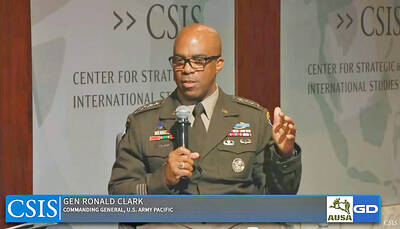
‘BUILDING PARTNERSHIPS’: The US military’s aim is to continue to make any potential Chinese invasion more difficult than it already is, US General Ronald Clark said The likelihood of China invading Taiwan without contest is “very, very small” because the Taiwan Strait is under constant surveillance by multiple countries, a US general has said. General Ronald Clark, commanding officer of US Army Pacific (USARPAC), the US Army’s largest service component command, made the remarks during a dialogue hosted on Friday by Washington-based think tank the Center for Strategic and International Studies. Asked by the event host what the Chinese military has learned from its US counterpart over the years, Clark said that the first lesson is that the skill and will of US service members are “unmatched.” The second

STANDING TOGETHER: Amid China’s increasingly aggressive activities, nations must join forces in detecting and dealing with incursions, a Taiwanese official said Two senior Philippine officials and one former official yesterday attended the Taiwan International Ocean Forum in Taipei, the first high-level visit since the Philippines in April lifted a ban on such travel to Taiwan. The Ocean Affairs Council hosted the two-day event at the National Taiwan University Hospital International Convention Center. Philippine Navy spokesman Rear Admiral Roy Vincent Trinidad, Coast Guard spokesman Grand Commodore Jay Tarriela and former Philippine Presidential Communications Office assistant secretary Michel del Rosario participated in the forum. More than 100 officials, experts and entrepreneurs from 15 nations participated in the forum, which included discussions on countering China’s hybrid warfare

MORE DEMOCRACY: The only solution to Taiwan’s current democratic issues involves more democracy, including Constitutional Court rulings and citizens exercising their civil rights , Lai said The People’s Republic of China (PRC) is not the “motherland” of the Republic of China (ROC) and has never owned Taiwan, President William Lai (賴清德) said yesterday. The speech was the third in a series of 10 that Lai is scheduled to deliver across Taiwan. Taiwan is facing external threats from China, Lai said at a Lions Clubs International banquet in Hsinchu. For example, on June 21 the army detected 12 Chinese aircraft, eight of which entered Taiwanese waters, as well as six Chinese warships that remained in the waters around Taiwan, he said. Beyond military and political intimidation, Taiwan


 RSS
RSS