


Torrential rainfall brought by Tropical Storm Kong-Rey caused severe flooding in central and southern Taiwan yesterday, forcing hundreds of people to evacuate and disrupting transportation.
Statistics from the Central Emergency Operation Center, as of 8pm yesterday, showed that 2,627 people in Greater Tainan, Greater Kaohsiung, Yunlin County, Chiayi City, Yilan County and Hualien County had been evacuated, with 546 taking refuge in shelters.
One person in Greater Tainan was injured after falling off a motorcycle yesterday morning.
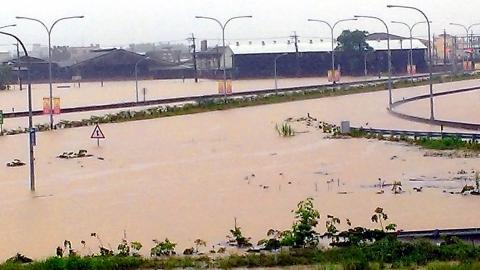
Photo: CNA
Flooding was reported in 87 areas in Chiayi city and county, and another 53 locations in Nantou, Yunlin and Pingtung counties, as well as Greater Tainan and Greater Kaohsiung.
Although the Central Weather Bureau (CWB) on Wednesday warned that extreme torrential rainfall could occur in central and southern Taiwan, the deluge still caught local governments in the two regions off guard.
The Yunlin County, Chiayi city and county, Greater Tainan, Pingtung County and Greater Kaohsiung governments made last-minute announcements yesterday morning canceling work and school for the rest of the day.
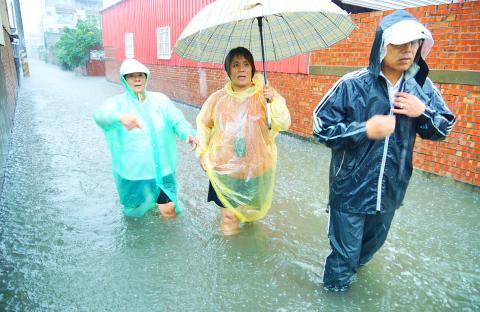
Photo: CNA
Television reports showed residents in Greater Tainan and Chiayi County waiting to be rescued on the second story or top floor of their houses because the ground floor was already flooded. Anxious parents fetched their children from school and complained that the local governments had been slow to respond to the emergency.
In Yunlin County’s Dounan Township (斗南), rescuers helped 36 senior residents in a nursing home to evacuate. More than 300 people were trapped by the flood in Hong Wa Yao (紅瓦窯) for more than 10 hours before rescuers sent in food and water supplies.
An angry man yelled at Greater Tainan Mayor William Lai (賴清德) when he inspected Sinhua District (新化), saying Lai should have canceled work and school earlier.
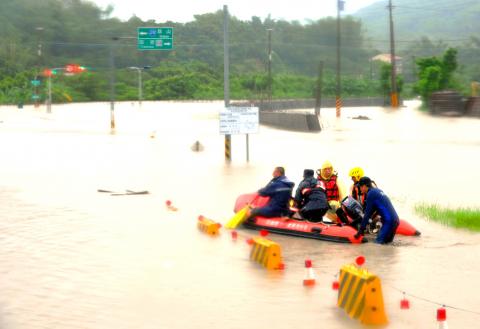
Photo: Huang Chih-yuan, Taipei Times
Lai apologized to the public on his Facebook page about the inconvenience, saying the city government’s decision on Wednesday evening that work and school should continue as normal yesterday was made based on information provided by the weather bureau.
“The forecast from the CWB up until 10am on Thursday did not meet the conditions for suspending work and school. The satellite cloud chart also showed that the rain clouds had moved to Chiayi and Yunlin. Our observation further showed that the rain had eased by 5am yesterday,” Lai wrote.
However, he said the forecast from the bureau at 10am yesterday listed Greater Tainan as one of the areas under an extreme torrential rainfall alert after the rain clouds moved south again. The city government then decided to cancel work and classes, he said.
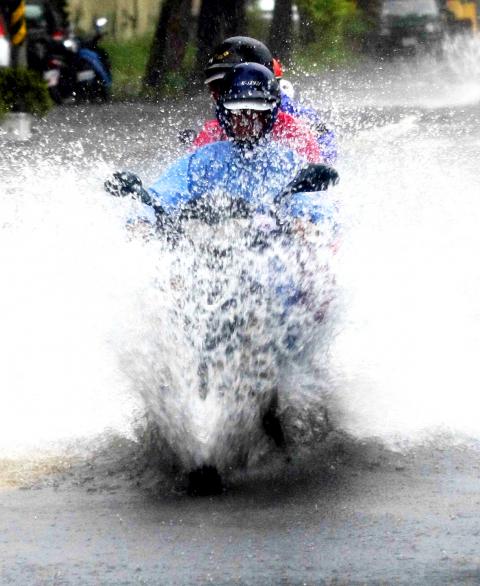
Photo: CNA
The bureau lifted its land and sea warning for Kong-Rey at 5:30pm and 8:30pm respectively yesterday after the storm moved away from Taiwan and headed toward Japan.
However, the bureau cautioned that heavy rainfall would continue on the west coast.
Although the tropical storm had passed, bureau forecaster Lo Ya-yin (羅雅尹) said heavy rainfall would continue as the nation would come under the influence of a southwesterly wind today.
The likelihood of showers or thundershowers remains high in central and southern Taiwan today, Lo said.
The weather would remain unstable over the weekend because of the arrival of the first frontal system this fall, she added.
According to the bureau’s forecast, the system would continue to affect the nation until Monday, bringing showers or thundershowers nationwide.

Right-wing political scientist Laura Fernandez on Sunday won Costa Rica’s presidential election by a landslide, after promising to crack down on rising violence linked to the cocaine trade. Fernandez’s nearest rival, economist Alvaro Ramos, conceded defeat as results showed the ruling party far exceeding the threshold of 40 percent needed to avoid a runoff. With 94 percent of polling stations counted, the political heir of outgoing Costa Rican President Rodrigo Chaves had captured 48.3 percent of the vote compared with Ramos’ 33.4 percent, the Supreme Electoral Tribunal said. As soon as the first results were announced, members of Fernandez’s Sovereign People’s Party
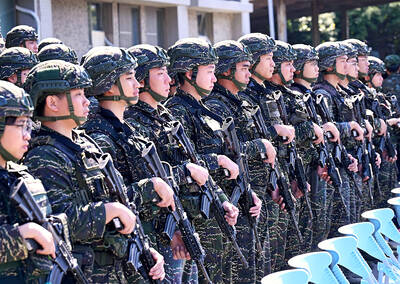
MORE RESPONSIBILITY: Draftees would be expected to fight alongside professional soldiers, likely requiring the transformation of some training brigades into combat units The armed forces are to start incorporating new conscripts into combined arms brigades this year to enhance combat readiness, the Executive Yuan’s latest policy report said. The new policy would affect Taiwanese men entering the military for their compulsory service, which was extended to one year under reforms by then-president Tsai Ing-wen (蔡英文) in 2022. The conscripts would be trained to operate machine guns, uncrewed aerial vehicles, anti-tank guided missile launchers and Stinger air defense systems, the report said, adding that the basic training would be lengthened to eight weeks. After basic training, conscripts would be sorted into infantry battalions that would take

EMERGING FIELDS: The Chinese president said that the two countries would explore cooperation in green technology, the digital economy and artificial intelligence Chinese President Xi Jinping (習近平) yesterday called for an “equal and orderly multipolar world” in the face of “unilateral bullying,” in an apparent jab at the US. Xi was speaking during talks in Beijing with Uruguayan President Yamandu Orsi, the first South American leader to visit China since US special forces captured then-Venezuelan president Nicolas Maduro last month — an operation that Beijing condemned as a violation of sovereignty. Orsi follows a slew of leaders to have visited China seeking to boost ties with the world’s second-largest economy to hedge against US President Donald Trump’s increasingly unpredictable administration. “The international situation is fraught

GROWING AMBITIONS: The scale and tempo of the operations show that the Strait has become the core theater for China to expand its security interests, the report said Chinese military aircraft incursions around Taiwan have surged nearly 15-fold over the past five years, according to a report released yesterday by the Democratic Progressive Party’s (DPP) Department of China Affairs. Sorties in the Taiwan Strait were previously irregular, totaling 380 in 2020, but have since evolved into routine operations, the report showed. “This demonstrates that the Taiwan Strait has become both the starting point and testing ground for Beijing’s expansionist ambitions,” it said. Driven by military expansionism, China is systematically pursuing actions aimed at altering the regional “status quo,” the department said, adding that Taiwan represents the most critical link in China’s


 RSS
RSS