


Two people died, 21 were injured and one remains missing after the nation was hit by a magnitude 6.3 earthquake yesterday afternoon that was also felt more than 700km away in Hong Kong.
As of 6pm, hundreds of tourists and residents were still stranded in the Ladder Scenic Area (天梯遊樂區) in Nantou County as roads were blocked by landslides caused by the quake.
The National Fire Agency said that one of the victims was a mountain climber, who was killed by falling rocks on Alishan (阿里山).
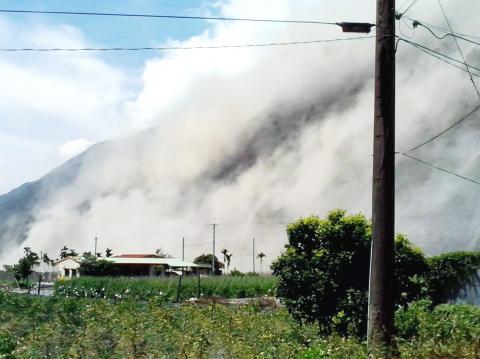
Photo: Courtesy of Chang Kai-ming
In Chiayi County, a woman driving a car was struck by falling rocks and lost consciousness, the fire agency said.
She was taken to the Buddhist Tzu Chi General Hospital in Dalin Township (大林), the agency said.
Another serious injury occurred in Nantou County’s Jhushan Township (竹山) as a result of falling rocks, it added.
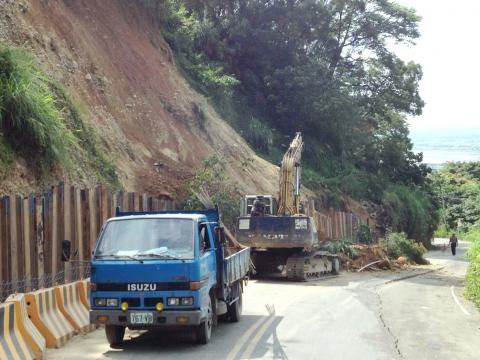
Photo: CNA
The individual was rescued at about 3pm by a National Airborne Service Corps helicopter and taken to a nearby hospital, the agency said.
The agency told reporters that four helicopters had been sent to scout the area near the epicenter as authorities awaited further information.
Both severe and minor injuries were reported in Shueili (水里), Lugu (鹿谷) and Yuchih (魚池) townships in Nantou County, the agency said.
Meanwhile, the earthquake caused massive landslides in mountainous areas in central parts of the country, forcing the highway authority to close some of the nation’s highways.
Train operations were also disrupted by the earthquake, affecting approximately 20,200 passengers of the Taiwan Railway Administration and 50,000 High-Speed Rail passengers.
Several houses in Nantou were damaged by the temblor.
Lu Pei-ling (呂佩玲), deputy director of the Central Weather Bureau’s seismology center, said that the epicenter of the earthquake, which occurred at 1:43pm, was 32km east of the Nantou County Government building.
The epicenter of the quake was in the administrative area of the county’s Renai Township (仁愛), she said.
“Because the epicenter was only 10km below the Earth’s surface at the center of Taiwan, the earthquake was felt nearly everywhere,” she added.
A magnitude 6.2 earthquake struck in the same area on March 27, with its epicenter 36.9km east of Nantou County Government building.
The epicenter was 19.4km below the surface.
Lu said yesterday’s earthquake may have been an aftershock of the magnitude 7.3 921 Earthquake in 1999.
“The 921 Earthquake was the strongest earthquake in Taiwan in the past 100 years,” Lu said. “A magnitude 7.3 earthquake can cause many aftershocks, which creates tremendous stress beneath the surface of the Earth in Nantou. We believe that both the earthquake in March and the one yesterday were part of the readjustment of the stress caused by the 921 Earthquake.”
Five aftershocks occurred between 1:59pm and 6:16pm, with magnitudes ranging between 3.1 and 4.6.
Kuo Kai-wen (郭鎧紋), director of the seismology center, said that both the magnitude 6.2 quake in March and yesterday’s quake occurred in a blind thrust fault.
Meanwhile, an earthquake jolted the southern Philippines late on Saturday, injuring at least 33 people and damaging more than 140 houses.
The magnitude 5.7 quake rattled North Cotabato Province and nearby areas as people slept, damaging more than 140 houses and several school buildings, and setting off a landslide that partially blocked a road with boulders, officials said.
At least 33 people, including children, were injured by collapsing walls and falling debris in the villages of Kimadzil and Kibugtongan, said Hermes Daquipa, a Philippine Institute of Volcanology and Seismology official, who joined a government team that surveyed the hilly villages.
The quake, which was set off by the movement of a nearby fault, damaged the approaches to two bridges and concrete pipes that cut off water supply to the two villages.
Additional reporting by CNA and AFP
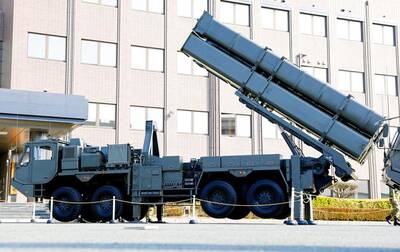
Japan has deployed long-range missiles in a southwestern region near China, the Japanese defense minister said yesterday, at a time when ties with Beijing are at their lowest in recent years. The missiles were installed in Kumamoto in the southern region of Kyushu, as Japan is attempting to shore up its military capacity as China steps up naval activity in the East China Sea. “Standoff defense capabilities enable us to counter the threat of enemy forces attempting to invade our country ... while ensuring the safety of our personnel,” Japanese Minister of Defense Shinjiro Koizumi said. “This is an extremely important initiative for

Chinese Nationalist Party (KMT) Chairwoman Cheng Li-wun (鄭麗文) today accepted an invitation from Chinese President Xi Jinping (習近平) to lead a delegation to China next month, saying she hopes to promote the peaceful development of cross-strait relations and bring stability to the Taiwan Strait. “I am grateful and happy to accept this invitation,” Cheng said in a statement from the KMT chairperson’s office. Cheng said she hopes both sides can work together to promote the peaceful development of cross-strait relations, enhance exchange and cooperation, bring stability to the Taiwan Strait and improve people’s livelihoods. At today's news conference, Cheng said any efforts to

MORE POPULAR: Taiwan Pass sales increased by 59 percent during the first quarter compared with the same period last year, the Tourism Administration said The Tourism Administration yesterday said that it has streamlined the Taiwan Pass, with two versions available for purchase beginning today. The tourism agency has made the pass available to international tourists since 2024, allowing them to access the high-speed rail, Taiwan Railway Corp services, four MRT systems and four Taiwan Tourist Shuttles. Previously, five types of Taiwan Pass were available, but some tourists have said that the offerings were too complicated. The agency said only two types of Taiwan Pass would be available, starting from a three-day pass with the high-speed rail and a three-day pass with Taiwan Railway Corp. The former costs NT$2,800

The nation’s fastest supercomputer, Nano 4 (晶創26), is scheduled to be launched in the third quarter, and would be used to train large language models in finance and national defense sectors, the National Center for High-Performance Computing (NCHC) said. The supercomputer, which would operate at about 86.05 petaflops, is being tested at a new cloud computing center in the Southern Taiwan Science Park in Tainan. The exterior of the server cabinet features chip circuitry patterns overlaid with a map of Taiwan, highlighting the nation’s central position in the semiconductor industry. The center also houses Taiwania 2, Taiwania 3, Forerunner 1 and


 RSS
RSS