


The Democratic Progressive Party (DPP) is set to propose lowering the referendum threshold from half of the electorate to 25 percent in party negotiations over the controversial referendum proposal on the Fourth Nuclear Power Plant today in the legislature.
The party reached a consensus after an internal meeting yesterday to adopt DPP Legislator Yeh Yi-jin’s (葉宜津) proposal as its final position in negotiations with the Chinese National Party (KMT) over an amendment to the Referendum Act (公民投票法) today.
Yeh’s proposal won the nod over the other six proposals made by DPP lawmakers because of its completeness, DPP spokesperson Wang Min-sheng (王閔生) said, adding that Yeh’s proposal was also favored because it was now in the plenary awaiting negotiation.
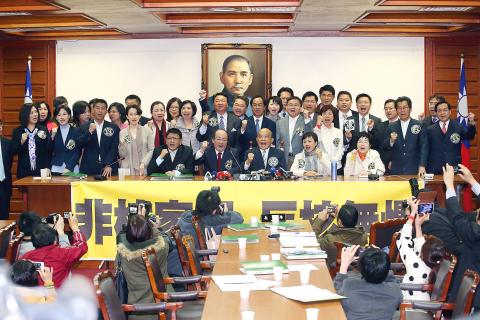
Photo: CNA
The initiative proposes the referendum be approved if the voters who vote “yes” outnumber those who vote “no” and the yes votes account for more than 25 percent of the electorate.
The DPP has made clear that it would engage in a “head-on war” with the KMT in a battle favoring the ruling party, which will likely ask voters if they support suspending construction at the nuclear power plant, rather than launching a new referendum initiative.
Regardless of what referendum question the KMT eventually asks, the DPP will focus on winning the referendum and suspending construction of the nuclear power plant, Wang said.
DPP Chairman Su Tseng-chang (蘇貞昌) reiterated that position again after attending a party caucus meeting yesterday morning at the Legislative Yuan.
DPP Legislator Pan Men-an (潘孟安) said the DPP caucus would likely adopt a strategy that urges voters to treat the referendum as a vote of no confidence in President Ma Ying-jeou (馬英九) to mobilize local communities.
In addition to the amendment of the Referendum Act, Wang added, the DPP would also work on legislation regarding promotion of a nuclear-free homeland (非核家園推動法), as well as amending the Nuclear Reactor Facilities Control Act (核子反應器設施管制法).
In related news, DPP legislators Chen Chi-mai (陳其邁), Cheng Li-chiun (鄭麗君), Tsai Chi-chang (蔡其昌) and Lee Chun-yi (李俊俋) yesterday filed an appeal with the Control Yuan accusing Premier Jiang Yi-huah (江宜樺) of “manipulating the referendum.”
The lawmakers said that Jiang had violated the Referendum Act, which prohibits the administrative body from authorizing an individual or institution to propose a referendum.
Meanwhile, Presidential Office spokesperson Lee Chia-fei (李佳霏) said the government was taking the referendum seriously and that Ma would not only participate, but also encourage others to take part in a referendum.
The remarks were in response to an article by lawyer C.V. Chen (陳長文), in which Chen said that “the Fourth Nuclear Power Plant issue will only be resolved once and for all if half of the current eligible voters cast their vote.”
Chen called on Ma to publicly announce his participation in the referendum to draw more public participation.
Lee said the president felt this was a referendum that was not about political ideology, but was a referendum in its true sense, adding that Ma confirmed he would participate in the referendum.
Lee said the Executive Yuan also supported the legislature’s decision to turn over the nuclear power plant issue to the will of the people, adding that the purpose of the move was to let the public come to an understanding of the issue through debate.
The challenges and costs of halting the construction, as well as the benefits, would be made known to the public, who would then make their decision based on their knowledge of both sides of the argument, Lee said.
The move could resolve a thorny problem that has plagued three governments in Taiwan for 33 years, so the Presidential Office is treating the issue with all the seriousness it deserves, Lee said.

Tropical Storm Gaemi strengthened into a typhoon at 2pm yesterday, and could make landfall in Yilan County tomorrow, the Central Weather Administration (CWA) said yesterday. The agency was scheduled to issue a sea warning at 11:30pm yesterday, and could issue a land warning later today. Gaemi was moving north-northwest at 4kph, carrying maximum sustained winds near its center of up to 118.8kph and gusts of 154.8kph. The circumference is forecast to reach eastern Taiwan tomorrow morning, with the center making landfall in Yilan County later that night before departing from the north coast, CWA weather forecaster Kuan Shin-ping (官欣平) said yesterday. Uncertainty remains and

SEA WARNING LIKELY: The storm, named Gaemi, could become a moderate typhoon on Wednesday or Thursday, with the Taipei City Government preparing for flooding A tropical depression east of the Philippines developed into a tropical storm named Gaemi at 2pm yesterday, and was moving toward eastern Taiwan, the Central Weather Administration (CWA) said. Gaemi could begin to affect Taiwan proper on Tuesday, lasting until Friday, and could develop into a moderate typhoon on Wednesday or Thursday, it said. A sea warning for Gaemi could be issued as early as Tuesday morning, it added. Gaemi, the third tropical storm in the Pacific Ocean this typhoon season, is projected to begin moving northwest today, and be closest to Taiwan on Wednesday or Thursday, the agency said. Today, there would likely

DISRUPTIONS: The high-speed rail is to operate as normal, while several airlines either canceled flights or announced early departures or late arrivals Schools and offices in 15 cities and counties are to be closed today due to Typhoon Gaemi, local governments announced last night. The 15 are: Taipei, New Taipei City, Taoyuan, Tainan, Keelung, Hsinchu and Kaohsiung, as well as Yilan, Hualien, Hsinchu, Miaoli, Chiayi, Pingtung, Penghu and Lienchiang counties. People should brace for torrential rainfall brought by the storm, with its center forecast to make landfall on the east coast between tonight and tomorrow morning, the Central Weather Administration (CWA) said. The agency issued a sea warning for the typhoon at 11:30pm on Monday, followed by a land warning at 11:30am yesterday. As of

CASUALTY: A 70-year-old woman was killed by a falling tree in Kaohsiung as the premier warned all government agencies to remain on high alert for the next 24 hours Schools and offices nationwide are to be closed for a second day today as Typhoon Gaemi crosses over the nation, bringing torrential rain and whipping winds. Gaemi was forecast to make landfall late last night. From Tuesday night, its outer band brought substantial rainfall and strong winds to the nation. As of 6:15pm last night, the typhoon’s center was 20km southeast of Hualien County, Central Weather Administration (CWA) data showed. It was moving at 19kph and had a radius of 250km. As of 3pm yesterday, one woman had died, while 58 people were injured, the Central Emergency Operation Center said. The 70-year-old


 RSS
RSS