


President Ma Ying-jeou (馬英九) yesterday bowed to apologize for the then-Chinese Nationalist Party (KMT) government’s crackdown on civilians during the 228 Massacre, and instructed the Ministry of Education to increase the amount of educational materials dealing with the incident to teach the next generation about the tragedy.
Speaking at the main memorial ceremony, which was held in Yilan City, the president said he understood that the suffering and pain of the victims of the incident and their family members could not be erased, despite years of efforts by the government to acknowledge past mistakes, offer a formal apology to the victims and their families and make the day a national holiday, and promised to protect human rights and promote peace to prevent such incidents in the future.
“I know that memorial ceremonies cannot take away the sufferings of the victims and their families. On behalf of the nation and the government, I apologize again to the victims and their families,” he said.
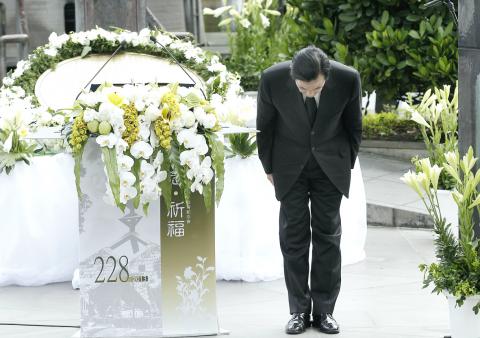
Photo: Pichi Chuang, Reuters
Ma renewed his pledge to uncover the truth behind the tragedy, and promised to promote human rights as a universal value that has been underscored by the historical tragedy.
Lu Song-hai (呂崧海), the director of the Family of Victims of the 228 Incident Association in Yilan, said the Ministry of National Defense and all the intelligence bodies should open all related documents to help uncover the truth behind the tragedy.
He also urged the government to increase the amount of educational materials dealing with the incident to turn the tragedy into a significant lesson in history for the nation.
Ma said he would instruct the Ministry of Education to focus on the 228 Incident and help the nation learn from the incident and the White Terror era.
Yesterday marked the 66th anniversary of the 228 Incident, which refers to a brutal crackdown launched by the then-KMT regime on Feb. 27, 1947, against tens of thousands of Taiwanese, many of them among the intellectual elite. The incident led to nearly four decades of martial law in Taiwan.
During the ceremony, Peter Wang (王獻極), convener of the 908 Taiwan Republic Campaign, and a small group of protesters called for Ma to step down. Security guards immediately carried Wang out and cleared the scene.
Ma yesterday presented to the family of 228 victim Chiang Shih-chin (蔣時欽) a certificate restoring the reputation of the native of Yilan and son of Chiang Wei-shui (蔣渭水), an important figure in Taiwan’s resistance against Japanese colonial rule.
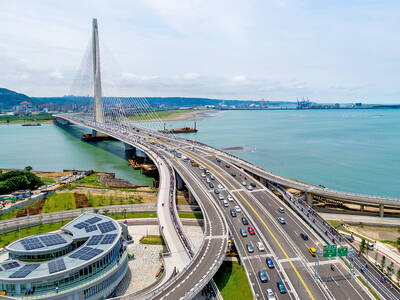
The Ministry of Transportation and Communications yesterday inaugurated the Danjiang Bridge across the Tamsui River in New Taipei City, saying that the structure would be an architectural icon and traffic artery for Taiwan. Feted as a major engineering achievement, the Danjiang Bridge is 920m long, 211m tall at the top of its pylon, and is the longest single-pylon asymmetric cable-stayed bridge in the world, the government’s Web site for the structure said. It was designed by late Iraqi-British architect Zaha Hadid. The structure, with a maximum deck of 70m, accommodates road and light rail traffic, and affords a 200m navigation channel for boats,
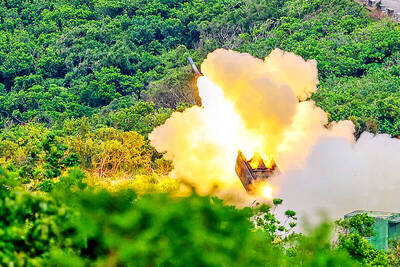
PRECISION STRIKES: The most significant reason to deploy HIMARS to outlying islands is to establish a ‘dead zone’ that the PLA would not dare enter, a source said A High Mobility Artillery Rocket System (HIMARS) would be deployed to Penghu County and Dongyin Island (東引) in Lienchiang County (Matsu) to force the Chinese military to retreat at least 100km from the coastline, a military source said yesterday. Taiwan has been procuring HIMARS and Army Tactical Missile Systems (ATACMS) from the US in batches. Once all batches have been delivered, Taiwan would possess 111 HIMARS units and 504 ATACMS, which have a range of 300km. Considering that “offense is the best defense,” the military plans to forward-deploy the systems to outlying islands such as Penghu and Dongyin so that

Taiwan Semiconductor Manufacturing Co (TSMC, 台積電), the world’s largest foundry service provider, yesterday said that global semiconductor revenue is projected to hit US$1.5 trillion in 2030, after the figure exceeds US$1 trillion this year, as artificial intelligence (AI) demand boosts consumption of token and compute power. “We are still at the beginning of the AI revolution, but we already see a significant impact across the whole semiconductor ecosystem,” TSMC deputy cochief operating officer Kevin Zhang (張曉強) said at the company’s annual technology symposium in Hsinchu City. “It is fair to say that in the past decade, smartphones and other mobile devices were
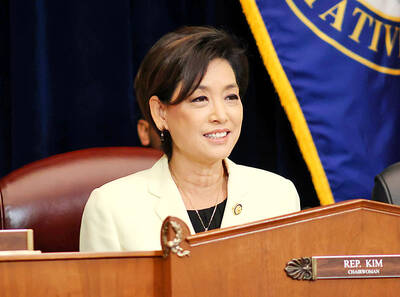
‘CLEAR MESSAGE’: The bill would set up an interagency ‘tiger team’ to review sanctions tools and other economic options to help deter any Chinese aggression toward Taiwan US Representative Young Kim has introduced a bill to deter Chinese aggression against Taiwan, calling for an interagency “tiger team” to preplan coordinated sanctions and economic measures in response to possible Chinese military or political action against Taiwan. “[Chinese President] Xi Jinping [習近平] has directed the People’s Liberation Army to be ready to invade Taiwan by 2027. China has a plan. America should have one too,” Kim said in a news release on Thursday last week. She introduced the “Deter PRC [People’s Republic of China] aggression against Taiwan act” to “ensure the US has a coordinated sanctions strategy ready should


 RSS
RSS