


Of the NT$17.5 billion (US$601.23 million) offered by a consortium headed by Chinatrust Charity Foundation chairman Jeffrey Koo Jr (辜仲諒) to buy four media outlets in the Next Media Group (壹傳媒集團), up to NT$9 billion came from Want Want China Times Group (旺旺中時集團) chairman Tsai Eng-meng (蔡衍明), the Chinese-language Wealth Magazine reported in its latest edition yesterday.
If the report is confirmed, it is a surprising development as Next Media Group chairman Jimmy Lai (黎智英) said in an interview with the Apple Daily published on Oct. 18 that he had decided to finalize the sale of the four media outlets after ensuring that none of the funding came from Tsai.
Next Media, in an announcement filed to the Hong Kong Stock Exchange on Oct. 17, confirmed that it had signed a memorandum of understanding with Koo, who has agreed to purchase the Apple Daily, the Sharp Daily, Next Magazine and Next TV.
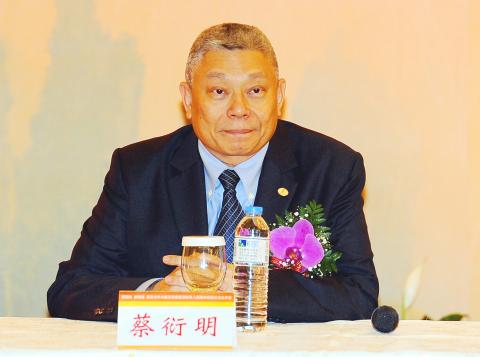
Photo: Chang Chia-ming, Taipei Times
Koo’s co-investors in the deal include Formosa Plastics Group (台塑集團) chairman William Wong (王文淵) and a Singapore-based private equity firm.
Asked for comment on Wealth Magazine’s report, National Communications Commission (NCC) spokesperson Yu Hsiao-cheng (虞孝成) said the commission had not officially received that information and therefore he was unable to comment on the matter.
According to the report, at a recent meeting held between Next Media Group officials and representatives from Koo’s consortium held to finalize the deal, Tsai Eng-meng showed up unexpectedly, startling Next Media Group officials.
The report said Chinatrust, in the hope that the deal could be completed smoothly, had requested that Tsai keep a low profile. However, Tsai was not happy about having to downplay his role, the report said, adding that during the meeting Tsai bellowed: “I’m the one who put up the most money, why can’t I say something?”
When an official reminded Tsai that if his role was revealed, the NCC may rule against him in a review of his purchase of a TV network, the report quoted Tsai as replying: “I don’t want the TV network.”
The Apple Daily declined to comment on the report, with the paper’s executive editor-in-chief Ma Wei-min (馬維敏) and Next Magazine publisher Pei Wei (裴偉) saying that Chinatrust has denied that Tsai is an investor in the consortium.
Apple Daily Workers’ Union president Tsai Jih-yun (蔡日雲) said the union would not comment on the allegations without seeing solid evidence.
In light of the Wealth Magazine report, a number of activists expressed concern about monopolization of Taiwanese media, which is increasingly being concentrated in the hands of a few tycoons.
They called on the Financial Supervisory Commission to investigate the sources of the funding in the Next Media Group bid and demanded that the NCC review any deal in a rigorous manner if indeed Tsai is the main player bankrolling the purchase.
Anti-Media Monster Youth Alliance spokesperson Lin Fei-fan (林飛帆) said although the report has not been confirmed, there had been speculation that Tsai may be among the investors.
“Tsai has utilized the China Times to promote and espouse his views and the policies of China. We are very worried that China will in the future [effectively] control more of Taiwan’s news outlets,” he said.

A signaling system malfunction disrupted high-speed rail (HSR) services beginning at 8am today, with trains temporarily reduced to three northbound and three southbound trains per hour as authorities conduct inspections. The malfunction occurred on a section of track in Miaoli County during pre-operation checks early this morning, forcing northbound and southbound trains to use a single track, the HSR operator said. The regular schedule has been replaced with three hourly trains offering only nonreserved seating in each direction, stopping at every station, it said, adding that business class cars would still have reserved seating. Departures from terminal stations are scheduled at the top

DRONE CENTRAL: Taiwan aims to become Asia’s democratic hub for drones, with most exports focused on high-quality military-grade models, an official said Taiwan’s drone industry is expected to expand significantly by 2030, producing 100,000 units per month and exporting half of them, the Ministry of Economic Affairs said yesterday. Current drone production capacity is about 15,000 units per month, but the industry can quickly scale up as demand increases, Industrial Development Administration Director-General Chiou Chyou-huey (邱求慧) told a news conference in Taipei. Taiwan’s drone output grew 2.5-fold last year to NT$12.9 billion (US$408.3 million) under a government program to develop the uncrewed vehicle sector, he said. The Executive Yuan in October last year approved plans to invest NT$44.2 billion into domestic production of uncrewed aerial

VERBOSE VESSELS: A CGA cutter and a China Coast Guard exchanged verbal barbs for more than a day in Taiwanese-controlled waters before the Chinese vessel left The Taiwanese and Chinese coast guards had a standoff near the strategically located Pratas Islands (Dongsha Islands, 東沙群島) in the north of the South China Sea, the Coast Guard Administration (CGA) said yesterday. The two sides engaged in intense radio exchanges over sovereignty claims during the 33-hour standoff. China Coast Guard vessel 3501 eventually left the restricted waters, 26.6 nautical miles (49.2km) west of the Pratas Islands, at 5pm yesterday, the CGA said. Lying approximately between southern Taiwan and Hong Kong, the Taiwan-controlled Pratas are seen by some security experts as vulnerable to Chinese attack due to their distance — more than
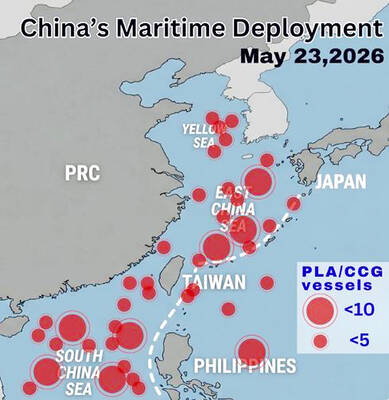
WARNING: China should stop engaging in actions that undermine regional peace and stability, as it would only build resentment among people across the Strait, the CGA said China has deployed more than 100 navy, coast guard and other vessels in waters from the Yellow Sea to the South China Sea and the western Pacific since US President Donald Trump and Chinese President Xi Jinping (習近平) met in Beijing, National Security Council Secretary-General Joseph Wu (吳釗燮) said yesterday. “In this part of the world, #China is the one & only PROBLEM wrecking the #StatusQuo & threatening regional peace & stability,” Wu wrote on X. In a separate post, he said Beijing was coercing Taiwan’s maritime domain, calling it illegal and provocative, after the Coast Guard Administration (CGA) expelled a


 RSS
RSS